The Whitecleuch Chain: a Pictish silver chain pulled from a sheep drain by a shepherd
Famous find About AD 400 to 800 · Found in 1869 See it on the timeline →
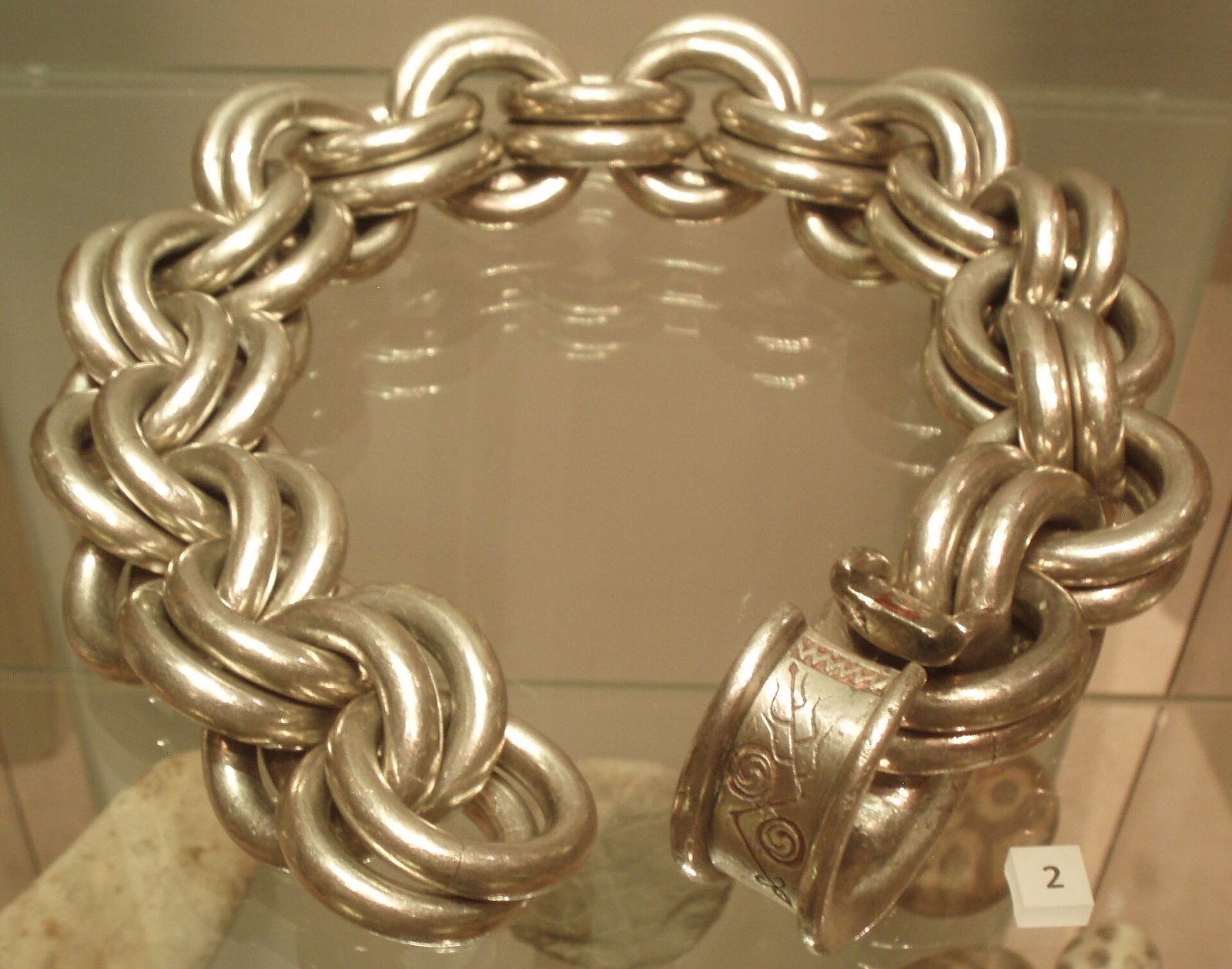
In May 1869 a Lanarkshire shepherd noticed silver rings sticking out of the side of a sheep drain and pulled out a massive chain of silver, closed by a ring carved with Pictish symbols. It is one of only about ten such chains known.
In May 1869, John Murray, the shepherd at Shieldholm farm in the parish of Crawfordjohn, in the hills of south Lanarkshire close to the border with Dumfriesshire, noticed two or three metal rings sticking out of the side of a sheep drain where running water had widened it. He took hold of them and pulled, and out came a heavy chain of silver, about half a metre long. It had been lying about 45 centimetres down, on the clay beneath the turf.
The chain is made of pairs of thick silver rings, linked together, 22 pairs when it was described in 1881, and closed by a larger open ring, about five centimetres across, which fastened it. The terminal ring is carved with Pictish symbols: on one side a double disc crossed by a Z-shaped rod, on the other a notched rectangle. The same symbols appear on the silver plaques from the Norrie's Law hoard, also on this site. When it was found, the chain weighed more than 60 ounces, nearly two kilograms; a couple of its links were later broken by people trying to open them.
Chains like this are among the most remarkable objects of early medieval Scotland. Only about ten certain examples are known, almost all from southern Scotland, and they are thought to date from about AD 400 to 800. They are far too heavy to be ordinary jewellery, and archaeologists think they were worn around the neck as symbols of rank, by chieftains or kings, and may have been made from melted-down Roman silver. Why this one was lost or hidden on a lonely hillside is unknown. The antiquary who first described it in detail wondered if it had been dropped in a fight on an old road nearby, but that was only a guess.
The chain was found on land belonging to the Duke of Buccleuch, who obtained it from the shepherd. It was shown to the Society of Antiquaries of Scotland in March 1880 and displayed in the Society's museum, and it is now in the National Museum of Scotland in Edinburgh.
Written for Global Finds from J. T. Clark's account in the Proceedings of the Society of Antiquaries of Scotland (1880) and R. A. Smith's description in the same journal (1881). Photo: the Whitecleuch Chain in the National Museum of Scotland, Catfish Jim and the soapdish, Wikimedia Commons, CC BY-SA 3.0.
Approximate location55.46, -3.88View on map
Source: Proceedings of the Society of Antiquaries of Scotland