The Newark Torc: Iron Age gold that came out of the ground looking brand new
Famous find About 250 to 50 BC · Found in 2005 See it on the timeline →
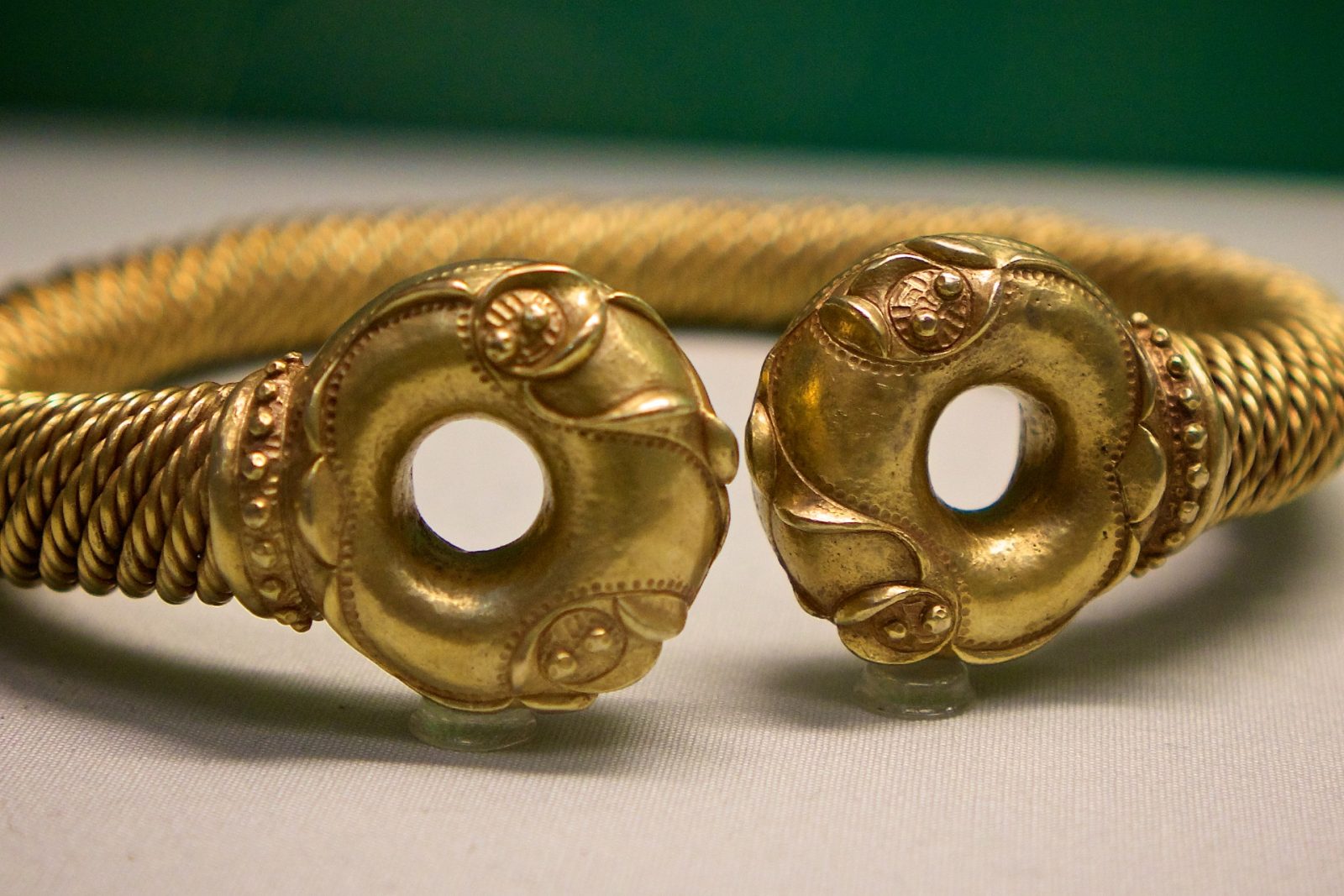
In February 2005 a detectorist searching a field near Newark in Nottinghamshire found a gold torc made from eight ropes of twisted wire, buried in a pit more than 2,000 years ago. It is one of the finest pieces of Iron Age gold ever found in Britain.
In February 2005, Maurice Richardson, a metal detectorist from Newark-on-Trent in Nottinghamshire, was searching a field on the outskirts of the town when he got a strong signal. In a pit beneath the ploughsoil he found a heavy gold neck ring. He later said it looked as though he had bought it from a shop the day before. The exact findspot has been kept secret.
The Newark Torc is made of electrum, gold mixed with silver and copper, and weighs about 700 grams. It is about 20 centimetres across. Its hoop is made of eight ropes of hand-twisted wire, about 50 metres of wire in all, wound together, and it ends in two hollow ring-shaped terminals, cast and decorated with swirling spirals and plant-like patterns in the La Tène style of Iron Age Celtic art. The way it was buried, alone in a pit, suggests it was placed in the ground deliberately, perhaps as an offering.
It is so close in style to the famous gold torc from Sedgeford in Norfolk that the two may have been made by the same craftsman, probably in Norfolk, the heartland of the Iceni, where the great Snettisham torcs were also found. It is dated to between about 250 and 50 BC. The British Museum's Iron Age specialist Jeremy Hill described it as probably the most significant find of Iron Age gold jewellery in fifty years.
A coroner's inquest declared the torc Treasure in May 2005. It was valued at £350,000, and the reward was shared between the finder and the landowner. Newark and Sherwood District Council bought it for its museum service, with a grant of £285,000 from the National Heritage Memorial Fund and £20,000 from Art Fund. After a period on loan to the British Museum, it came home to Newark and is displayed at the National Civil War Centre in the town.
Written for Global Finds from the National Heritage Memorial Fund, Art Fund, the National Civil War Centre and The Guardian (February 2005). Photo: the Newark Torc, Paul Hudson, Wikimedia Commons, CC BY 2.0.
Approximate location53.08, -0.81View on map
Source: National Heritage Memorial Fund