The Vače Situla: an Iron Age bronze bucket decorated with feasting, chariots and boxing
Famous find About 500 to 450 BC · Found in 1882 See it on the timeline →
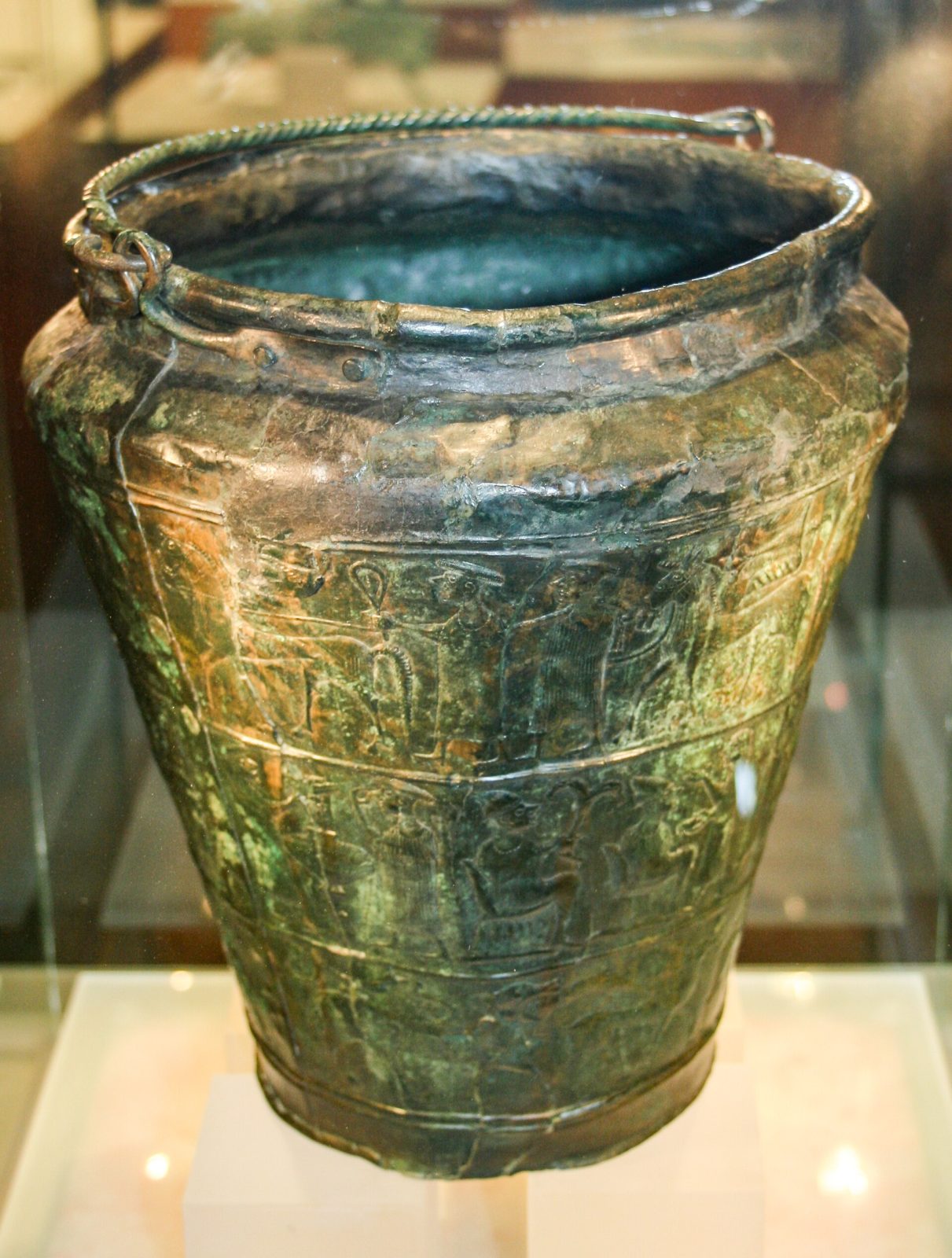
In 1882 a Slovenian farmer digging on his land found a bronze bucket in an Iron Age warrior's grave. Its three bands of decoration show a procession, a feast and two boxers fighting for a helmet, and it is now a national symbol of Slovenia.
Early in 1882, Janez Grilc, a farmer from Klenik near Vače, in the hills north of Litija in central Slovenia, was digging on his land at a place called Reber when he uncovered an ancient grave. It belonged to a warrior of the Early Iron Age. With the remains were a bronze helmet with a double crest, two iron spearheads, an iron axe, a bronze bracelet, and a bronze bucket covered in figures.
The bucket, called a situla, is 23.8 centimetres tall and made of sheets of bronze riveted together, with a handle of twisted wire. Its decoration, hammered out from the inside, runs in three bands around it. In the top band, men ride in procession on horseback and in two chariots. The middle band shows a feast: important men sit on thrones and are served drink, a ram is led to sacrifice, a musician plays pan pipes, and at the centre two naked boxers, wearing belts and holding dumbbell-shaped weights in their fists, fight over a crested helmet set between them as the prize. In the bottom band, animals walk in a line: a lion, deer and ibex.
The Vače Situla is the finest example of situla art, a style of decorated bronze vessels made in the eastern Alps and northern Italy in the Iron Age, and its scenes are among the most vivid pictures of life in prehistoric Europe. The National Museum of Slovenia dates it to the first half of the 5th century BC; others place it a little earlier, around 500 BC.
The Carniolan Provincial Museum in Ljubljana bought it from the farmer in 1882, reportedly for a very small sum. It is now one of the treasures of the National Museum of Slovenia in Ljubljana, where it is on permanent display. It has become a national symbol: its figures appear on Slovenian passports, and in 2021 it was the design of a two-euro commemorative coin marking the museum's 200th anniversary. A five-times enlarged bronze copy stands at the start of an archaeological trail at Vače.
Written for Global Finds from B. Lazar's study of the boxing scene in Arheološki vestnik (2011), M. Murgelj's new drawing and study of the situla in Arheološki vestnik (2020), and the National Museum of Slovenia. Photo: the Vače Situla in the National Museum of Slovenia, Szilas, Wikimedia Commons, CC0.
Approximate location46.12, 14.83View on map
Source: Arheološki vestnik