The Gessel Gold Hoard: 117 Bronze Age gold pieces found by metal detector on a pipeline route
Famous find About 1300 BC · Found in 2011 See it on the timeline →
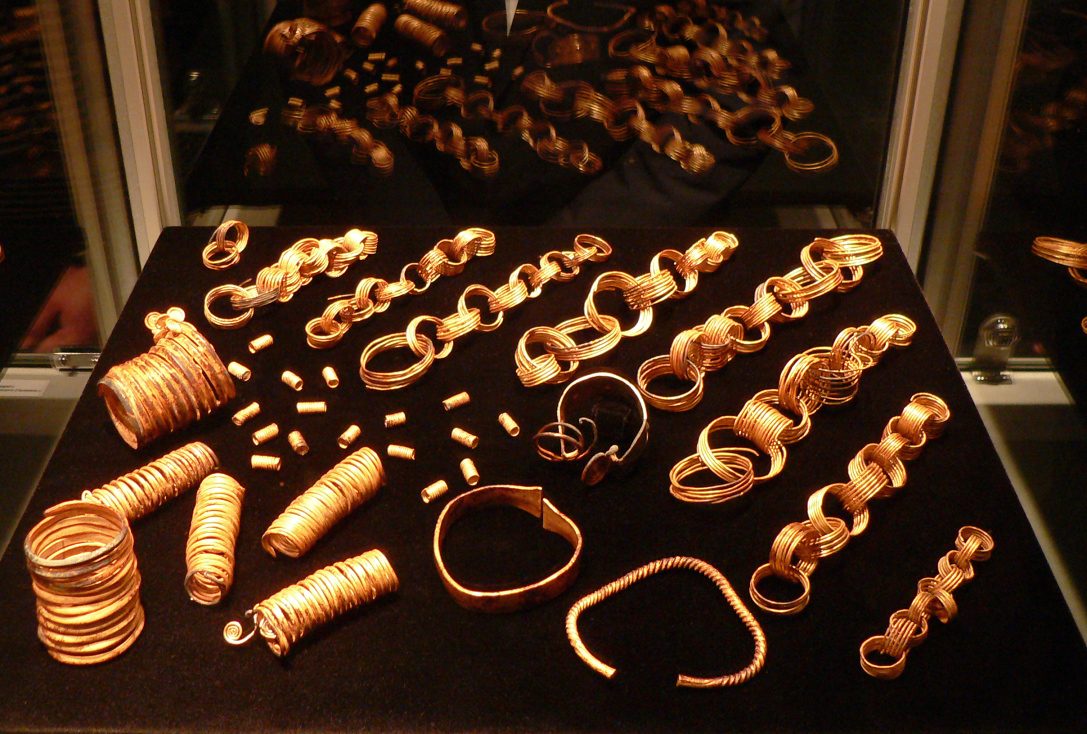
In April 2011 archaeologists checking the route of a new gas pipeline near Syke in northern Germany got a signal on their metal detector and uncovered a cloth bag of Bronze Age gold: 117 pieces weighing about 1.7 kilograms, buried some 3,300 years ago.
In early April 2011, archaeologists were working ahead of the construction of a new natural gas pipeline across Lower Saxony, in northern Germany, on a site near Gessel, a village belonging to the town of Syke, south of Bremen, where finds had been expected. Searching the ground systematically with metal detectors, they found a bundle of corroded bronze pins, a small gold spiral and a decorated gold object. Realising what they had, they lifted the whole find in a block of soil the same day and took it to the laboratory of the state heritage office in Hannover.
Excavated in the lab, the block contained 117 objects of gold weighing about 1.7 kilograms. Most of them are spiral rings of gold wire, 82 of them linked into chains, with 32 more loose spirals. There are also three personal ornaments: a large bracelet, a twisted armband and a gold brooch, about 16 centimetres long when complete, decorated with five raised sun symbols. The brooch had been bent and its pin removed before it was buried, and it is said to be the only solid gold brooch of its kind known from Central Europe. Fibres of flax still clinging to the bronze pins showed that everything had been packed in a linen bag, pinned shut.
The hoard dates from the Middle Bronze Age, around 1300 BC. Some of the spirals look unworn, as if they were new when they were buried. Analysis of the gold by researchers at the University of Hannover suggested that some of it may have come from as far away as Central Asia, though other specialists have called that idea highly speculative. A new research project starting in 2026 aims to settle where the gold came from.
The heritage office kept the discovery secret until February 2012, partly for fear that treasure hunters would descend on the pipeline route. Under Lower Saxony's law the hoard belongs to the state. The originals are kept by the Landesmuseum Hannover, and since 2020 the Kreismuseum in Syke has had a permanent gallery about the hoard, the Forum Gesseler Goldhort, showing replicas alongside original pieces on rotation.
Written for Global Finds from the Lower Saxony State Office for Heritage's announcement of the find (2012), Live Science (2026) and Stone Pages. Photo: the Gessel gold hoard, Axel Hindemith, Wikimedia Commons, CC BY 3.0.
Approximate location52.92, 8.80View on map
Source: Live Science