The Golden Rhinoceros of Mapungubwe: gold from a lost African kingdom
Famous find About AD 1220 to 1290 · Found in 1933 See it on the timeline →
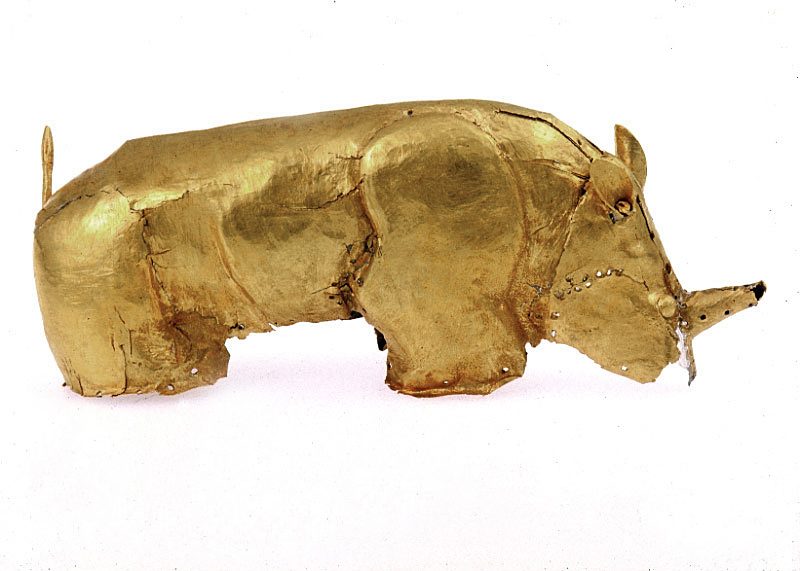
On New Year's Eve 1932 a local guide led a South African farmer and his companions up Mapungubwe Hill, where they picked up gold. Excavations then uncovered royal graves holding a small gold-foil rhinoceros, now the emblem of South Africa's highest honour.
On 31 December 1932, a local man named Mowena led the farmer and prospector E. S. J. van Graan, his son and three companions up Mapungubwe Hill, a steep sandstone outcrop near the meeting of the Limpopo and Shashe rivers in the far north of South Africa. On the summit they picked up pieces of gold, iron, pottery and glass beads. Van Graan's son reported the find to the historian Professor Leo Fouché. The state bought the farm in 1933 and gave the university the right to excavate, and its archaeologists worked on the hill until 1947.
On the hilltop they found 27 graves, and three of them contained large amounts of gold. In one royal grave, found in the early 1930s, lay the object that has become famous: a small rhinoceros, small enough to sit in the palm of a hand, made of thin gold foil fixed with tiny gold tacks over a carved core, probably of wood, which has long since rotted away. It has a single horn. With the gold were other foil animals, including a bovine and a wild cat, gold sceptres, a bowl, bangles and thousands of gold beads. One scholar has argued that the rhino and the other animals once decorated the same wooden bowl.
Mapungubwe was the capital of the first great kingdom of southern Africa, flourishing from about AD 1220 to 1290. Its rulers lived on the hilltop, apart from their people below, and grew rich trading gold and ivory to the Indian Ocean coast in exchange for glass beads and Chinese celadon. After its decline, power moved north to Great Zimbabwe.
For decades the finds received little public attention; the idea of a sophisticated African kingdom did not suit the politics of apartheid. After 1994 that changed. The collection was declared a national heritage collection in 1997, and in 2002 the rhino became the centre of the Order of Mapungubwe, South Africa's highest honour, first awarded to Nelson Mandela. In 2003 the Mapungubwe landscape became a UNESCO World Heritage Site. In 2007 the remains of about 150 people excavated from the hill were returned and reburied there in ceremonies with their descendants.
The gold rhino belongs to the Mapungubwe Collection of the University of Pretoria Museums. In 2016 it travelled abroad for the first time, to an exhibition at the British Museum.
Written for Global Finds from South African History Online, John Giblin's account in The Conversation (2016), the Mail & Guardian (2015) and published research from the University of Pretoria. Photo: the gold rhinoceros of Mapungubwe, Sian Tiley-Nel, University of Pretoria Museums, Wikimedia Commons, CC BY-SA 4.0.
Approximate location-22.19, 29.24View on map
Source: South African History Online