The Hochdorf Chieftain's Grave: a Celtic prince on a bronze couch, saved from the plough by a volunteer who would not give up
Famous find Buried about 530 BC · Found in 1977 See it on the timeline →
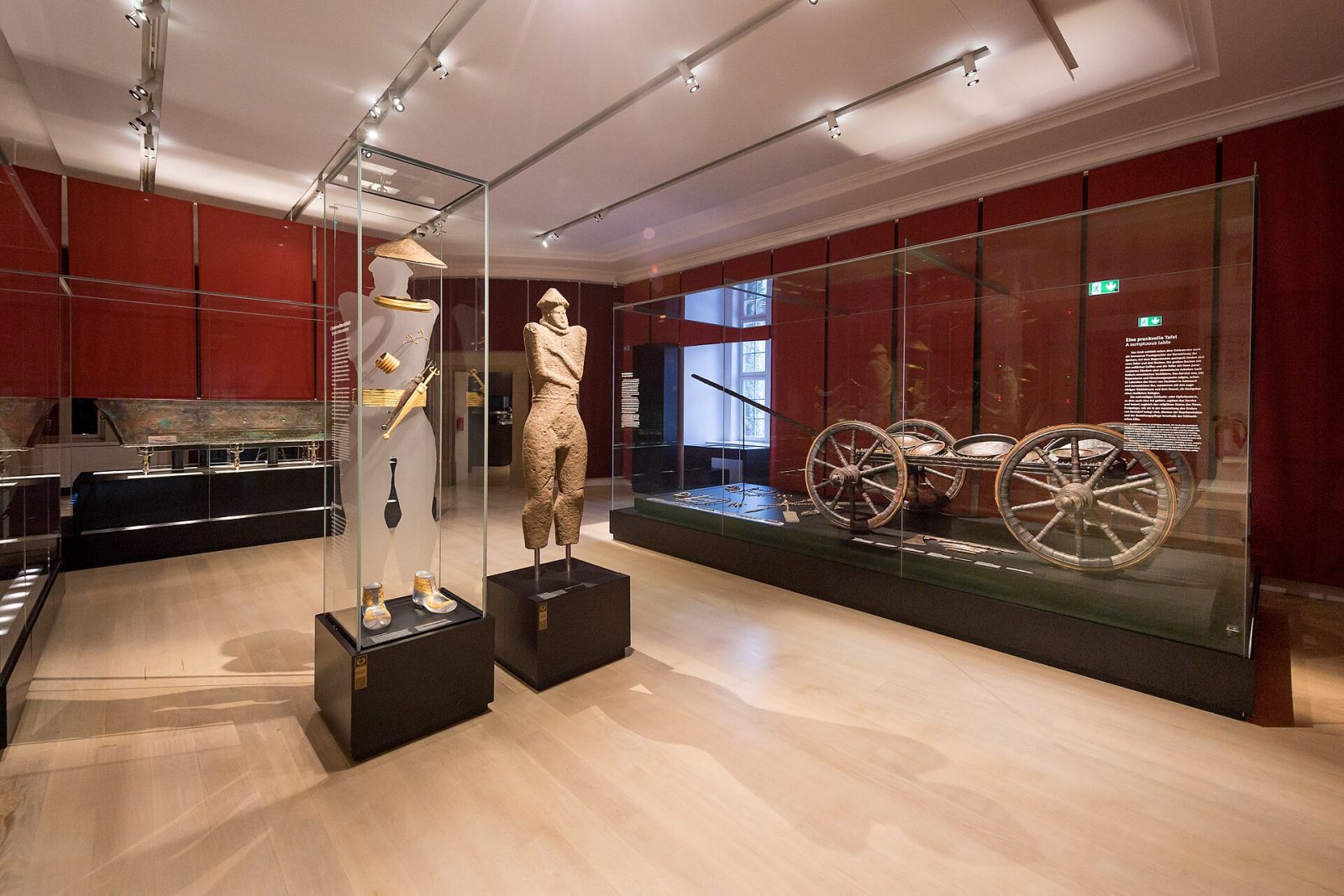
In 1977 Renate Leibfried, a volunteer for the Baden-Württemberg monuments office, showed archaeologists a low rise in a field at Hochdorf that she had first reported in 1968. Under it lay the unrobbed grave of a Celtic chieftain of about 530 BC, with a bronze couch on wheels, 600 grams of gold and a 500-litre cauldron.
In 1968 Renate Leibfried, a volunteer field officer for the Baden-Württemberg state monuments office who lived in the village of Hochdorf an der Enz, near Stuttgart, wrote to report stones turned up by the plough and a slight rise in a field called the Biegel. Nine years later, in February 1977, she took the archaeologist Jörg Biel to the spot. Winter rain had washed a great ring of stones clean, and Biel recognised the remains of a burial mound, once 60 metres across and six metres high, that ploughing was slowly destroying. He excavated it in 1978 and 1979.
Below the mound was a pit eleven metres square holding a double chamber of oak, packed around with about fifty tonnes of stone, which is probably why no robber had ever reached it. On a bronze couch 2.75 metres long, carried by eight cast bronze women inlaid with coral whose feet rest on wheels, lay a man about forty years old and about 1.85 metres tall. He wore a sheet-gold neck ring decorated with rows of tiny horsemen, gold brooches and a bracelet, a gold belt plate and a dagger sheathed in gold, and his leather shoes were covered with gold sheet cut specially for the funeral and never walked in. About 600 grams of gold in all.
Against the wall hung nine drinking horns with gold bands, eight of aurochs horn and one of iron more than a metre long, holding five and a half litres. In the corner stood a bronze cauldron over a metre across, made in the Greek world with three lions on its rim, one of them a Celtic replacement; residue showed it had held about 300 litres of mead. A four-wheeled wagon sheathed in iron, 4.5 metres long, carried nine bronze dishes. Scraps of rare textiles survived. The burial dates from about 530 BC, in the Late Hallstatt period, when Celtic rulers in the region were growing rich on trade with the Mediterranean.
The original finds are displayed in the Landesmuseum Württemberg in Stuttgart. The mound was rebuilt in 1987, and the Keltenmuseum Hochdorf, beside it, shows a full-size reconstruction of the chamber.
Written for Global Finds from the Keltenmuseum Hochdorf, the Landesmuseum Württemberg (2025) and P. S. Wells in Ancient Europe 8000 BC to AD 1000. Photo: the Hochdorf finds in the Landesmuseum Württemberg, Stuttgart, Kommunikation LMW, Wikimedia Commons, CC BY-SA 4.0.
Approximate location48.89, 9.00View on map
Source: Keltenmuseum Hochdorf