Champlain's Astrolabe: a navigator's instrument found by a farm boy in the Canadian woods
Famous find Made in 1603, perhaps lost in 1613 · Found in 1867 See it on the timeline →
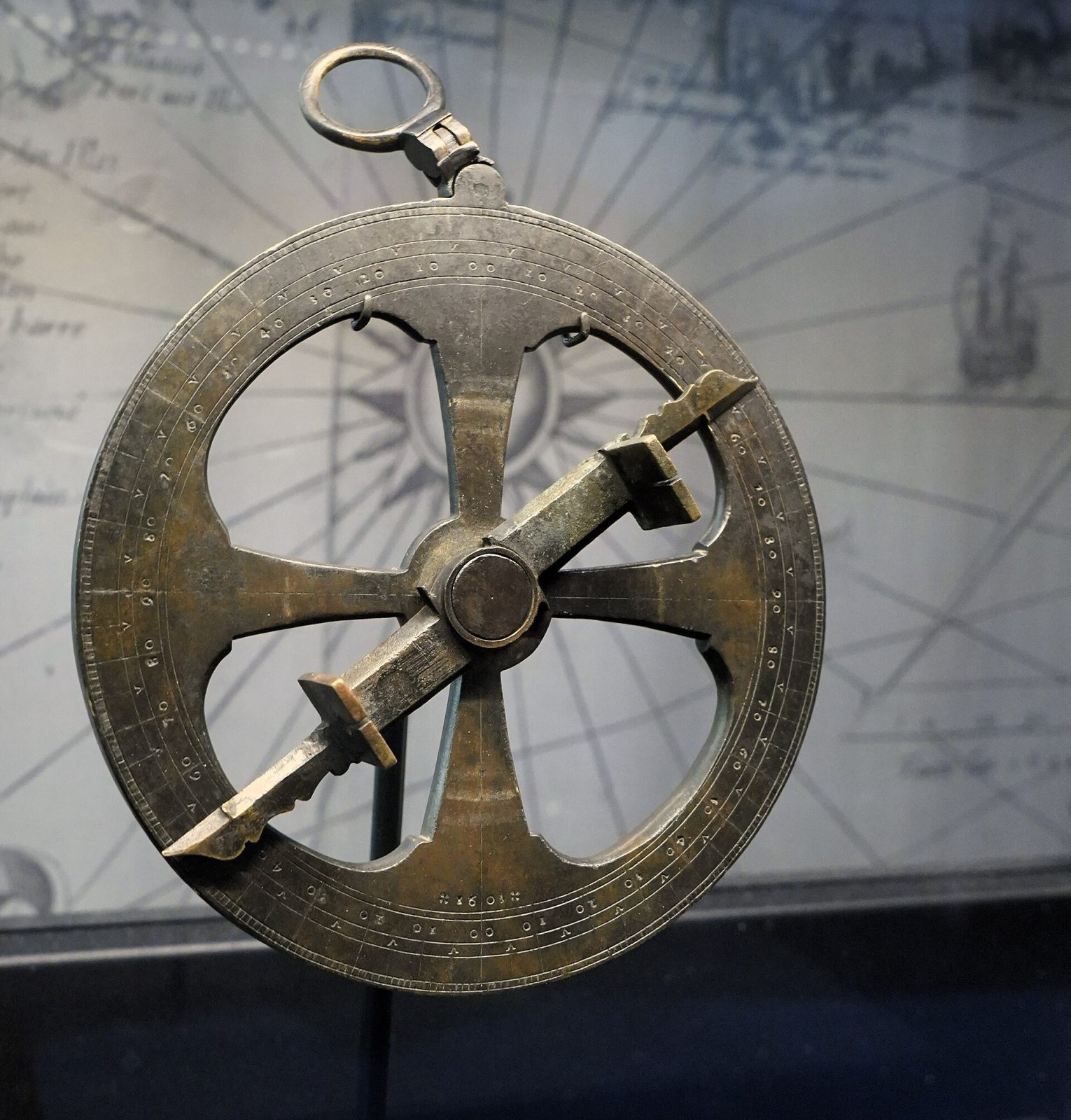
In 1867 a 14-year-old boy helping his father clear trees beside a lake in Ontario found a brass mariner's astrolabe dated 1603. It is said to have been lost by the explorer Samuel de Champlain in 1613, a story historians still argue about.
In 1867, Edward Lee, a 14-year-old farm boy, was helping his father clear trees beside Green Lake, near Cobden in the Ottawa Valley of Ontario, when he found a heavy brass disc beneath a fallen tree. It was a mariner's astrolabe, an instrument used by sailors to find their latitude by measuring the height of the sun or a star above the horizon, and it was engraved with the date 1603.
The astrolabe is about 13 centimetres across and weighs about 630 grams. According to the Canadian Museum of History, which now owns it, it is the smallest of the 35 or so mariner's astrolabes known from the early 17th century, and the only one made in France. Apart from a small ring that was lost in the late 1800s, it is complete.
The find was soon linked with one of the founders of Canada. In the spring of 1613, the French explorer Samuel de Champlain travelled up the Ottawa River, and near Cobden his party left the river to avoid rapids, making a difficult crossing past a chain of small lakes, Green Lake among them. Nineteenth-century writers concluded that he must have dropped his astrolabe there. It is an attractive story, but the museum itself says the connection has never been confirmed by historical evidence. Champlain's own detailed account of the journey does not mention losing an instrument, and in 2013 a historian found a manuscript from 1893 that further muddied the story.
The astrolabe's own history is no less winding. The boy was promised ten dollars for it by a local steamboat captain, Daniel Cowley, but was never paid and never saw it again. Cowley sold it to a collector in Toronto, who sold it to a collector in New York, who left it to the New-York Historical Society in 1942. In 1989 the Canadian government bought it back, and it is now on display in the Canadian History Hall of the Canadian Museum of History in Gatineau, Quebec. Green Lake has since been renamed Astrolabe Lake.
Written for Global Finds from the Canadian Museum of History, Canada's History and the History News Network's summary of the National Post (2013). Photo: the 1603 mariner's astrolabe in the Canadian Museum of History, Pierre5018, Wikimedia Commons, CC BY-SA 4.0.
Approximate location45.60, -76.83View on map
Source: Canadian Museum of History