The Lord of Sipán: the royal tomb that looters missed
Famous find Moche, about AD 250 · Found in 1987 See it on the timeline →
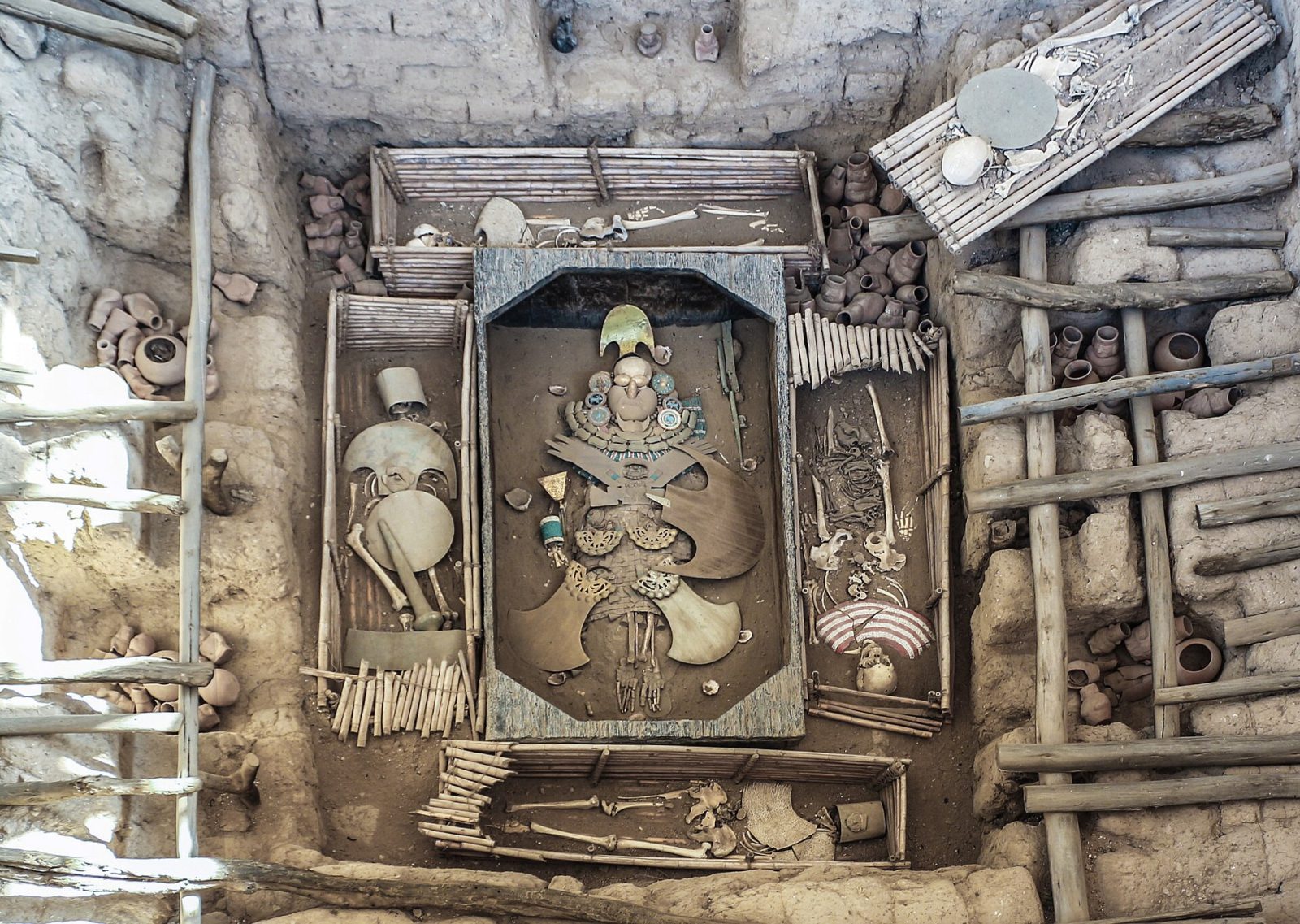
In 1987 looters digging into an adobe pyramid in northern Peru found a tomb full of gold and quarrelled over the spoils. The police were tipped off, and the archaeologist Walter Alva went on to find an untouched royal tomb nearby: the Lord of Sipán, buried around AD 250.
Huaca Rajada, near the village of Sipán in the Lambayeque region of northern Peru, is a group of eroded mud-brick pyramids built by the Moche people, who ruled this stretch of the Pacific coast from about AD 100 to 800. In late 1986 a gang of local looters began tunnelling into one of them. In February 1987 they broke into an elite tomb and carried away its gold and silver in sacks. They then fell out over how to share it, and one of them told the police.
The archaeologist Walter Alva, director of the Brüning Museum in Lambayeque, was called in to examine what the police had recovered: a gold face with turquoise eyes, gold beads shaped like giant peanuts, a gold feline head. Realising that the site was being plundered, he began an excavation there in April 1987, with Luis Chero and Susana Meneses, while guards protected the site.
In July 1987 Alva's team found what the looters had missed: an intact royal tomb. The man buried there, now known as the Lord of Sipán, was a Moche ruler laid to rest around AD 250 in a wooden coffin with hundreds of offerings: a gold headdress, a gold mask, ear ornaments of gold and turquoise, a sceptre, a heavy gold backflap worn at the waist, and two necklaces of large peanut-shaped beads, one of gold and one of silver. Buried with him were several other people, a dog and two llamas. Later excavations found more tombs, including an older ruler beneath him. It was one of the richest archaeological discoveries ever made in the Americas.
Some of the looted objects travelled the world. In 1997, in a sting operation in Philadelphia, the FBI seized a gold backflap from the looted tomb that was being offered for sale for 1.6 million dollars, and in 1998 it was handed back to Peru.
The Lord of Sipán's treasures are displayed in the Museo Tumbas Reales de Sipán in Lambayeque, built in the shape of a Moche pyramid and opened in 2002, where photography is not allowed. A reconstruction of the tomb can be seen at Huaca Rajada.
Written for Global Finds from World Archaeology, Archaeology magazine (1998), the Trafficking Culture project and Andina, Peru's state news agency. Photo: the reconstruction of the tomb of the Lord of Sipán at Huaca Rajada, with replicas of the grave goods, Bernard Gagnon, Wikimedia Commons, CC BY-SA 3.0.
Approximate location-6.80, -79.60View on map
Source: World Archaeology