The King of Na Gold Seal: an emperor's gift found under a stone in a Japanese ditch
Famous find Given in AD 57 (Eastern Han) · Found in 1784 See it on the timeline →
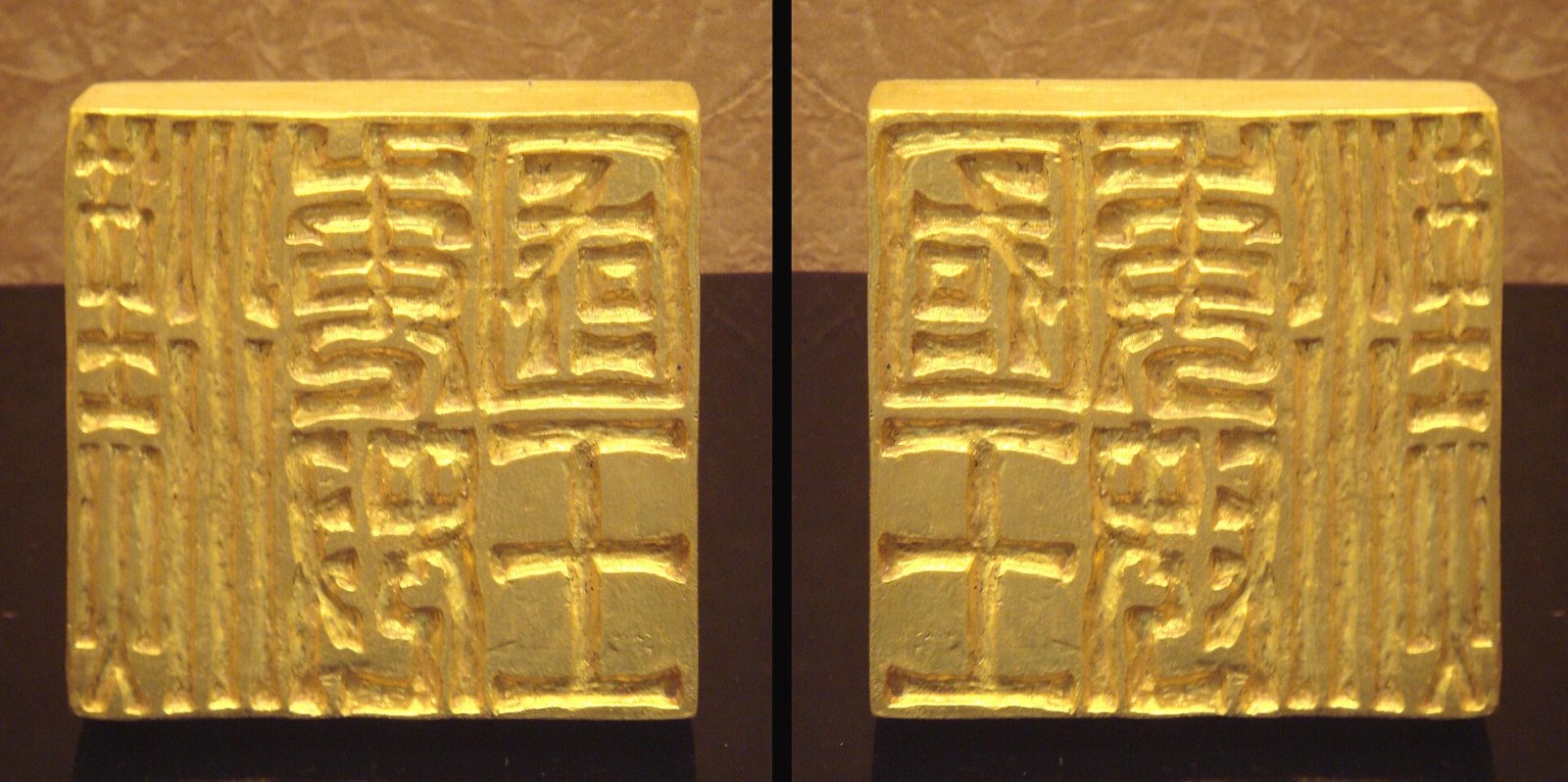
In 1784 a farmer repairing an irrigation ditch on Shikanoshima island in Japan found a tiny gold seal with a snake on top. It is thought to be the seal a Chinese emperor gave to a Japanese king in AD 57, and it is one of Japan's National Treasures.
In 1784, a farmer named Jinbei was repairing an irrigation ditch on Shikanoshima, a small island in Hakata Bay, off the city of Fukuoka in southern Japan, when he found a small square block of gold under a large stone. Some accounts say it lay in a setting of stones beneath a heavy capstone; others say labourers did the digging and Jinbei, as the landowner, reported it. Either way, it was handed to the lords of the Fukuoka domain, the Kuroda family.
The object is a seal, only 2.3 centimetres square and about 2.2 centimetres tall, but solid gold and weighing almost 109 grams. Its handle is a coiled snake turning its head to look back, its body covered in 125 tiny punched scales, with a hole through it for a cord. On its face, cut in ancient Chinese seal script, are five characters, usually read as Kan no Wa no Na no Kokuō: the King of Na of Wa, vassal of Han. Wa was the old Chinese name for Japan, and Na a small kingdom in what is now the Fukuoka area.
A scholar of the Fukuoka domain, Kamei Nanmei, recognised what it was from Chinese records, and his identification is said to have saved it from being melted down. The Book of the Later Han, a Chinese history, records that in AD 57 the emperor Guangwu presented a seal and cord to envoys from the land of Na. If this is that seal, it is one of the earliest pieces of written evidence for a Japanese state, and a record of its first known diplomatic contact with China.
For a long time some scholars suspected it was a later fake, made in Japan in the 18th century. That doubt was greatly weakened in 1981, when a very similar gold seal, made for a Chinese prince, was excavated from a Han dynasty tomb in Jiangsu, China. Today the King of Na seal is widely accepted as genuine. It was made a National Treasure of Japan and is kept in the Fukuoka City Museum. A small park, Kin'in Park, marks the findspot on Shikanoshima.
Written for Global Finds from the Fukuoka City Museum's description of the seal and published accounts of its discovery. Photo: a replica of the seal's face and its impression, PHGCOM, Wikimedia Commons, CC BY-SA 3.0. No free photograph of the original seal is available.
Approximate location33.66, 130.30View on map