The Rogart Brooch: Pictish silver blasted out of a boulder by railway builders
Famous find 8th century AD · Found in 1868 See it on the timeline →
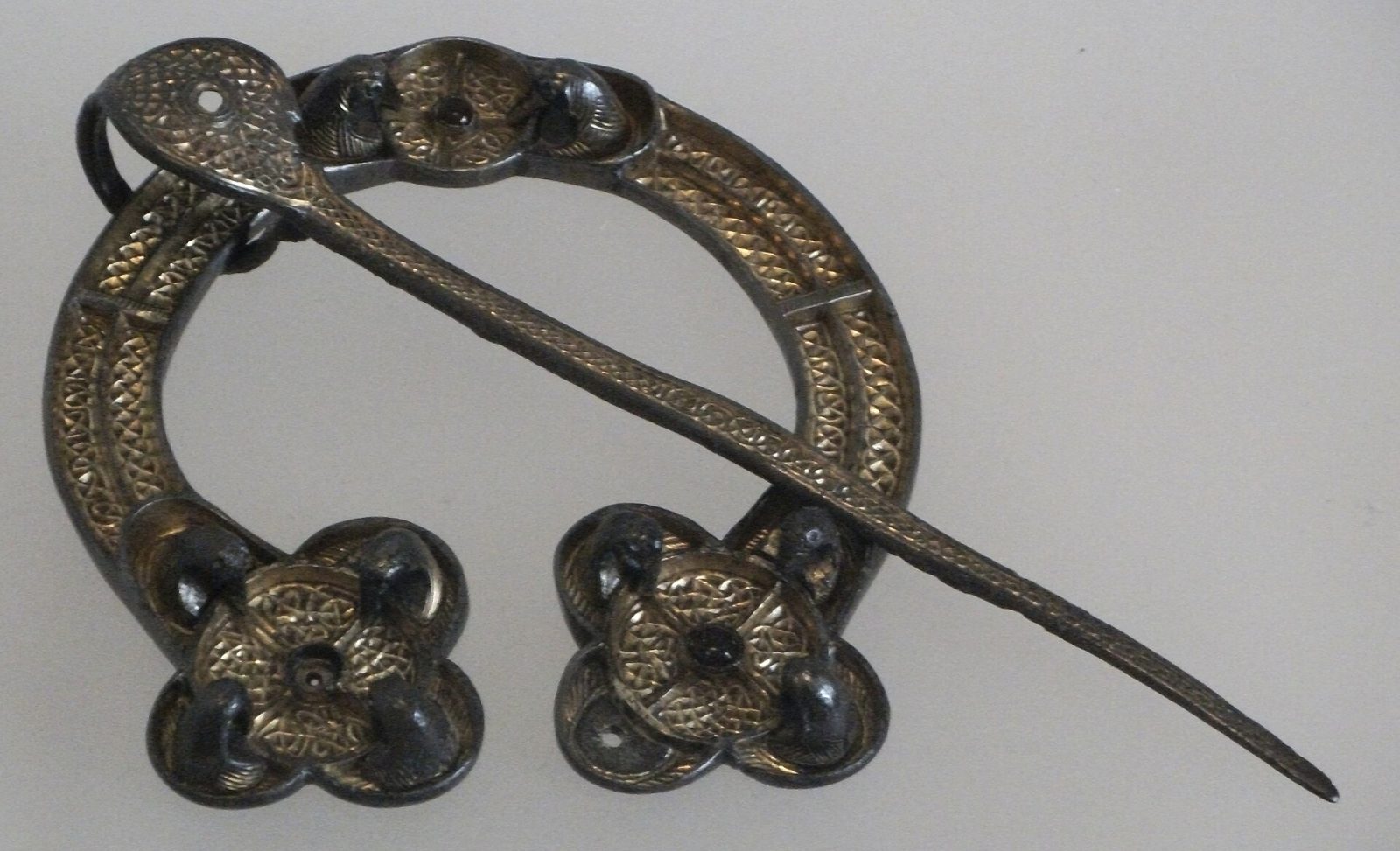
In 1868 workmen building the railway through Rogart in Sutherland blasted a boulder and found a hoard of silver brooches beneath it. Most were sold and lost; the finest survivor, decorated with tiny glass-eyed birds, is in the National Museum of Scotland.
In 1868, workmen building the Sutherland Railway through the parish of Rogart, in the far north of Scotland, came to a large boulder set in the ground near Rovie Lodge. When they blasted it out of the way, they found a hoard of silver brooches hidden beneath it. Accounts of how many there were differ, from nine to eleven, but only three survive today.
Two of the survivors are large silver penannular brooches, ring brooches with a gap in the hoop through which the long pin could pass, of a type made in Pictish Scotland and Ireland in the 8th century. The finer of them, now known as the Rogart Brooch, is of silver gilt, with a head 12 centimetres across and a pin nearly 20 centimetres long. Its decoration is astonishing in its detail: tiny three-dimensional birds' heads with glass eyes bend over the ring as if drinking, among settings of coloured glass. The third survivor is a smaller bronze brooch coated with silver gilt.
The fate of the hoard after its discovery was all too typical of the time. The two large brooches went to a local shopkeeper and were then bought by R. B. A. McLeod of Cadboll, who showed them to the Society of Antiquaries of Scotland in 1870, calling them the Cadboll brooches. They were bought for the museum in 1888. The Duke of Sutherland, on whose land the railway was built, acquired the small bronze brooch, which is now in the Dunrobin Castle Museum. The rest were sold, and no one knows where they went.
The brooches date from the 8th century AD, when Pictish and Irish craftsmen were making some of the finest metalwork in Europe. Why someone hid a whole set of them under a boulder in Sutherland is not known. In 1992 archaeologists surveyed the findspot with metal detectors in the hope of finding more, but nothing else turned up.
The Rogart Brooch and its companion are on display in the National Museum of Scotland in Edinburgh.
Written for Global Finds from the Highland Historic Environment Record, Rogart Heritage and the Proceedings of the Society of Antiquaries of Scotland. Photo: the Rogart Brooch in the National Museum of Scotland, Johnbod, Wikimedia Commons, CC BY-SA 3.0.
Approximate location58.01, -4.18View on map