The Gilling Sword: a Viking-age sword found by a nine-year-old boy in a beck
Famous find 9th century AD · Found in 1976 See it on the timeline →
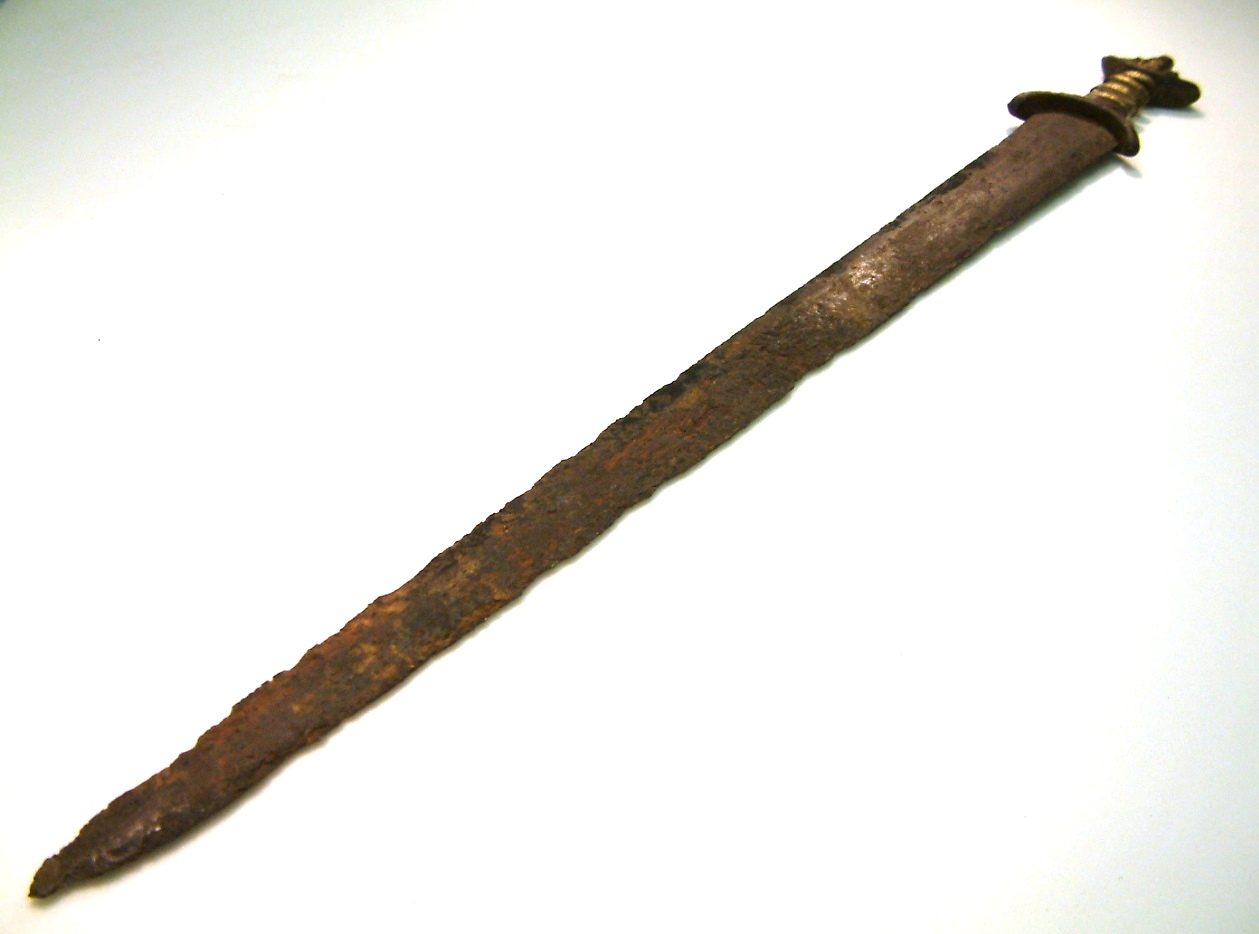
On 9 April 1976 a nine-year-old boy playing beside Gilling Beck in North Yorkshire noticed metal in the bank. It was a 9th-century Anglo-Saxon sword with a silver-decorated hilt, one of the finest ever found in Britain, and it earned him a Blue Peter badge.
On 9 April 1976, nine-year-old Garry Fridd was playing beside Gilling Beck, the stream that runs through the village of Gilling West, near Richmond in North Yorkshire, when he noticed a piece of metal sticking out of the bank, close to the water. A mechanical digger had recently been working along the beck. What he pulled out was an iron sword, nearly a metre long.
It is a two-edged sword, 84 centimetres long overall, with a pattern-welded blade, made by twisting and hammering together strips of iron to give strength and a rippling pattern. Its hilt is the treasure: the pommel is covered with silver plates, and five silver bands, decorated with geometric and plant designs, once wrapped around a grip of wood or horn that has since rotted away. Near the hilt the blade is still sharp. The tip, which lay in the water, is badly corroded.
Experts date the sword to the 9th century AD, the time when the Viking Great Army was fighting the Anglo-Saxon kingdoms, including Northumbria, of which this part of Yorkshire was part. The Yorkshire Museum dates it to between about 800 and 866. It was an expensive weapon, made for a warrior of high status. The museum suggests that swords like this were sometimes placed in rivers deliberately, as offerings, rather than being lost.
A coroner's inquest in September 1976 decided that the sword was not treasure trove, so it belonged to its finder. It was sold at auction and bought by the Yorkshire Museum in 1977, and the British Museum cleaned and conserved it. Garry Fridd appeared on the BBC children's programme Blue Peter, and both he and the sword were given Blue Peter badges.
The Gilling Sword has since toured in the Vikings exhibitions and even appears in a video game, and it is on display in the medieval gallery of the Yorkshire Museum in York.
Written for Global Finds from the Yorkshire Museum and York Museums Trust's catalogue, with J. R. Watkin's study in Medieval Archaeology (1986). Photo: the Gilling Sword, York Museums Trust, Wikimedia Commons, CC BY-SA 4.0.
Approximate location54.44, -1.72View on map
Source: Yorkshire Museum