The Hockwold Treasure: Roman silver cups crushed into scrap and buried in a Norfolk fen
Famous find 1st century AD · Found in 1962 See it on the timeline →
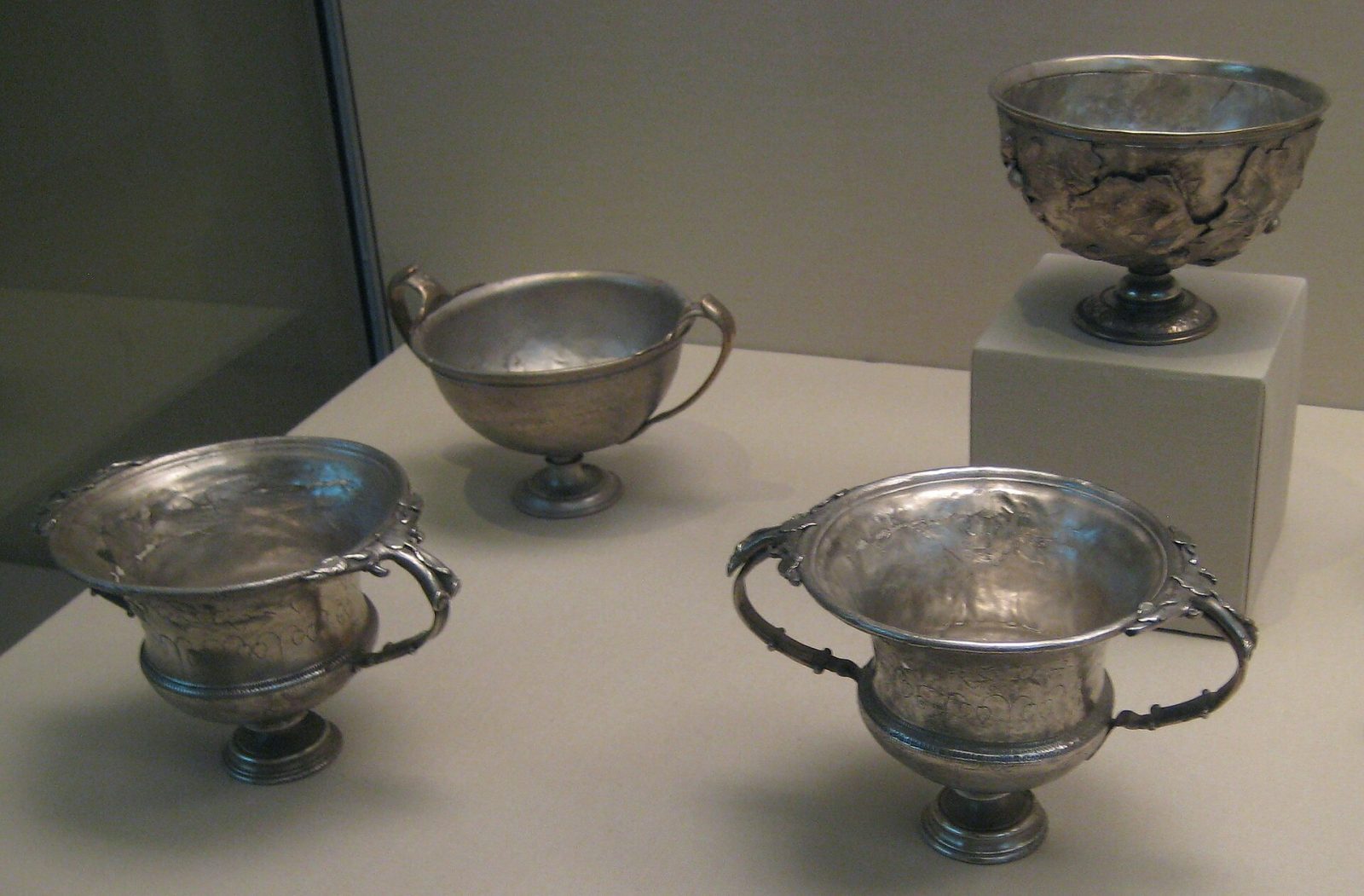
In 1962 a man cutting a trench across a suspected ancient road in the Norfolk fens found Roman silver wine cups, taken apart and crushed flat. It took twenty years of work at the British Museum to discover there were seven of them.
In early February 1962, Frank Curtis was cutting a section across what was thought to be an ancient roadway near Black Dyke Farm, at Hockwold cum Wilton, on the edge of the Norfolk fens, when he found crushed and folded silver about 60 centimetres down in the peat. Newspapers reported it within days: a farmworker had found Roman silver cups.
The silver turned out to be a set of fine Roman drinking cups that had been deliberately dismantled. Their pedestal bases and handles had been taken off, the bodies of the cups bent and flattened, and loose pieces packed inside two of the cups, which were then folded over them like envelopes. There were bases, some decorated with palm leaves, and pairs of handles decorated with ivy, scrolls and dolphins. One cup is decorated in relief with vine leaves and olives, and two matching two-handled cups, called kantharoi, are engraved with scenes linked to Bacchus, the god of wine.
At first the hoard was described as five cups. It was only when conservators at the British Museum painstakingly unfolded and reconstructed the battered silver, work that was finished in 1981, that it became clear there were seven. Fine silver tableware like this, made for wealthy Roman households in the 1st century AD, has been found in only a handful of places, including Hildesheim in Germany and Boscoreale near Pompeii.
Why it was crushed is not known for certain. Cutting up silver plate and folding it into compact packages turned it into bullion, valued by weight rather than as works of art. It may have been loot, perhaps from a shrine or a rich household, flattened for easy carrying and hidden in the fen, or the stock of someone who traded in silver.
A coroner's inquest was held later in February 1962, and the British Museum acquired the cups that year. After their long restoration they went on display in 1981, and they are in the British Museum's collection today.
Written for Global Finds from the Norfolk Heritage Explorer record of the find and C. Johns's study of the cups in Archaeologia (1986). Photo: the Hockwold cups in the British Museum, BabelStone, Wikimedia Commons, CC0.
Approximate location52.46, 0.48View on map
Source: Norfolk Heritage Explorer