The Llyn Fawr Hoard: the first iron in Wales, found while building a reservoir
Famous find About 800 to 600 BC · Found in 1911 See it on the timeline →
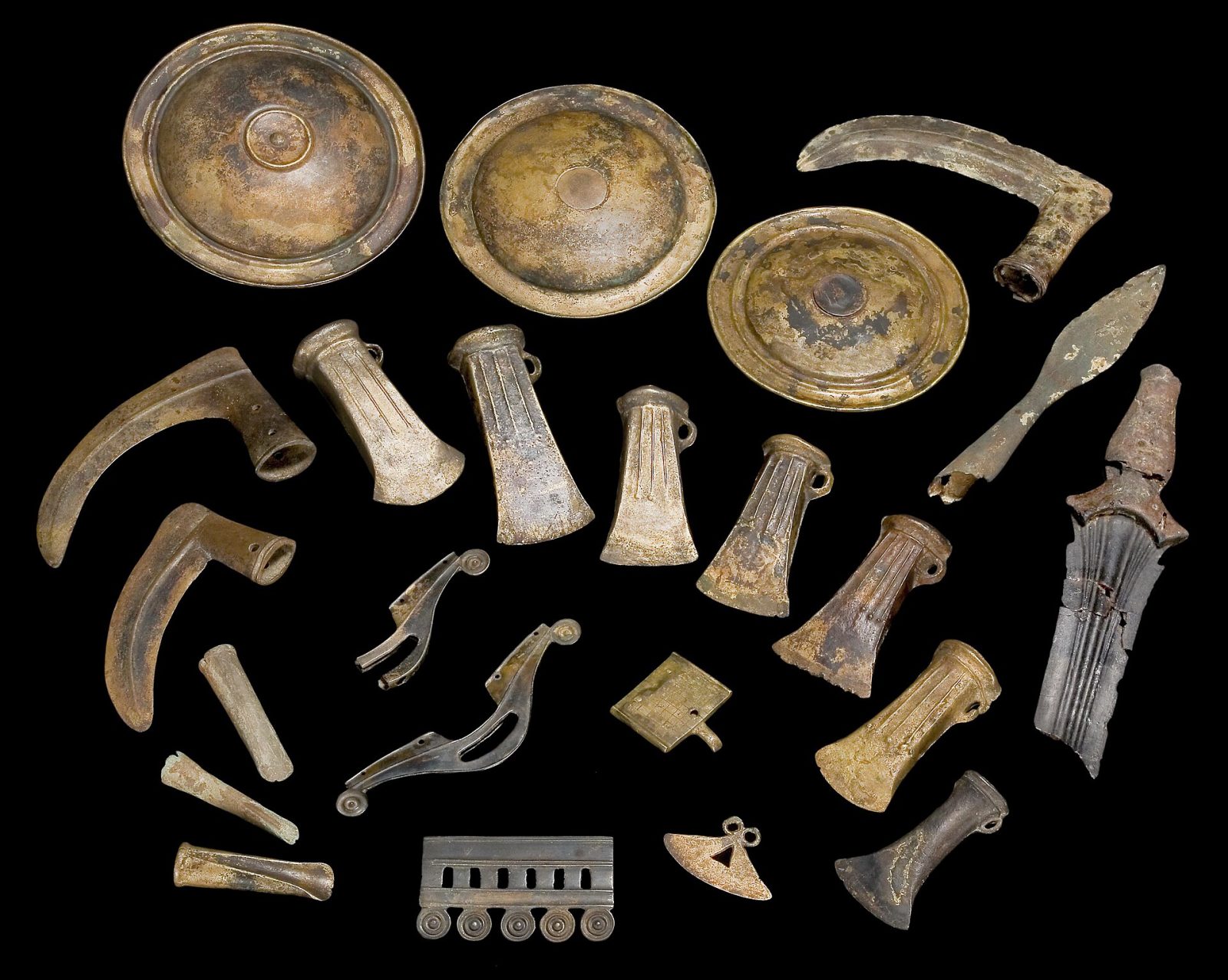
Between 1911 and 1912 workmen turning a mountain lake in the Rhondda into a reservoir found a hoard of bronze and iron in the peat: cauldrons, axes, sickles and an iron sword, among the earliest iron objects ever found in Britain.
Between 1909 and 1913, the lake of Llyn Fawr, high on the moorland above Rhigos near Hirwaun, at the head of the Rhondda valleys in South Wales, was turned into a reservoir. In 1911, workmen clearing the bed of the lake found a group of bronze and iron objects lying in the peat. The following year a second bronze cauldron turned up about 60 metres away. The Rhondda Urban District Council gave the finds to the National Museum of Wales.
The Llyn Fawr Hoard is made up of about 21 objects. There are two great bronze cauldrons, one of them more than half a metre across and able to hold about 50 litres, enough to feed a large gathering. There are pieces of horse harness, bronze socketed axes, chisels and sickles, and a razor. And there are three objects of iron: a spearhead, a socketed sickle with traces of its wooden handle still in the socket, and part of a sword with bone plates on its grip. The sword is of a type made in central Europe at the time of the Hallstatt culture, and is the earliest iron object found in Wales. Its smith hammered the iron laboriously into a shape copied from bronze swords.
The hoard dates from about 800 to 600 BC, the moment when Britain was moving from bronze to iron, and it has given its name to the Llyn Fawr phase, the earliest stage of the Iron Age in Britain. Placed in a lake, it was almost certainly an offering, like other great deposits of metalwork thrown into water in prehistoric Britain.
The sword took a strange route to the museum. It was found soon after the rest of the hoard, but only reached the museum in 1936, when an engineer who had worked on the reservoir remembered that it belonged with the other finds. Some objects may have been lost during the construction work.
The Llyn Fawr Hoard is in the collection of Amgueddfa Cymru - Museum Wales. The iron sword and sickle are displayed at St Fagans National Museum of History, near Cardiff.
Written for Global Finds from the Royal Commission's Coflein record, Amgueddfa Cymru - Museum Wales's collection records, Cynon Valley Museum and C. Fox and H. A. Hyde's study in the Antiquaries Journal (1939). Photo: objects from the Llyn Fawr Hoard, Amgueddfa Cymru - Museum Wales, Wikimedia Commons, CC BY-SA 4.0.
Approximate location51.73, -3.58View on map
Source: Coflein (Royal Commission on the Ancient and Historical Monuments of Wales)