The Muisca Raft: the golden legend of El Dorado, found in a Colombian cave
Famous find Made about AD 1295 to 1410 · Found in 1969 See it on the timeline →
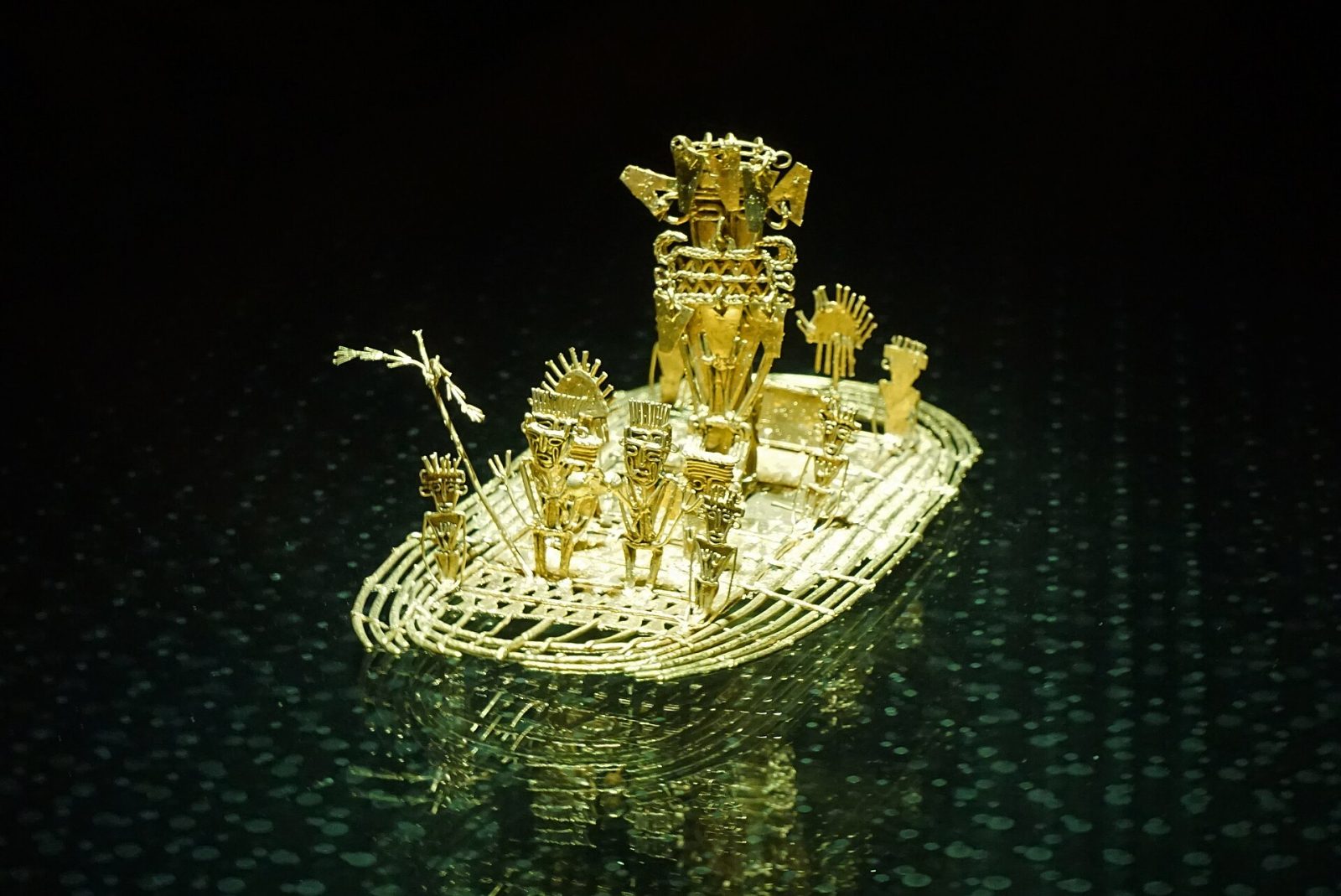
In 1969 a farmworker found a small gold model of a raft carrying a chief and his attendants in a cave above Pasca, near Bogotá. It brings to life the ceremony behind the legend of El Dorado, and it is the most famous object in Colombia's Gold Museum.
In 1969, Cruz María Dimaté, a farmworker from Pasca, a village in the mountains south of Bogotá in Colombia, found a small gold object in a cave on La Campana hill. With it were a second gold figure, in the shape of a litter, and two pottery vessels. The local parish priest, Jaime Hincapié Santamaría, helped the Museo del Oro, Colombia's Gold Museum, to acquire it. People in Pasca still argue about exactly which cave it came from.
The object is a model of a raft, about 20 centimetres long, carrying eleven figures. In the centre stands a chief, larger than the rest, wearing a headdress and nose and ear ornaments. Around him are two large masked figures holding rattles, two seated figures holding poporos, the gourds used for lime when chewing coca, and six small attendants. The whole scene was cast in a single piece by the lost-wax method, in tumbaga, an alloy of gold, silver and copper. It was made by the Muisca people, who lived in the highlands around Bogotá, as a tunjo, an offering to be placed in a sacred place.
The raft is famous because it seems to show the ceremony behind the legend of El Dorado, the golden man. According to a Spanish chronicle written in 1636, when a new Muisca ruler took power he was covered in gold dust and rowed out on a raft into the middle of Lake Guatavita, where he and his companions threw gold and emeralds into the water as offerings. The legend drew generations of treasure hunters to Colombia, and attempts to drain Lake Guatavita. A similar gold raft found in 1856 during an attempt to drain another lake, Siecha, was lost in a fire on its way to a museum in Germany.
The Gold Museum dates the raft to between AD 600 and 1600. In 2021, researchers radiocarbon-dated charcoal left from the clay mould in its crevices, and found it was made between about 1295 and 1410.
The Muisca raft is the centrepiece of the Museo del Oro in Bogotá, where it is displayed on its own in a darkened room, above a surface like still water.
Written for Global Finds from J. P. Uribe-Villegas, M. Martinón-Torres and J. S. Quintero-Guzmán's study of the raft (Dumbarton Oaks, 2021) and the Museo del Oro. Photo: the Muisca raft in the Museo del Oro, Bogotá, Mariordo (Mario Roberto Durán Ortiz), Wikimedia Commons, CC BY-SA 4.0.
Approximate location4.31, -74.30View on map
Source: University of Cambridge repository (Dumbarton Oaks, 2021)