The Croatian Apoxyomenos: a bronze athlete found by a diver, with a mouse's nest inside
Famous find Cast in the 2nd or 1st century BC · Found in 1996 See it on the timeline →
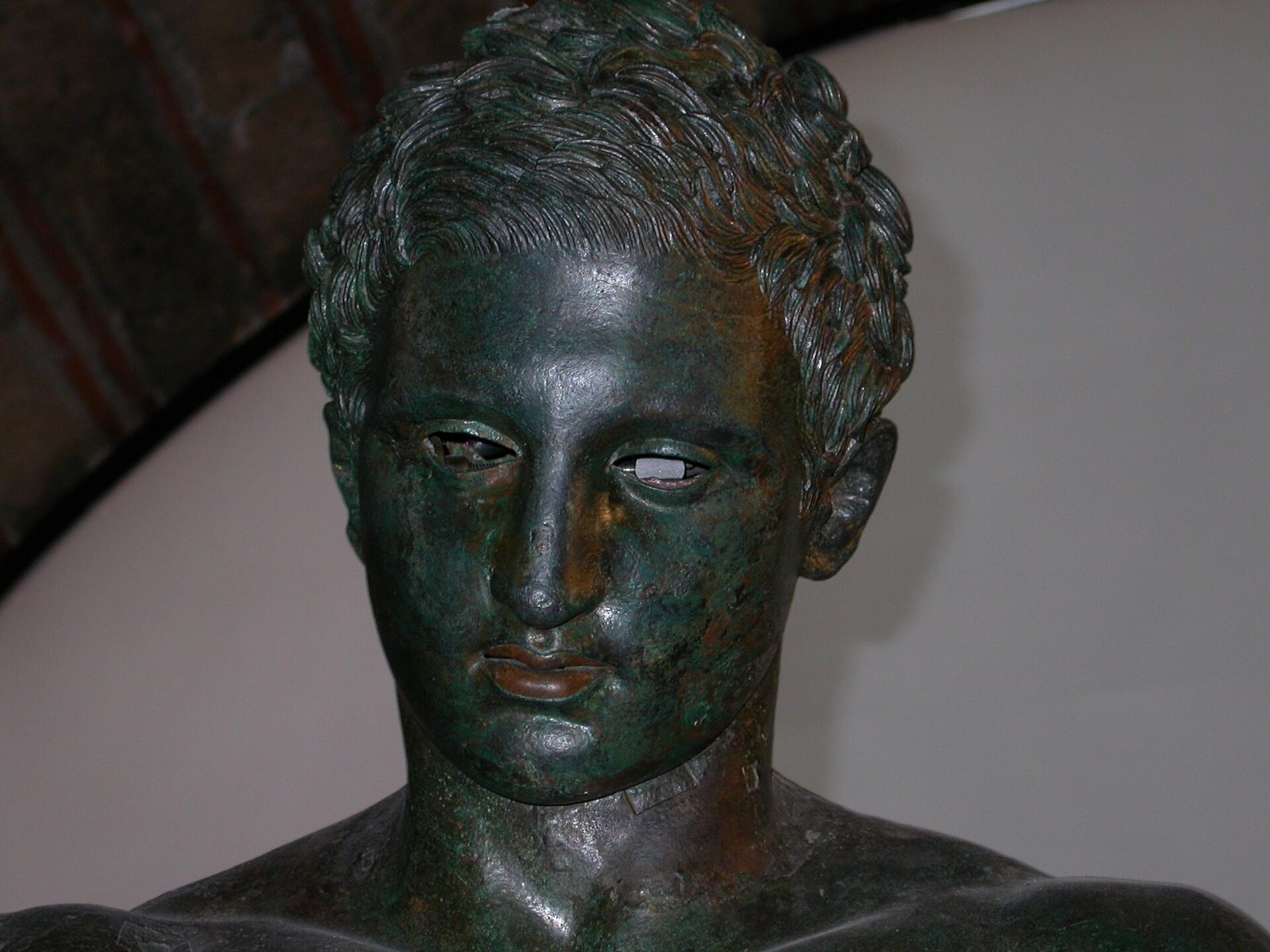
In 1996 a Belgian diver exploring the seabed off the Croatian island of Lošinj spotted a bronze statue lying between two rocks 45 metres down. It turned out to be a nearly complete ancient Greek-style athlete, with a mouse's nest from antiquity still inside it.
In 1996, René Wouters, a Belgian tourist and amateur underwater photographer, was diving off the islet of Vele Orjule, south-east of the island of Lošinj in the northern Adriatic, when he saw a bronze statue lying on the sand between two rocks, about 45 metres down. He reported it, and in April 1999 the statue was raised from the sea.
It is an Apoxyomenos, Greek for 'one who scrapes himself': an athlete cleaning the oil, sweat and dust from his body after exercise with a curved metal scraper called a strigil. The statue is 1.92 metres tall and weighs about 300 kilograms. It was cast from bronze in at least seven separate pieces joined together, and it is almost complete; only the little finger of the left hand is missing, along with the strigil and the inlaid eyes. Of the eight known statues of this type, it is the most complete.
Conservators at the Croatian Conservation Institute spent six years restoring it, removing the crust of marine growth by hand without chemicals. Inside they found a surprise. In ancient times, before the statue went into the sea, a field mouse had made its home inside it, probably getting in through a hole in the sole of the left foot. Its nest of twigs and leaves was still in the left arm, along with walnuts and the stones of olives, cherries and peaches, some still marked with the mouse's teeth. Radiocarbon dating of the nest helped to show when the statue was lost.
The statue was cast in the 2nd or 1st century BC, copying a famous Greek design of the 4th century BC. It was probably being carried by ship, perhaps as a work of art for a wealthy buyer, when it was lost overboard or went down in a wreck. After exhibitions in Zagreb, Florence, the Louvre and the Getty, the Apoxyomenos came home in 2016 to its own museum, the Museum of Apoxyomenos in Mali Lošinj, only a few kilometres from where it was found.
Written for Global Finds from the Museum of Apoxyomenos, the Croatian Conservation Institute and Croatia Week. Photo: the head of the Croatian Apoxyomenos, Edgar Allan Poe (Wikimedia Commons user), Wikimedia Commons, public domain.
Approximate location44.50, 14.56View on map
Source: Museum of Apoxyomenos