The Cramond Lioness: a Roman man-eater found in the river mud by the Cramond ferryman
Famous find Mid-2nd to early 3rd century AD · Found in 1997 See it on the timeline →
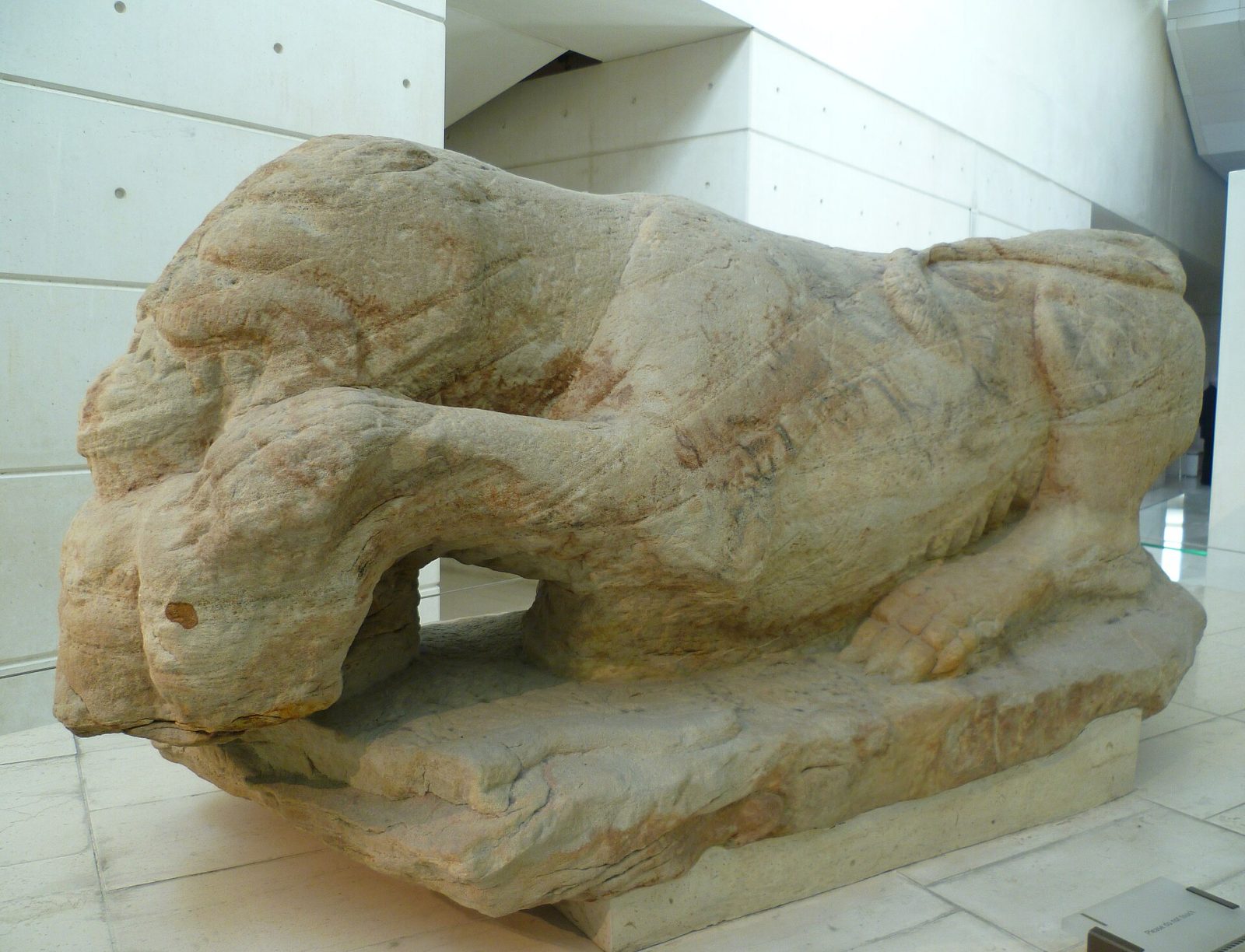
In the winter of 1996 to 1997 Robert Graham, the ferryman at Cramond near Edinburgh, saw a carved head sticking out of the mud beside his ferry steps. It was a Roman tomb sculpture of a lioness devouring a captive, more than 1.5 metres long.
Over the winter of 1996 to 1997, Robert Graham, who ran the little ferry across the mouth of the River Almond at Cramond, on the edge of Edinburgh, noticed something new in the mud beside his ferry steps. The river had scoured away the silt and exposed a carved stone head. In January 1997 archaeologists from the City of Edinburgh Council and National Museums Scotland dug it out and lifted it. It was a Roman sculpture, almost complete, lying a short distance from the Roman fort at Cramond.
Carved from a single block of white sandstone, not from the local stone, it is about 1.5 metres long. It shows a lioness with her paws on the shoulders of a bearded man and his head in her jaws. His hands are tied behind his back, and the museum sees him as a captive, probably a local Caledonian. The base, found broken off nearby, shows two snakes emerging from under the lioness; in Roman belief, snakes could stand for the survival of the soul.
The lioness was almost certainly a tomb monument, set up for a high-ranking Roman officer at Cramond, and acted both as a guardian of the grave and as a monument to Roman victory. It was carved between the middle of the 2nd and the early 3rd century AD, when Cramond was an important Roman base on the Firth of Forth. Nobody knows where the tomb stood, or how the sculpture ended up in the river.
In Scotland, ownerless archaeological finds of any material belong to the Crown and are dealt with through Treasure Trove, so the lioness was claimed even though it was stone, not metal. It was acquired jointly by National Museums Scotland and the City of Edinburgh Council for £50,000, with help from Art Fund and the Heritage Lottery Fund, and according to The Scotsman Robert Graham received a reward of £50,000. The Cramond Lioness is displayed in the National Museum of Scotland in Edinburgh.
Written for Global Finds from National Museums Scotland, Archaeology magazine (1997), Art Fund, the Heritage Fund and The Scotsman (2003). Photo: the Cramond Lioness in the National Museum of Scotland, Kim Traynor, Wikimedia Commons, CC BY-SA 3.0.
Approximate location55.98, -3.30View on map
Source: National Museums Scotland