Ferlini's Meroë Treasure: the gold a treasure hunter found by wrecking a pyramid
Famous find Late 1st century BC or early 1st century AD · Found in 1834 See it on the timeline →
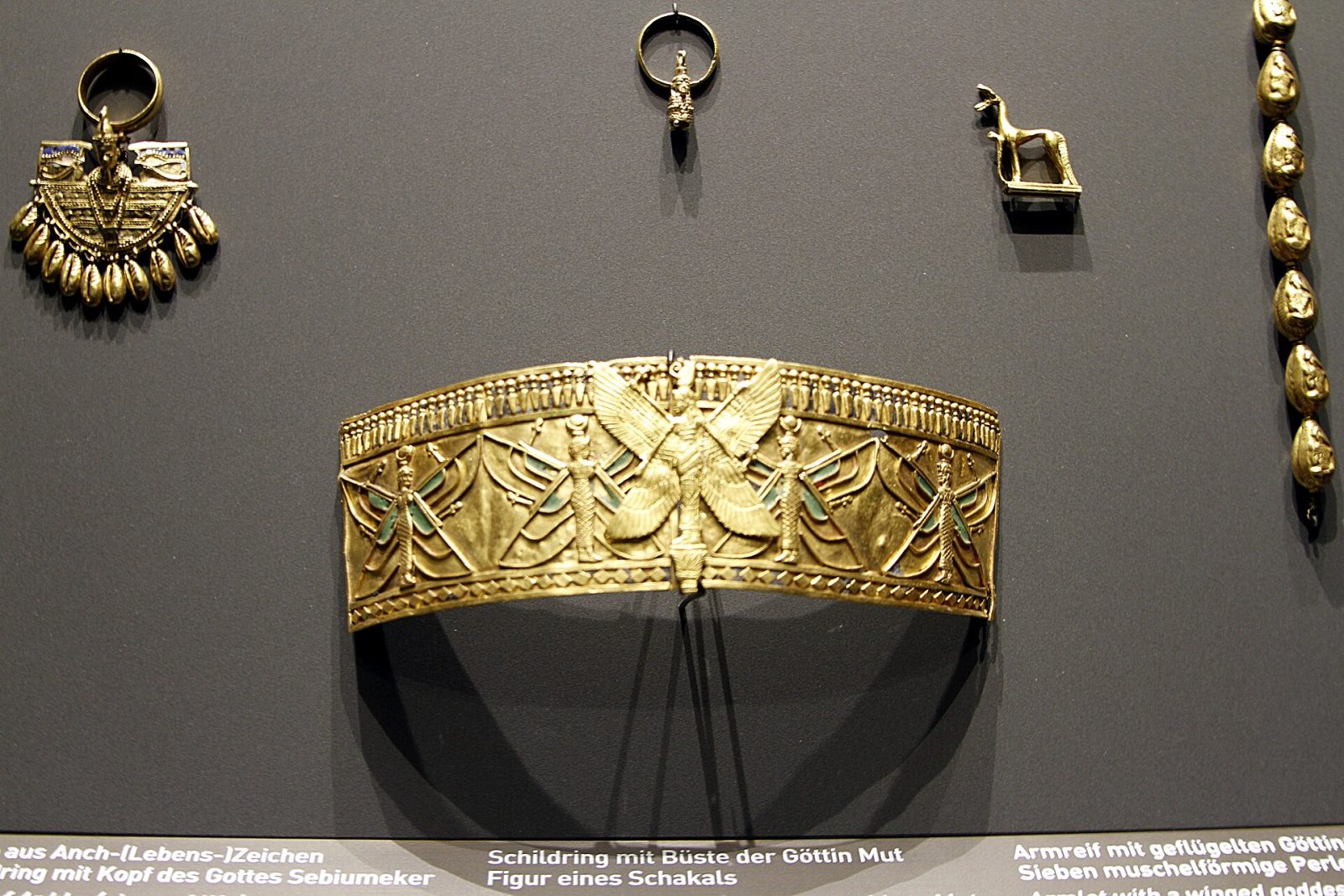
In 1834 the Italian treasure hunter Giuseppe Ferlini had the top of a royal pyramid at Meroë in Sudan torn down, and claimed to have found a hoard of a Kushite queen's gold jewellery inside. Experts at first called it a fake; it is now in Berlin and Munich.
In 1834, Giuseppe Ferlini, an Italian doctor from Bologna who had served with the Egyptian army in Sudan, set out with an Albanian merchant, Antonio Stefani, to look for treasure in the royal cemeteries of Meroë, on the Nile north of Khartoum. Meroë had been the capital of the kingdom of Kush, whose rulers were buried under steep-sided pyramids. Ferlini chose one of the largest, about 28 metres high, built for Queen Amanishakheto, and had local workers dismantle it from the top down.
Ferlini claimed that near the top of the pyramid he found a hidden chamber containing the queen's jewellery: about 240 pieces of gold and other metal, including bracelets, armlets, large shield-shaped rings, dozens of signet rings, collars and amulets, many decorated with coloured glass and images of Kushite and Egyptian gods. Some scholars have doubted his account, suspecting that the treasure actually came from the burial chambers beneath the pyramid; his story was, however, later supported by local witnesses. The jewellery dates from the late 1st century BC or early 1st century AD.
When Ferlini brought the treasure to Europe, experts dismissed it as fake, partly because it did not look like the Egyptian jewellery they knew. He sold some pieces on the way home, published his account in 1837, and struggled for years to find a buyer. King Ludwig I of Bavaria bought part of it, and in 1844 the Egyptologist Karl Richard Lepsius persuaded the Berlin museums to buy most of the rest. Lepsius, who later visited Meroë, wrote that Ferlini's find had brought many a pyramid to ruin, as other treasure hunters copied him.
About two-thirds of the treasure is now in the Egyptian Museum and Papyrus Collection in Berlin, in the Neues Museum, and about a third in the State Museum of Egyptian Art in Munich. The ruined pyramid still stands, cut short, at Meroë, which is now a UNESCO World Heritage Site.
Written for Global Finds from the Berlin State Museums' records, A. Zach's study in Sudan and Nubia (2023) and published accounts of Ferlini's expedition. Photo: jewellery from the pyramid of Queen Amanishakheto in the State Museum of Egyptian Art, Munich, José Luiz, Wikimedia Commons, CC BY-SA 4.0.
Approximate location16.94, 33.75View on map