The Ormside Bowl: Anglo-Saxon silver from a Cumbrian churchyard
Famous find Made about AD 750 to 800 · Found in 1823 See it on the timeline →
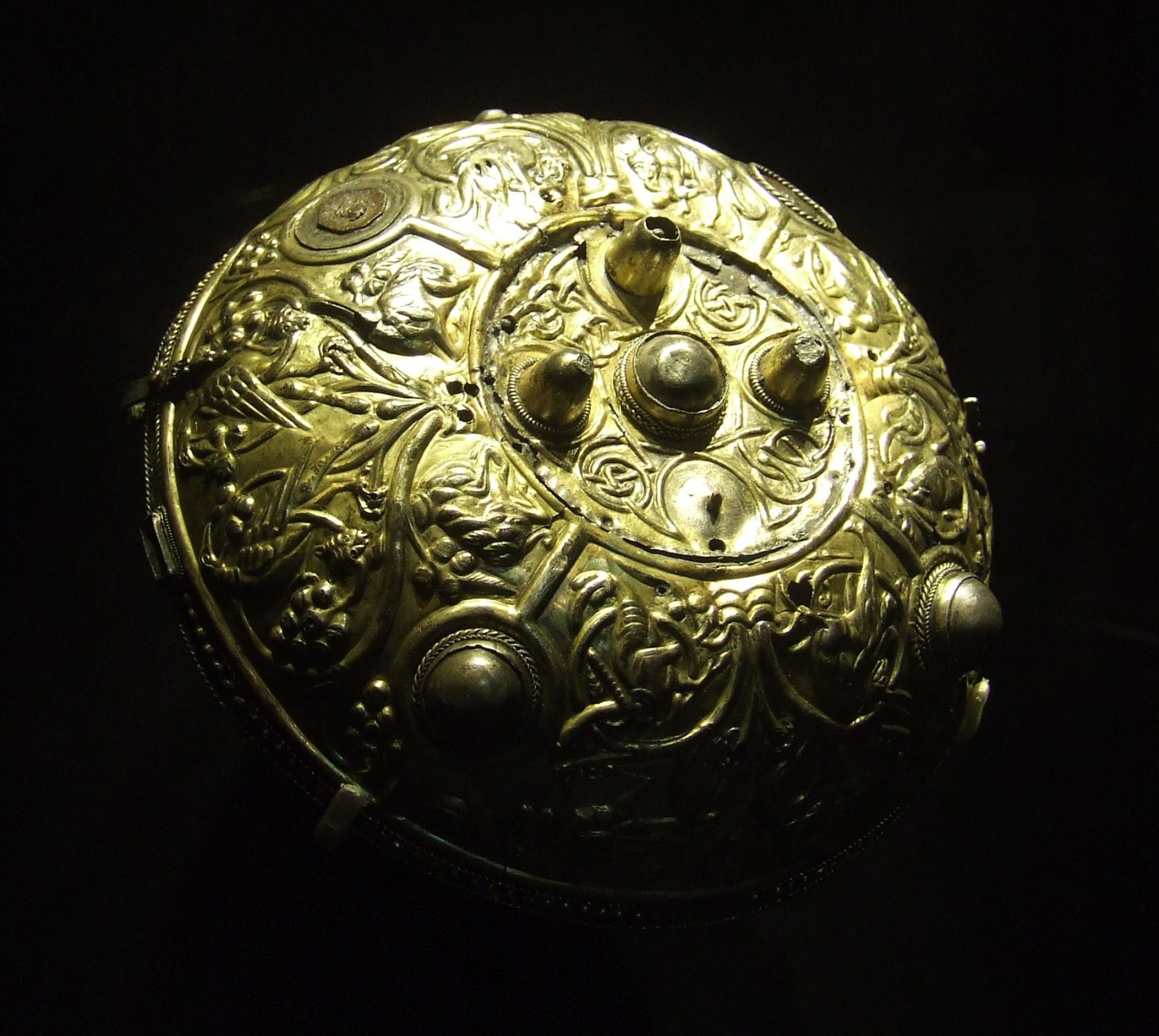
In 1823 a richly decorated bowl of gilded silver and bronze was found in the churchyard at Great Ormside in Cumbria. First thought to be medieval, it is in fact a masterpiece of 8th-century Anglo-Saxon art, and how it came to be buried there is still a puzzle.
In 1823, a small, battered bowl was found in the churchyard at Great Ormside, a village in the Eden valley in Cumbria, then part of Westmorland. Nobody recorded exactly who found it or how. It was given to the Yorkshire Philosophical Society in York, which listed it among the very first gifts to its new museum, and catalogued it as a 14th-century object. It was about five hundred years older than that.
The Ormside Bowl is made of two shells. The outer bowl is of silver gilt, worked in repoussé, hammered out from behind, with a design of vines, grapes and birds, among which strange interlaced creatures twist and bite. Inside it is a cup of gilt bronze. The base is decorated with sixteen pieces of coloured glass set in cells and five domed rivets, and the rim was once bound with a silver strip held by clips in the shape of animal heads, two of which survive. It is about 15 centimetres across.
The bowl was made in Anglo-Saxon England, probably in Northumbria or Mercia, around AD 750 to 800, and its decoration is related to some of the great works of the time, such as the Book of Durrow. It may have been made for a church, perhaps as a vessel used in services.
How it came to be in a Cumbrian churchyard is a mystery. One theory is that it was looted from a monastery by Vikings, who settled in this area in the 10th century, and buried with one of them; a Viking burial with a sword was found in the same churchyard in 1898. Another is that it was hidden in or near the church for safe keeping. Because the circumstances of the find were never recorded, there is no way to tell.
The Ormside Bowl was cleaned by the British Museum in 1951, has been shown in the Vikings exhibitions, and is in the collection of the Yorkshire Museum in York.
Written for Global Finds from York Museums Trust's catalogue and Tom Spencer's article on the bowl for York Museums Trust. Photo: the Ormside Bowl, on loan to the British Museum in 2010, JMiall, Wikimedia Commons, CC BY-SA 3.0.
Approximate location54.55, -2.46View on map
Source: York Museums Trust