The Ciumești Helmet: a Celtic chieftain's helmet with a bird of prey whose wings flapped
Famous find About 250 to 175 BC · Found in 1961 See it on the timeline →
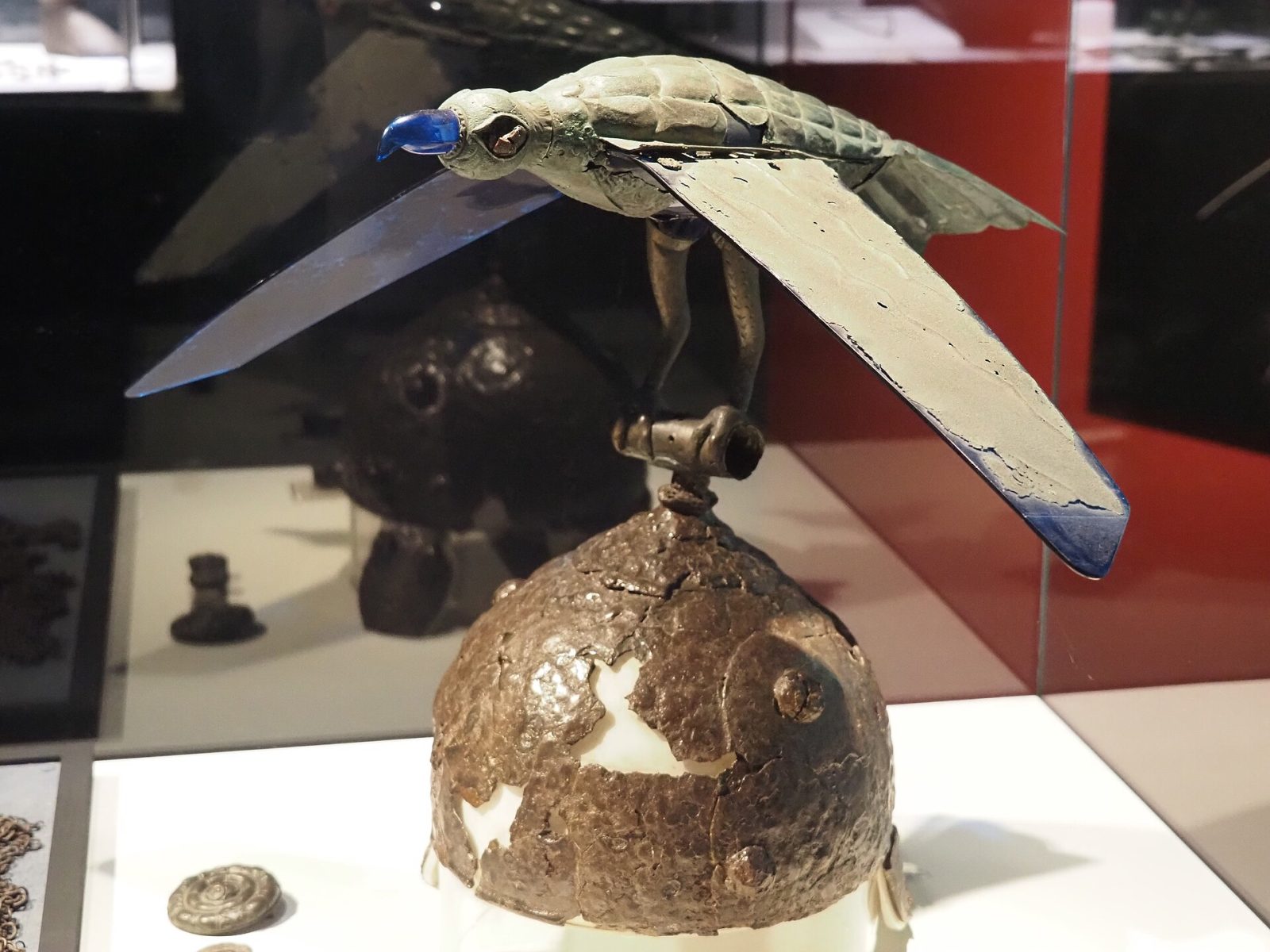
In 1961 workers levelling ground at Ciumești in north-western Romania found the grave of a Celtic chieftain. His iron helmet is crowned with a bronze bird of prey whose hinged wings moved as he walked, the only real helmet of its kind ever found.
In the summer of 1961, at Ciumești, a village in Satu Mare county in north-western Romania, near the borders with Hungary and Ukraine, ground was being levelled when workers came across a grave. Accounts differ on the details: the National History Museum of Romania says a sand dune was being levelled, while another report says foundations were being dug for farm stables. Either way, the find led archaeologists to a Celtic cemetery of 32 graves, both burials and cremations.
The richest grave belonged to a warrior of high rank. With him were an iron mail shirt with bronze fittings, a pair of bronze greaves to protect his shins, a spearhead and pottery. And there was his helmet. It is made of hammered iron, with hinged cheek guards and a guard for the neck. On top stands a large bronze bird of prey, perhaps a raven, its eyes inlaid with enamel and red coral. Its wings were fixed on hinges, so that they moved as the wearer walked or rode.
The Celts, who spread across much of Europe in the last centuries BC, had settled in Transylvania and the surrounding region by the 3rd century BC. The helmet and the grave date from the second half of the 3rd century or the early 2nd century BC, about 250 to 175 BC. Bird-crested helmets like this are shown on the Gundestrup cauldron, the great silver bowl found in Denmark, but Ciumești is the only real one ever found by archaeologists. It was probably a parade helmet, worn to impress, and the mail shirt and greaves show that its owner was equipped like an elite warrior of the Greek world.
The helmet belongs to the National History Museum of Romania in Bucharest, which made it its exhibit of the month in May 2026. It has also been lent to exhibitions in Madrid and Târgu Mureș.
Written for Global Finds from Agerpres (2025 and 2026), Mediafax (2026), the National History Museum of Romania and Livius.org. Photo: the Ciumești Helmet on loan to the National Archaeological Museum in Madrid, Laci3, Wikimedia Commons, CC0.
Approximate location47.67, 22.33View on map
Source: Agerpres