The Inariyama Sword: a rusty blade that hid a gold inscription naming a Great King for ten years
Famous find Inscribed in AD 471 (some scholars read 531) · Found in 1968 See it on the timeline →
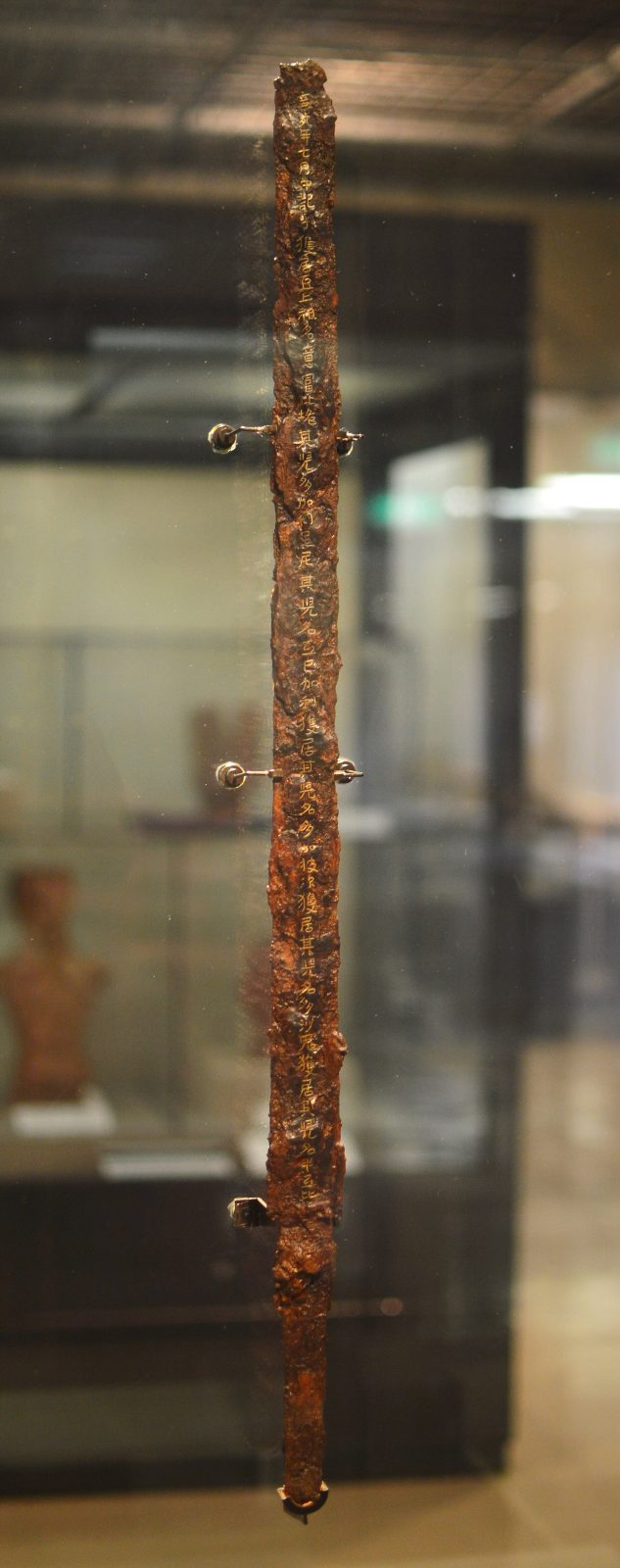
In 1968 archaeologists excavating the Inariyama burial mound in Saitama, Japan, found a rusted iron sword. Ten years later, X-rays revealed 115 characters inlaid in gold, naming a Great King and recording one of the earliest datable written texts from Japan.
In 1968, archaeologists from Saitama Prefecture excavated the top of the Inariyama Kofun, a keyhole-shaped burial mound about 120 metres long in the Sakitama group of tombs at Gyōda, north of Tokyo, as part of creating a heritage park. One of the mound's two burial places had been robbed, but the other, a boat-shaped bed of river stones 5.7 metres long, was intact. Beside the left leg of the dead person lay an iron sword 73.5 centimetres long, badly rusted.
Ten years later, in 1978, the sword was being cleaned for conservation at the Gangōji Institute for Research of Cultural Property in Nara when X-rays revealed something hidden under the rust: 115 characters inlaid in gold, 57 on one face of the blade and 58 on the other. It is the longest inscription known on any sword of Japan's Kofun period.
The inscription opens with a date, the seventh month of a xinhai year. It lists eight generations of a family, from an ancestor called Ohohiko down to Wowake, whose family had served as chiefs of the sword-bearers, the royal guard. Wowake says that he helped the Great King Wakatakeru to rule while the court was at Shiki, and had the sword made to record his service. Most scholars identify Wakatakeru as Emperor Yūryaku and read the xinhai year as 471, though some prefer 531. The text also helped scholars read a damaged king's name on another sword, from the Eta Funayama tomb in Kumamoto, far to the south-west, as the same Wakatakeru. Whether Wowake was the person buried here, a local chief or a member of a clan from the royal court is still debated.
The sword and the other grave goods, among them a mirror, armour, horse gear and gilt-bronze belt fittings, were designated National Treasures in 1983. After a replica stood in from 2023 while a new display case was built, the real sword went back on show in February 2026 at the Saitama Prefectural Museum of the Sakitama Ancient Burial Mounds.
Written for Global Finds from the Saitama Prefectural Museum of the Sakitama Ancient Burial Mounds (Google Arts & Culture), the Heibonsha World Encyclopedia (via Kotobank) and Saitama Prefecture (2026). Photo: the Inariyama sword at the Sakitama museum, Saigen Jiro, Wikimedia Commons, public domain.
Approximate location36.13, 139.48View on map
Source: Saitama Prefectural Museum of the Sakitama Ancient Burial Mounds (Google Arts & Culture)