The Carlingwark Hoard: a cauldron full of Roman-age tools fished out of a Scottish loch
Famous find About AD 80 to 200 · Found in 1866 See it on the timeline →
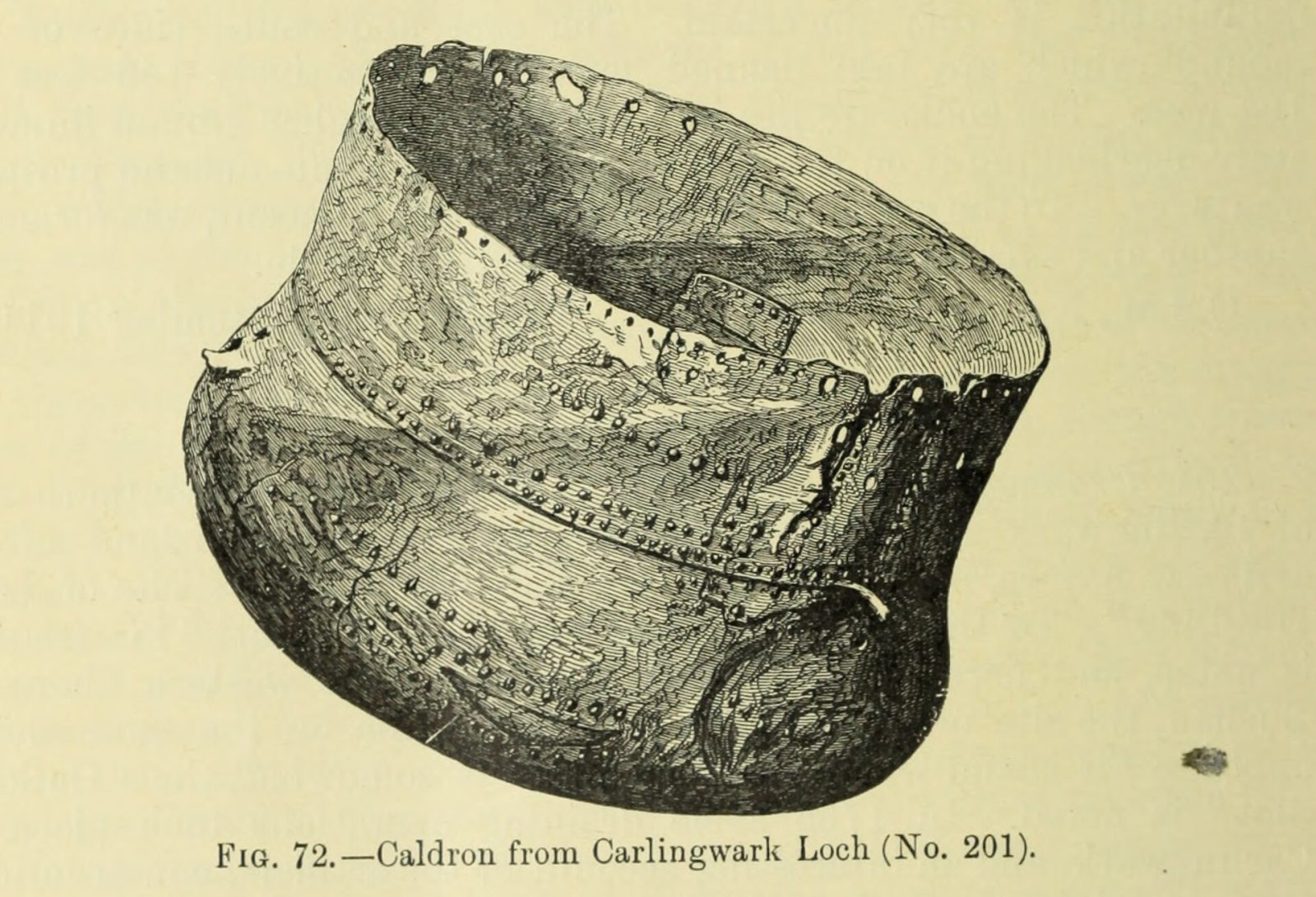
Around 1866 two fishermen on Carlingwark Loch, by Castle Douglas in Galloway, brought up an ancient bronze cauldron. Packed inside were about a hundred iron objects: hammers, a saw, files, punches, a gridiron, chain mail and eight sword tips, from the 1st or 2nd century AD.
Around 1866, two fishermen working on Carlingwark Loch, on the edge of the town of Castle Douglas in Kirkcudbrightshire, south-west Scotland, brought up a large bronze cauldron from the shallow bottom of the loch near Fir Island. They thought it might have belonged to Edward I, the English king who campaigned in Scotland six centuries earlier. It was far older than that, and it was full.
The cauldron is about 60 centimetres across and 45 centimetres deep, made of three thin bronze sheets riveted together. It had been used for a long time before it went into the loch: it is covered in riveted patches, some held on with bronze strips bent like modern paper clips. Inside were about a hundred objects, most of them iron, and most of them tools. There were eight hammer-heads of Roman type, an adze-hammer and an axe-head, a small saw, a draw-knife, punches and files, an iron bar that may have been a smith's raw material, and parts of scythes, a sickle and knives. There were also household and farm objects, among them a gridiron, a small tripod, a padlock spring, horse bits and fittings from a cart, and a bronze tankard handle. And there was war gear: fragments of iron chain mail and the tips of eight swords, but no other parts of any sword.
The objects date from the 1st or 2nd century AD, about AD 80 to 200, when the Roman army was campaigning in and occupying southern Scotland. In 1955 the archaeologist Stuart Piggott studied the hoard. He considered whether it was a smith's stock of scrap metal, but leaned towards seeing it as an offering to the spirit of the loch, placed there in a single act. The careful choice of sword tips alone suggests the objects were selected on purpose.
The cauldron and most of the hoard are in the collection of the National Museum of Scotland in Edinburgh. A piece of the chain mail is at Dumfries Museum.
Written for Global Finds from S. Piggott in the Proceedings of the Society of Antiquaries of Scotland (1955), National Museums Scotland and Dumfries Museum. Photo: the Carlingwark cauldron, an engraving from the Royal Commission on the Ancient and Historical Monuments of Scotland's Galloway inventory (1914), public domain.
Approximate location54.93, -3.93View on map
Source: Proceedings of the Society of Antiquaries of Scotland