The Sultanganj Buddha: a 500 kg copper Buddha found by a railway engineer, now in Birmingham
Famous find Made about AD 500 to 700 · Found in 1862 See it on the timeline →
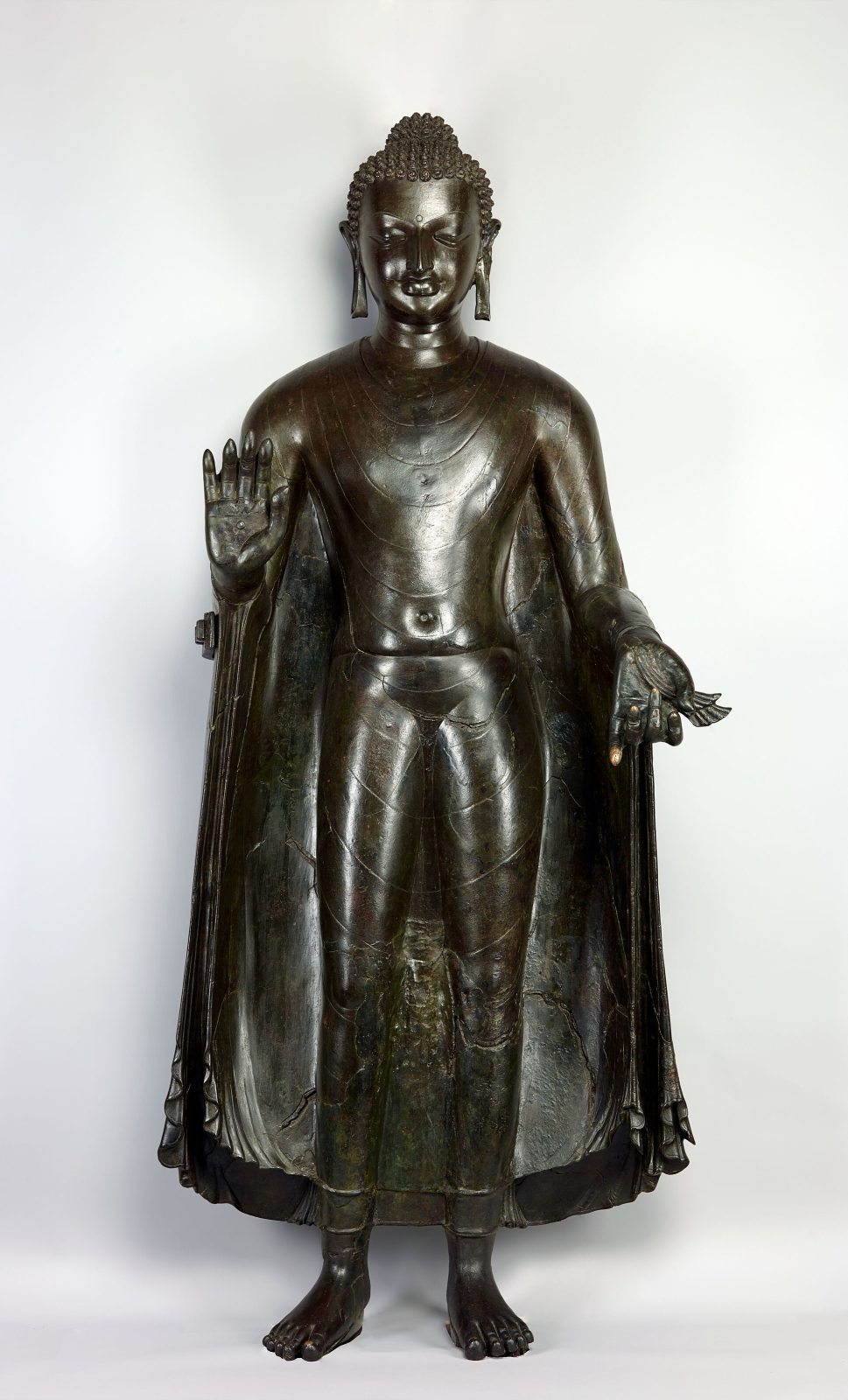
In 1861 or 1862 a railway engineer building a station at Sultanganj in Bihar, India, dug up a copper statue of the Buddha more than two metres tall. Shipped to Birmingham in 1864, it is the largest complete metal statue of its age to survive.
In 1861 or 1862, E. B. Harris, an engineer building a station on the East Indian Railway at Sultanganj, on the River Ganges in Bihar, north-eastern India, was clearing the ruins of an old Buddhist site to make way for the line. About three metres down, his workers uncovered a foot made of copper. As they dug further, they found that it belonged to a statue of the Buddha, lying where it had fallen, beneath a floor that Harris believed had been laid over it to hide it.
The statue is 2.3 metres tall and weighs more than 500 kilograms. It shows the Buddha standing, his right hand raised in the gesture known as abhaya mudra, meaning do not fear, and his left hand holding the edge of his robe. It was cast in almost pure copper by the lost-wax method, over a clay core mixed with rice husk. That husk has allowed the statue to be dated by radiocarbon. Birmingham Museums dates it to between AD 500 and 700, in the transition between the Gupta and Pala periods of Indian art. It is the only metal statue of its period larger than life to survive, and the casting was so ambitious that it shows signs of repairs made by its makers.
Harris's excavations also turned up smaller stone Buddhas, now in the British Museum and other collections. He published an account of his work in 1864.
The copper Buddha was shipped to England with the help of Samuel Thornton, a Birmingham metal manufacturer and former mayor, who presented it to the town in 1864 for its planned art museum; it was meant to inspire the city's own metalworkers. It has been in Birmingham ever since. Over the years there have been calls, in Birmingham and in India, for the statue to return to Bihar.
The Sultanganj Buddha is on show at Birmingham Museum and Art Gallery. Since May 2025 it has stood in a new gallery, The Elephant in the Room, which looks at how the city's collections were formed, including in the age of empire.
Written for Global Finds from Birmingham Museums Trust, E. B. Harris's 1864 report, and Who Was Who in Indology. Photo: the Sultanganj Buddha, Birmingham Museums Trust, Wikimedia Commons, CC0.
Approximate location25.24, 86.73View on map
Source: Birmingham Museums Trust