The Gold Crown of Geumgwanchong: Korea's first Silla crown, found by a tavern-keeper
Famous find Late 5th or early 6th century AD · Found in 1921 See it on the timeline →
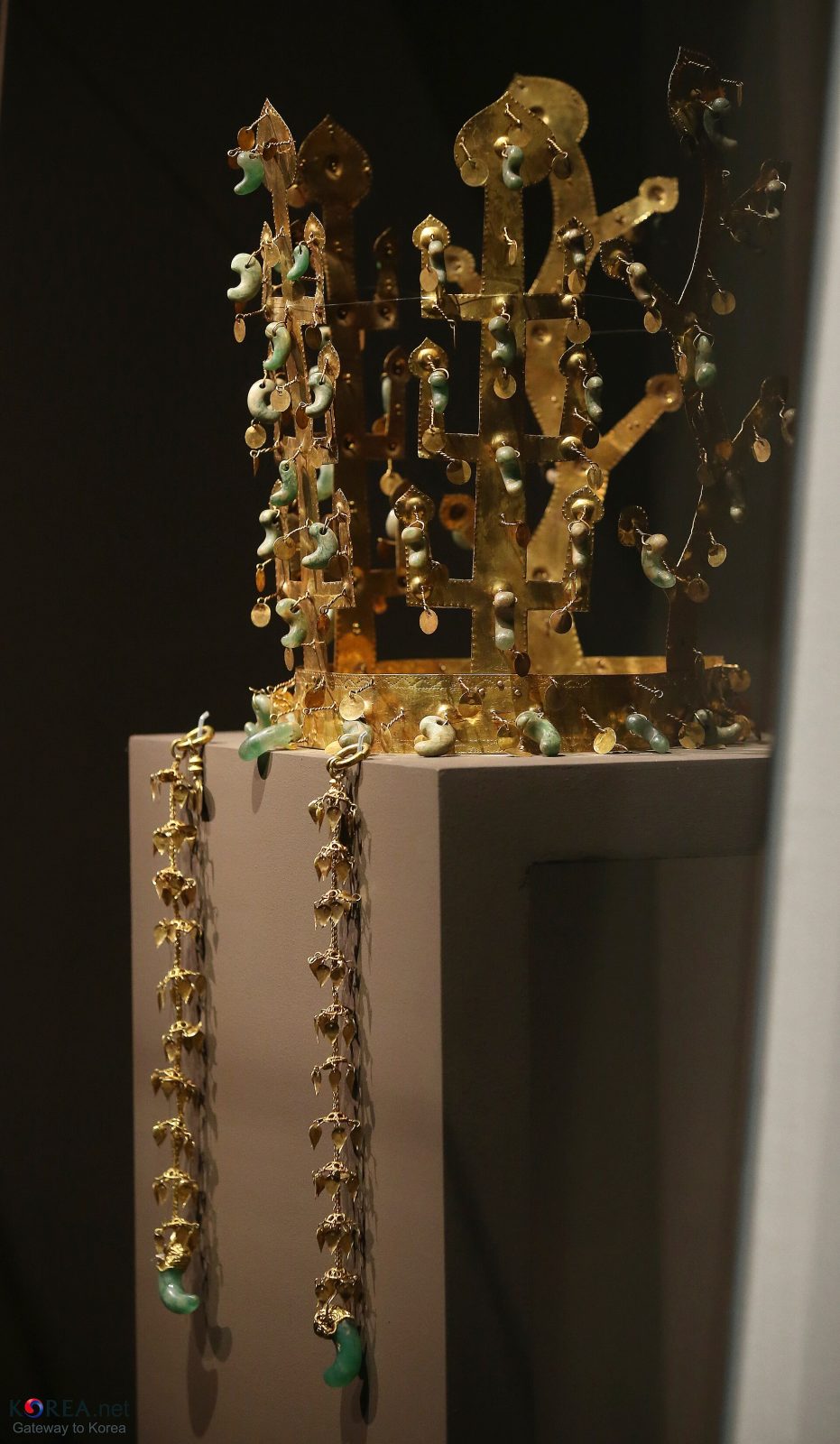
In September 1921 a tavern-keeper extending his house in Gyeongju, South Korea, dug into an ancient tomb. Inside was the first gold crown of the Silla kingdom ever found, with tree- and antler-shaped uprights hung with jade, and tens of thousands of beads.
In September 1921, Park Mun-hwan, who ran a tavern in Gyeongju, in the south-east of what is now South Korea, was extending his house into the yard behind it when gold objects began to turn up in the soil. According to one account, a police officer noticed children picking blue glass beads out of the spoil. The local police chief called in an agent of the Gyeongju antiquities society, and over three or four days, police and local teachers, without a trained archaeologist, cleared the burial they had found. It was a royal tomb of the Silla kingdom, and the most famous object in it gave the tomb its name: Geumgwanchong, the Gold Crown Tomb.
The crown is about 44 centimetres tall with its hanging chains, made of sheet gold. A headband supports three uprights shaped like stylised trees at the front and two shaped like antlers at the back, all hung with dozens of comma-shaped green jade beads, called gogok, and more than a hundred small gold spangles that would have shimmered as the wearer moved. Two long gold chains hang from the sides. The tree and antler shapes are thought to have had a spiritual meaning, linking the rulers of Silla with the shamanistic traditions of north-east Asia.
The tomb held more than 40,000 objects in all, among them tens of thousands of glass beads, a gold belt with dozens of pendants, gold rings and earrings, gilt-bronze armour and glass vessels that had travelled from the Roman world. In 1927 about ninety gold items from the tomb were stolen from the Gyeongju museum, though not the crown itself; they mysteriously reappeared the following year at the police chief's residence. In 2013 a sword scabbard from the tomb was read as naming a King Isaji, a ruler who appears in no surviving Silla record. The National Museum of Korea re-excavated the tomb in 2015 and dated it to the late 5th or early 6th century.
The crown was designated National Treasure No. 87 of South Korea in 1962. It is cared for by the Gyeongju National Museum, which in 2025 displayed all six known Silla gold crowns together for the first time.
Written for Global Finds from the Korea Heritage Service's listing of National Treasure No. 87, the Kyunghyang Shinmun (2021) and the Korea JoongAng Daily (2015). Photo: the gold crown from Geumgwanchong, Korea.net / Korean Culture and Information Service (Jeon Han), Wikimedia Commons, CC BY-SA 2.0.
Approximate location35.84, 129.21View on map
Source: Korea Heritage Service