The Tudor Heart: Henry VIII's gold pendant found by a detectorist six months into the hobby
Famous find Probably made about 1518 · Found in 2019 See it on the timeline →
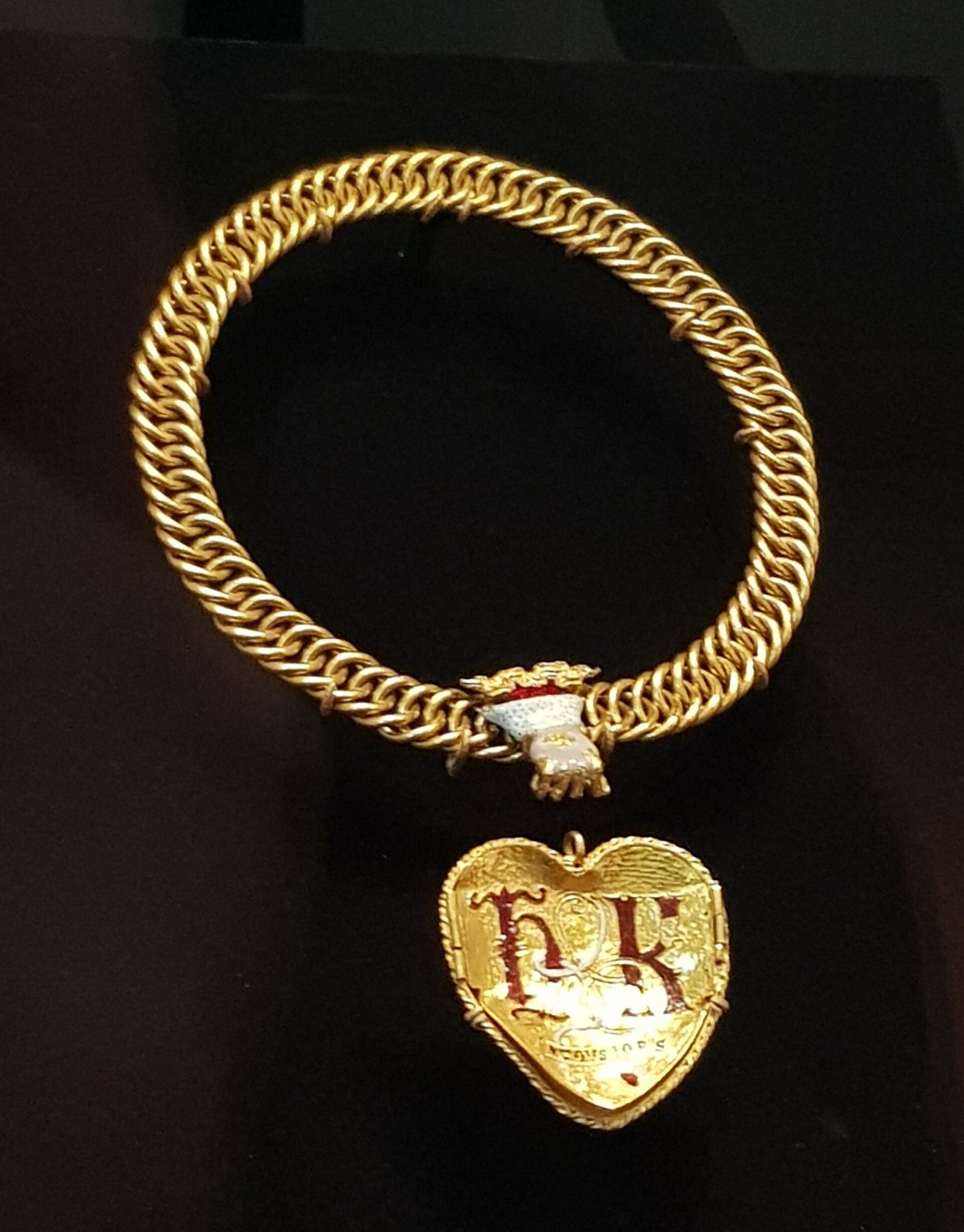
In December 2019 Charlie Clarke, who had been detecting for only six months, found a gold heart-shaped pendant in a Warwickshire field. It carries the initials of Henry VIII and Katherine of Aragon, and in 2026 the British Museum raised £3.5 million to buy it.
In December 2019, Charlie Clarke, a café owner from Birmingham, went out detecting with a friend in a ploughed field in Warwickshire. He had taken up the hobby only six months earlier. After hours of digging up scrap, he got a strong signal and kept digging in the rain until he was elbow-deep in the soil. At the bottom of the hole was a gold chain, and on it a gold heart. He reported it to his local Finds Liaison Officer, Teresa Gilmore.
The find has three parts: a hinged heart-shaped pendant about 5 centimetres across, a gold chain of 75 links, and a clasp in the form of a hand emerging from a cloud. Altogether it weighs about 300 grams of high-quality gold. One face of the heart shows a Tudor rose and a pomegranate bush, the emblem of Katherine of Aragon, growing from the same stem. The other shows the letters H and K tied together by a cord, with a banner reading TOVS IORS, an old French form of toujours, meaning always.
No document links the pendant to the royal couple directly, and its exact purpose is uncertain. The British Museum suggests that it may have been made for a tournament in October 1518 celebrating the betrothal of Henry and Katherine's daughter Mary to the French king's son, and worn as part of a costume rather than as a personal love token. Details of its black enamel suggest it was made before about 1526, before Henry turned against the marriage. How it came to be lost in a Warwickshire field is a mystery.
The pendant was declared Treasure and valued at £3.5 million. In October 2025 the British Museum launched an appeal to buy it, and in February 2026 announced that it had succeeded, helped by the National Heritage Memorial Fund, the Julia Rausing Trust, Art Fund, American Friends of the British Museum and more than 45,000 members of the public. The reward is shared between the finder and the landowner. The museum has said it plans to take the pendant on tour around the UK.
Written for Global Finds from the National Heritage Memorial Fund, the Museums Association, The Art Newspaper, NPR (2023) and Current Archaeology (via The Past). Photo: the Tudor heart pendant at the British Museum, Jononmac46, Wikimedia Commons, CC0.
Source: National Heritage Memorial Fund