The Dunstable Swan Jewel: a royal gold badge found in the rubble of a friary, and nearly lost to New York
Famous find Made about 1400 · Found in 1965 See it on the timeline →
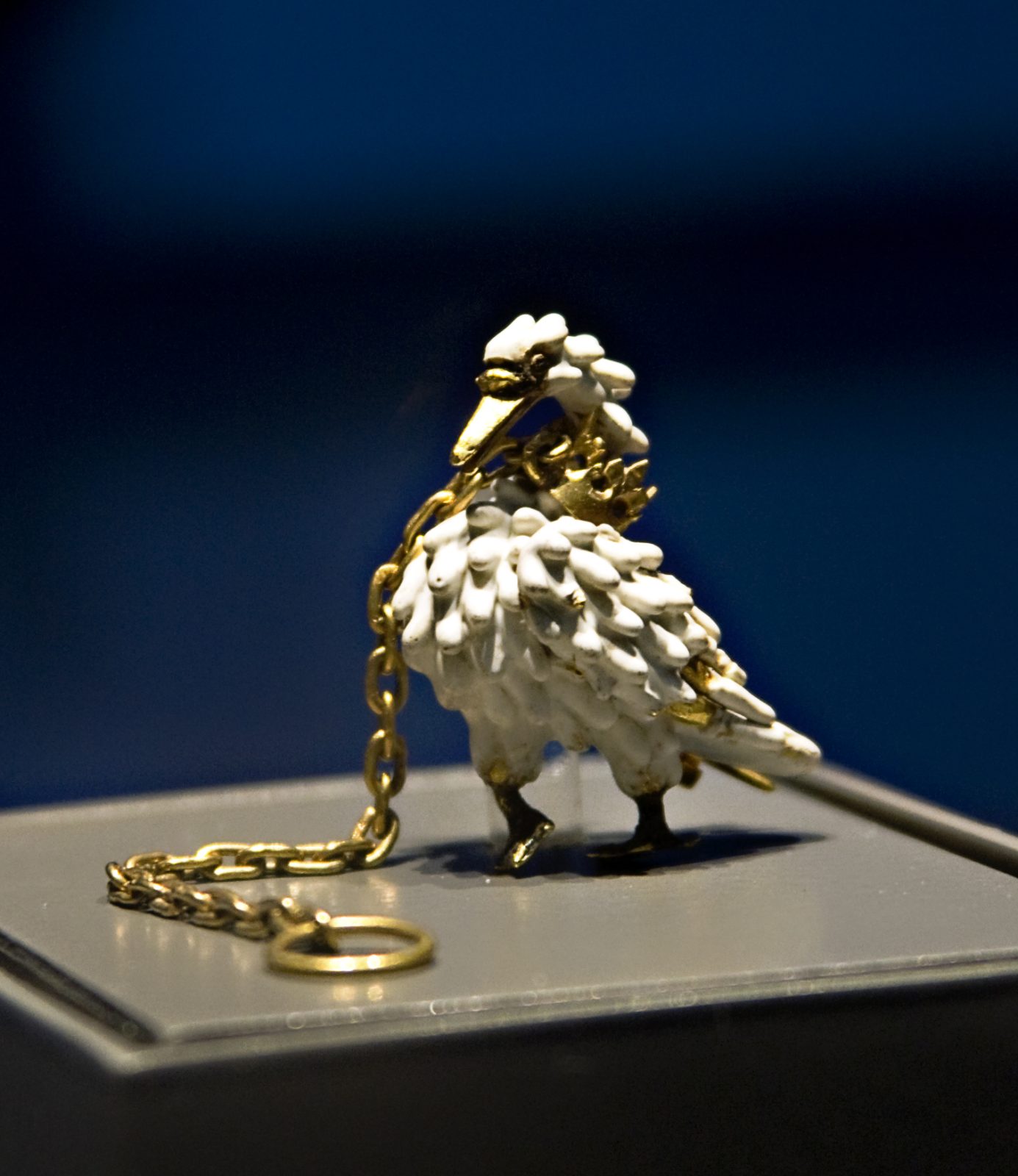
In 1965 volunteers excavating the site of Dunstable's medieval friary in Bedfordshire found a tiny gold swan covered in white enamel. It is a royal livery badge of about 1400, the only one of its kind to survive, and is now in the British Museum.
In 1965, members of the Manshead Archaeological Society, a local volunteer group, were excavating Friary Field in Dunstable, Bedfordshire, the site of a small Dominican friary founded in 1259 and closed by Henry VIII in the 1530s. In rubble left from the demolition of the friary buildings, they found a tiny gold bird, still bright white.
It is a swan, made of gold and almost entirely covered in opaque white enamel, a technique called émail en ronde bosse in which enamel is fused over a gold figure modelled in the round. The swan is 3.2 centimetres high. Its eyes are black enamel, and there are traces of black on its legs and feet. Around its neck is a gold crown with fleur-de-lys points, and from the crown runs a fine gold chain ending in a ring. A pin on the side shows it was worn as a brooch or hat badge.
It is a livery badge, worn to show loyalty to a great lord. The swan was the badge of the de Bohun family, and it passed to the House of Lancaster when Henry Bolingbroke, the future Henry IV, married Mary de Bohun in 1380; their son, later Henry V, used it as Prince of Wales. Most livery badges were made of cheap lead or copper alloy and handed out in hundreds, but a gold and enamel badge like this would have been given only to a favoured follower. Badges of this kind are known from royal inventories and from paintings such as the Wilton Diptych, but the Dunstable Swan is the only one known to survive. It was probably made around 1400, in England or in Paris.
In 1966 the jewel was sold at Sotheby's to the Metropolitan Museum of Art in New York for £4,800. An export licence was refused, and the British Museum bought it for £5,000, with help from the National Art Collections Fund, now Art Fund, and others. It is displayed in Room 40, the museum's medieval gallery.
Written for Global Finds from J. Stratford's Richard II's Treasure (Institute of Historical Research), Antiquity (1984), Art Fund and the Bedfordshire Virtual Library. Photo: the Dunstable Swan Jewel in the British Museum, Ealdgyth, Wikimedia Commons, CC BY-SA 3.0.
Approximate location51.88, -0.52View on map
Source: Institute of Historical Research (Richard II's Treasure)