The Dorestad Brooch: a Carolingian gold brooch found at the bottom of a well
Famous find Made about AD 800 · Found in 1969 See it on the timeline →
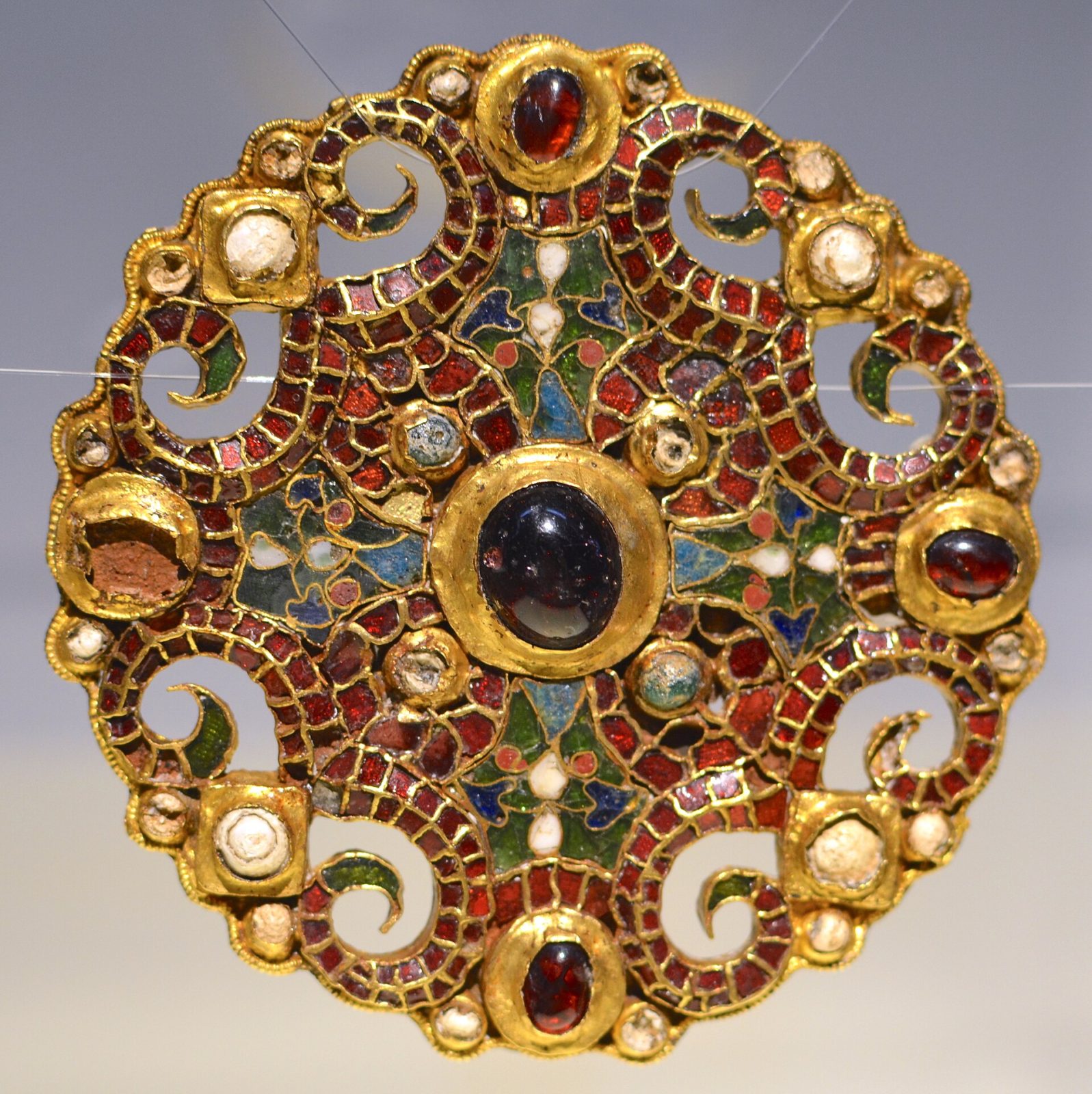
On 18 July 1969 archaeologists excavating the Viking-age trading town of Dorestad, at Wijk bij Duurstede in the Netherlands, found a gold brooch set with garnets and coloured glass at the bottom of a well. Made around 800, it is one of the finest jewels of its age.
In the 8th and 9th centuries, Dorestad, on the River Rhine in what is now the Netherlands, was one of the greatest trading towns of northern Europe, a port of the Frankish empire of Charlemagne. Its remains lie under the modern town of Wijk bij Duurstede, south-east of Utrecht. From 1967, the Dutch state archaeological service, led by W. A. van Es, carried out large excavations there, uncovering streets, houses, jetties and wells. On 18 July 1969, at the bottom of one of those wells, the excavators found a gold brooch.
It is a disc brooch, 8.5 centimetres across, made in the cloisonné technique, with small gold cells filled with coloured glass and enamel in red, white, green and blue. At the centre is a large red garnet, an almandine, with four smaller ones around it. The design shows a stylised tree bearing fruit, and two overlapping crosses, a Christian symbol. Around the edge are pearls and small bird heads in openwork gold. Some of the stones are now missing, and so is the pin.
The brooch was made around 800, probably in a workshop in what is now Switzerland or Burgundy, and is one of the finest pieces of Carolingian jewellery ever found. It may have belonged to a woman of high rank, or to the treasury of a church. It went into the well around 850, when Dorestad was in decline and repeatedly raided by Vikings, and it may have been hidden there during one of those raids, by someone who never came back to retrieve it.
The Dorestad Brooch is in the Rijksmuseum van Oudheden, the national museum of antiquities in Leiden, where it is one of the highlights of the collection. In May 2025 it appeared on a Dutch postage stamp.
Written for Global Finds from the Rijksmuseum van Oudheden, C. Bastinck (2002) and the Netherlands government's guidance on archaeological finds. Photo: the Dorestad Brooch in the Rijksmuseum van Oudheden, AlexanderVanLoon, Wikimedia Commons, CC BY-SA 4.0.
Approximate location51.98, 5.35View on map
Source: Rijksmuseum van Oudheden