Soldiers sweeping a Korean mountain for landmines found the country's oldest gun, a 600-year-old bronze "fire tube"
Made in 1377 or 1437 · Found in 2023 See it on the timeline →
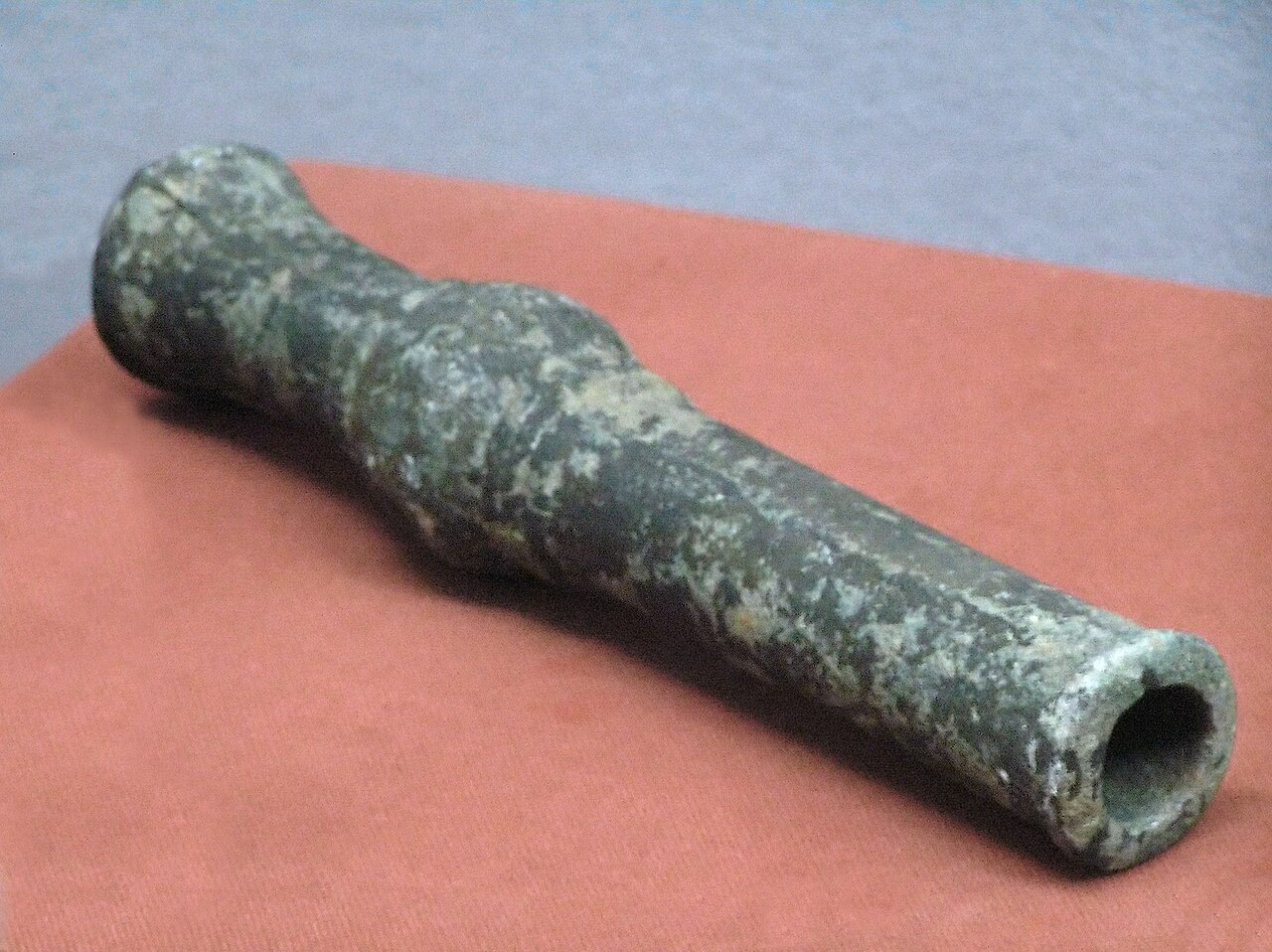
In November 2023 soldiers checking Geumseongsan mountain in Naju, South Korea, for landmines before a hiking trail was built found a small bronze tube 10 centimetres down. Three years of study have now confirmed it as Korea's oldest surviving gunpowder weapon, made in 1377 or 1437.
In November 2023, soldiers were sweeping part of Geumseongsan, a mountain in Naju in the south-west of South Korea, for landmines before a hiking trail was built. Their detectors picked up metal about ten centimetres below the surface. It was not a mine but a small bronze tube, and it has now been confirmed as the oldest surviving gunpowder weapon ever found in Korea.
The weapon is a hwatong, or "fire tube": a hand-held gun that fired arrows or shot and reached further, and hit harder, than a bow. It is 23.75 centimetres long, with a bore of 1.66 centimetres, and it weighs 1,032 grams. Twenty-eight characters are inscribed on it, twenty-seven of them in six columns on the socket at the back. They record that the Hwangja Hwatong was made in the twelfth month of a Jeongsa year, give its weight, and name the official who supervised the work, Noksa An Hyu-bo, and the artisan who cast it, Seok. "Hwangja" is a class name taken from the order of characters in the Thousand Character Classic.
Korean years ran in cycles of sixty, so a Jeongsa year can be either 1377 or 1437. The first falls in the reign of King U of Goryeo, the year a Directorate of Gunpowder Weapons was set up; the second in the reign of King Sejong of Joseon, when Korean firearms were redesigned. The round interior of its powder chamber is of the older kind, and analysis of the bronze, with its copper, tin and lead and traces of silver and sulphur, fits traditional casting methods rather than a modern copy.
The Naju National Research Institute of Cultural Heritage spent three years studying the gun before announcing it in September 2026. Weapons from this period very rarely survive, and this one has a known findspot and names its maker. The mountain overlooks the Yeongsan River, which Japanese pirates once sailed up to raid, and researchers suggest it may have been used by defenders there.
The Hwangja Hwatong is on display at the National Palace Museum of Korea in Seoul until 22 November 2026.
Reported by The Korea Times (21 September 2026), Archaeology News (October 2026) and Smithsonian Magazine. Written for Global Finds from those reports. Photo: a Chinese bronze hand gun of the Yuan dynasty (1271-1368) in the Shaanxi History Museum, the same family of weapon (not the Naju find), Ytrottier, Wikimedia Commons, CC BY-SA 3.0.
Source: The Korean Times