The Golden Man of Issyk: a Saka warrior dressed in 4,000 gold ornaments, now Kazakhstan's emblem
Famous find 4th to 3rd century BC · Found in 1969 See it on the timeline →
In 1969 a burial mound near Issyk, east of Almaty in Kazakhstan, gave up a Saka warrior dressed in more than 4,000 gold ornaments, with a tall gold-covered headdress and a silver bowl bearing writing no one can read. The Golden Man is now a national symbol.
In 1969, near the small town of Issyk, now Esik, about 50 kilometres east of Almaty in south-eastern Kazakhstan, a gold plaque came to light in a cemetery of some 45 great burial mounds. Accounts differ on how: one says a farmer turned it up while ploughing, another that it was found during building and road works. The archaeologist Kemal Akishev and his team excavated the mound in 1969 and 1970. It was about six metres high and sixty metres across. The central burial had been robbed long ago, but a side chamber, built of logs, was untouched.
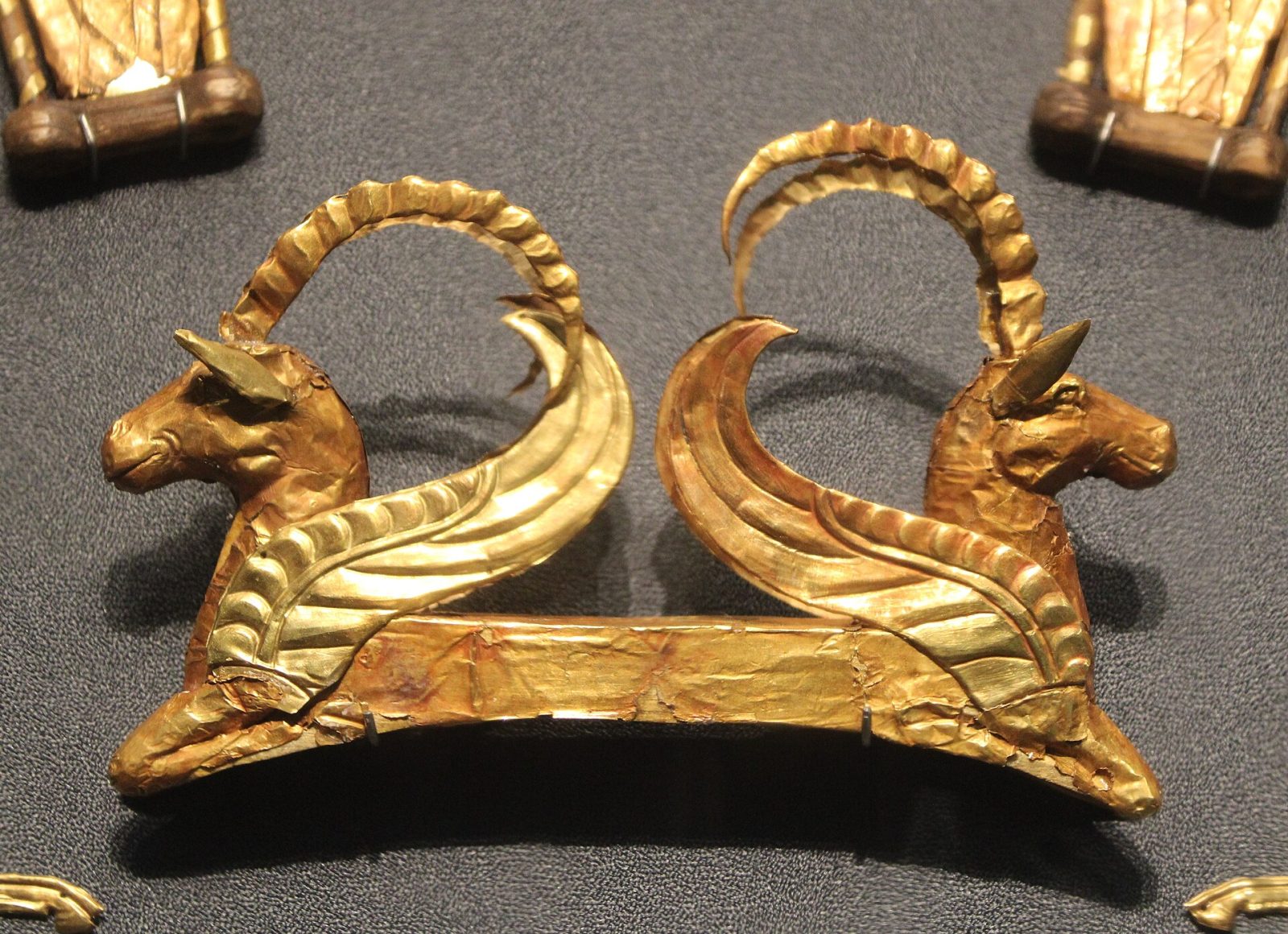
Inside lay a young person dressed in clothes covered with more than 4,000 gold ornaments: plaques shaped like tigers and arrowheads sewn onto a jacket, a belt of gold plaques, and a tall pointed headdress decorated with gold figures of horses and winged ibexes. With the burial were an iron sword and dagger, a bronze mirror, pottery, and a small silver bowl inscribed with about 25 signs. The inscription is the oldest writing ever found in Kazakhstan, and it has never been deciphered; scholars have proposed readings in early Iranian and in Turkic languages.
The burial belongs to the Saka, the nomadic horse-riding peoples of the Central Asian steppe related to the Scythians, and dates from the 4th or 3rd century BC. Akishev recorded the skeleton as a young man aged about 16 to 20, and the find became known as the Golden Man. But the bones were crushed and fragmentary, and in the 1990s the American archaeologist Jeannine Davis-Kimball argued that the earrings, beads, mirror and headdress could point to a woman. The question has never been settled.
After independence the Golden Man became a symbol of Kazakhstan. A figure of him riding a winged snow leopard stands on top of the Independence Monument in Almaty. The original gold belongs to the National Museum of the Republic of Kazakhstan in Astana, where it is shown in the Gold Halls beside a reconstruction of the full costume. In 2024 and 2025 pieces of the headdress were lent to the Musée Guimet in Paris.
Written for Global Finds from Archaeology magazine (1997), the Musée Guimet (2024), E-history.kz and The Astana Times (2026). Photo: winged ibexes from the Golden Man's headdress, National Museum of the Republic of Kazakhstan, shown at the Musée Guimet, Zunkir, Wikimedia Commons, CC BY-SA 4.0.
Approximate location43.35, 77.47View on map
Source: Archaeology magazine