The Chalgrove Hoard: a corroded lump of coins that proved a lost Roman emperor was real
Famous find Buried about AD 280 · Found in 2003 See it on the timeline →
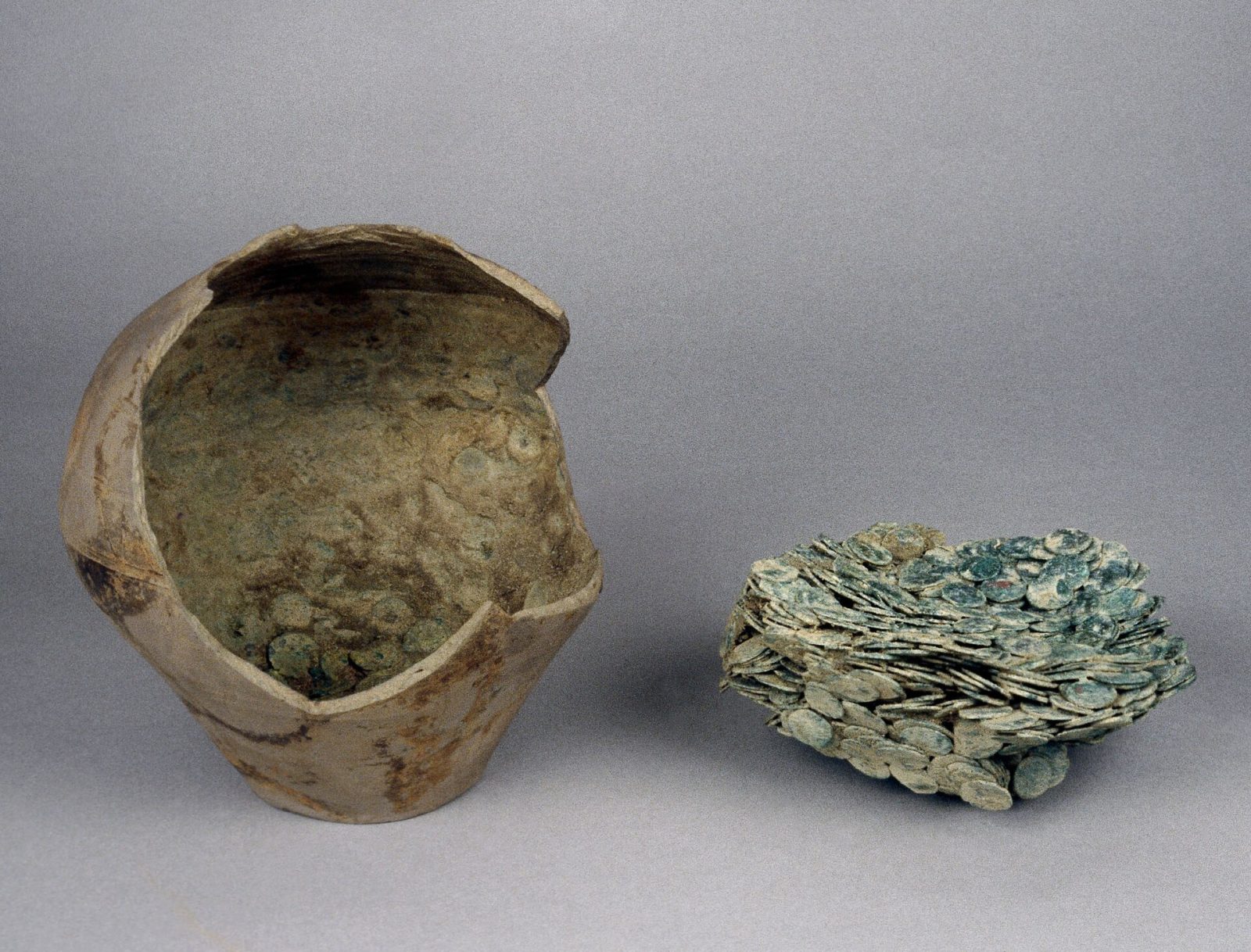
In April 2003 detectorist Brian Malin found a pot of almost 5,000 Roman coins near Chalgrove in Oxfordshire, a hundred feet from a hoard he had found in 1989. Inside was a coin of Domitian II, an emperor many historians had thought was a forgery.
In April 2003, Brian Malin, a metal detectorist, was searching farmland near the village of Chalgrove, about ten miles south-east of Oxford, when he found a grey pottery jar packed with Roman coins. It was not his first hoard there. In 1989 he had found another jar of Roman coins of a similar size about a hundred feet away. The new find became known as Chalgrove II.
The jar, made locally on a potter's wheel, held 4,957 coins, corroded together into a solid mass. They were all radiates, coins named after the spiked crown the emperor wears on them. They had begun as silver coins but by then contained only about one per cent silver. They were struck between AD 251 and 279, a time of crisis when the western provinces, Britain among them, broke away to form a separate Gallic Empire. Most of the coins are of its rulers, Tetricus I, Victorinus, Tetricus II and Postumus. More than 360 are ancient forgeries.
Conservators at the British Museum separated the coins by hand, one by one. Among them Richard Abdy of the museum spotted one that read IMP C DOMITIANVS P F AVG. Only one coin of this Domitian had ever been found before, in France in 1900, and many historians had dismissed it as a fake. The Chalgrove coin was struck from the same dies. It proved that Domitian II was real: a usurper who seized power in Gaul around AD 271, issued coins, and seems to have ruled for only a few days or weeks before he vanished from history.
The hoard was shown in the British Museum's Buried Treasure exhibition and was bought by the Ashmolean Museum in Oxford in 2004 for £40,000, with a grant of £20,000 from Art Fund. It is now in the Ashmolean's coin collection.
Written for Global Finds from the Ashmolean Museum, Art Fund, R. Abdy in Antiquity (2009) and Archaeology magazine (2005). Photo: the Chalgrove II hoard, with its jar and the fused mass of coins, Portable Antiquities Scheme, Wikimedia Commons, CC BY 2.0.
Approximate location51.67, -1.08View on map
Source: Ashmolean Museum