The Tovsta Mohyla Pectoral: Scythian royal gold that ancient tomb robbers walked straight past
Famous find Made about 360 to 340 BC · Found in 1971 See it on the timeline →
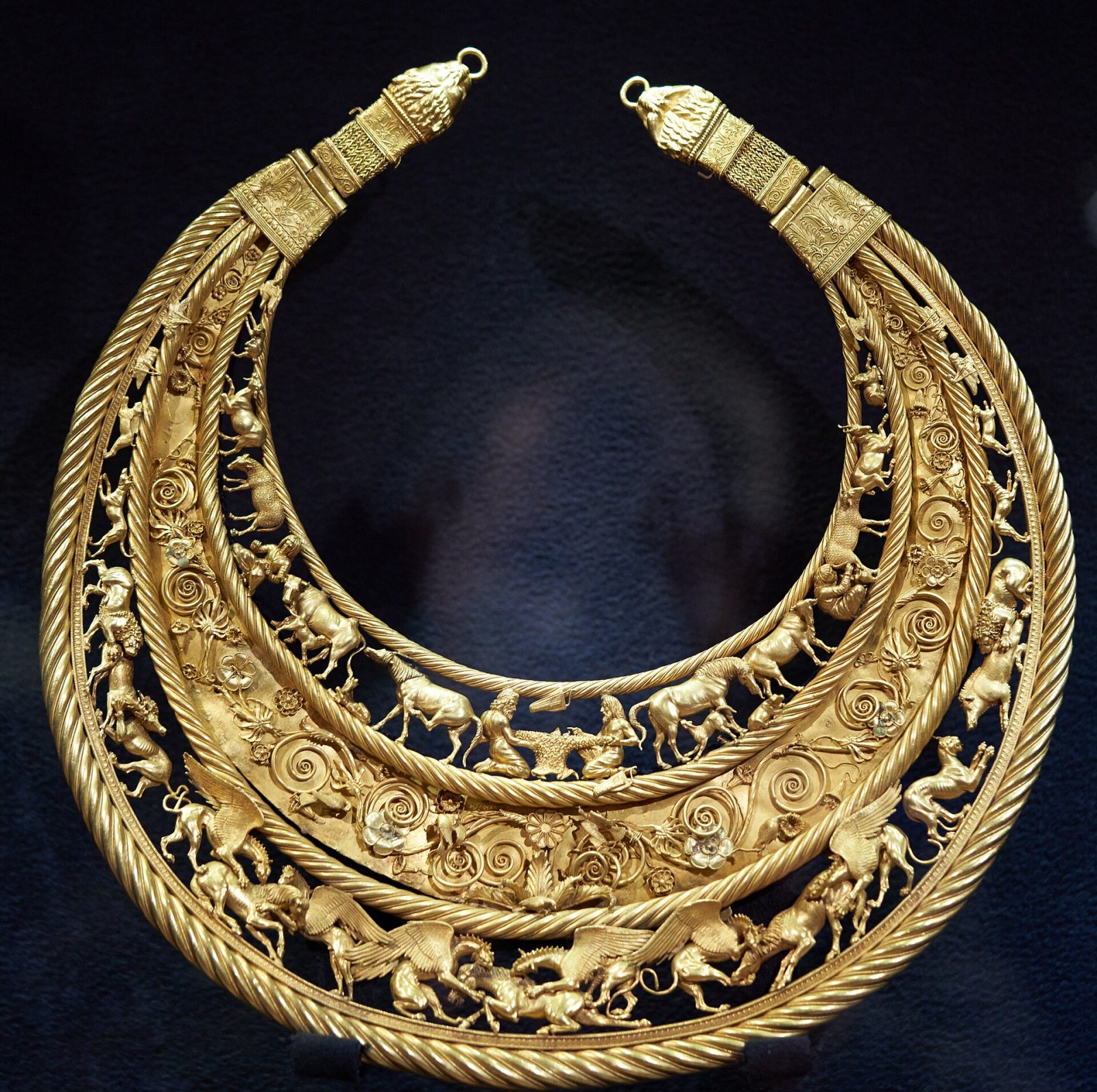
On 21 June 1971 the Ukrainian archaeologist Borys Mozolevsky, digging a Scythian burial mound ahead of a quarry, found a gold pectoral lying in the tomb's entrance passage, missed by ancient robbers. Weighing about 1.15 kilograms, it is one of the masterpieces of ancient goldwork.
In 1971 the archaeologist Borys Mozolevsky was carrying out a rescue excavation of a great Scythian burial mound, Tovsta Mohyla, the thick mound, near the town of Pokrov in the Dnipropetrovsk region of southern Ukraine. A mining quarry was expanding towards it, and the plant's director lent machinery for the dig. The central royal tomb had been robbed in antiquity. But at about half past two on the afternoon of 21 June 1971, in the passage leading into the tomb, Mozolevsky's team found a group of objects the robbers had missed: a sword in a scabbard covered in gold, a whip, and a great gold pectoral, a crescent-shaped ornament worn on the chest.
The pectoral is about 30 centimetres across and weighs about 1.15 kilograms, made of gold of very high purity. It is built from more than 160 separate parts, arranged in three curved tiers divided by twisted gold cords. In the top tier, scenes of Scythian life: two men sewing a fleece shirt, and animals suckling their young. The middle tier is filled with flowering tendrils and birds. In the bottom tier, griffins attack horses. Every tiny figure is modelled in detail. It was probably made by Greek goldsmiths for a Scythian king, around 360 to 340 BC.
A separate, untouched side burial held a woman and a child with their own gold ornaments, and six horses were buried nearby. In all the mound produced more than 600 gold objects. Mozolevsky, who was also a published poet, recorded in his diary the joy of the moment the pectoral came out of the ground.
The pectoral became one of Ukraine's best-known treasures, and the centrepiece of the Museum of Historical Treasures in Kyiv, now part of the National Museum of the History of Ukraine. During the war it has been kept in secure storage in Kyiv, and copies have been shown in its place.
Written for Global Finds from the National Museum of the History of Ukraine (via museum-digital), Focus.ua (2026), Radio Svoboda (2021), the Encyclopedia of Ukraine and Al Jazeera (2022). Photo: the Tovsta Mohyla pectoral, photographed in Kyiv in 2021, Sergio367, Wikimedia Commons, CC BY-SA 4.0.
Approximate location47.67, 34.13View on map
Source: National Museum of the History of Ukraine (museum-digital)