The Caesarea Gold Hoard: divers found gold coins on the seabed and swam straight to the authorities
Famous find Lost in the 11th century AD · Found in 2015 See it on the timeline →
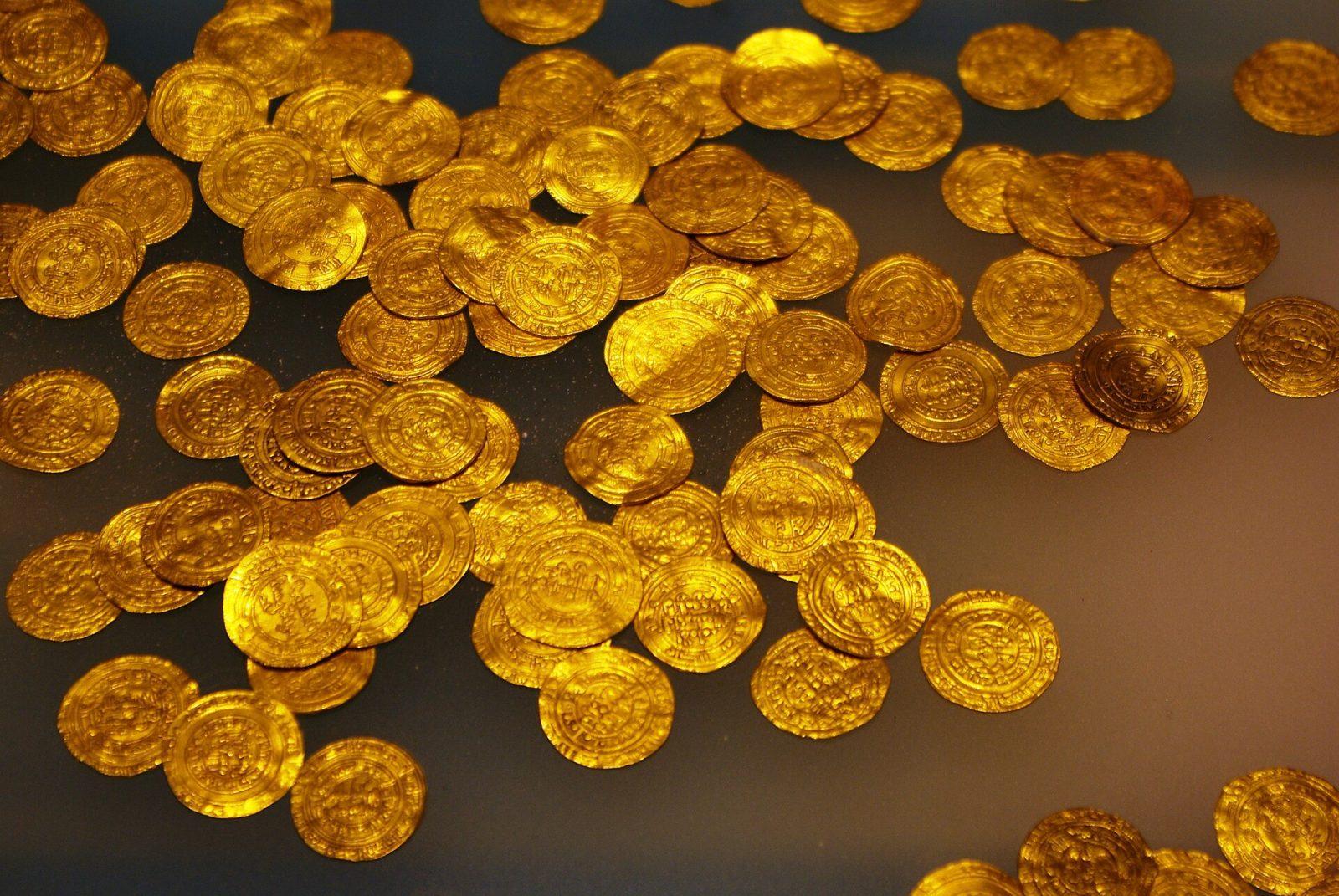
In February 2015 amateur divers exploring the ancient harbour of Caesarea in Israel saw gold coins glinting on the seabed. Marine archaeologists recovered more than 2,500 Fatimid gold dinars, the largest gold hoard ever found in Israel.
In February 2015, a group of divers from the local diving club were exploring the seabed of the ancient harbour at Caesarea, on the Mediterranean coast of Israel, when they saw something shining in the sand. Winter storms had stirred up the seabed and uncovered gold coins. They gathered a few, surfaced, and reported the find to the Israel Antiquities Authority.
The authority's Marine Archaeology Unit went to the site with the divers and used metal detectors to search the seabed. Over the following weeks they recovered more than 2,500 gold coins, weighing about 7.5 kilograms. It was the largest hoard of gold coins ever found in Israel, five times larger than the previous record. Some of the coins needed no cleaning at all: gold does not corrode, and after nearly a thousand years in the sea they came out of the sand bright. A few were bent or carried tooth marks, where someone had tested whether they were real gold.
The coins are dinars and quarter-dinars of the Fatimid caliphate, which ruled Egypt and much of North Africa and the eastern Mediterranean from Cairo. Most were struck under the caliph al-Hakim, who reigned from 996 to 1021, and his son al-Zahir, who reigned from 1021 to 1036. The oldest is a quarter-dinar struck in Palermo, Sicily, in the second half of the 9th century. The coins must have been lost in the 11th century, when Caesarea was a Fatimid town.
Nobody knows how they came to be on the seabed. Archaeologists suggested that they may have been tax money being shipped to Cairo in a vessel that sank in the harbour, wages for the soldiers of the Fatimid garrison, or the cash of a merchant ship. The Israel Antiquities Authority praised the divers as model citizens. The hoard went on show at the Israel Museum in Jerusalem in 2015, in an exhibition called Sea of Gold.
Written for Global Finds from National Geographic (2015), the Israel Museum's exhibition text (via The E-Sylum) and CoinsWeekly. Photo: coins from the Caesarea hoard on display at Caesarea in 2015, Olevy, Wikimedia Commons, CC BY-SA 4.0.
Approximate location32.50, 34.89View on map
Source: National Geographic