The Sword of Goujian: a king's bronze sword, still sharp after 2,400 years in a sealed scabbard
Famous find Made for King Goujian, who reigned 496 to 465 BC · Found in 1965 See it on the timeline →
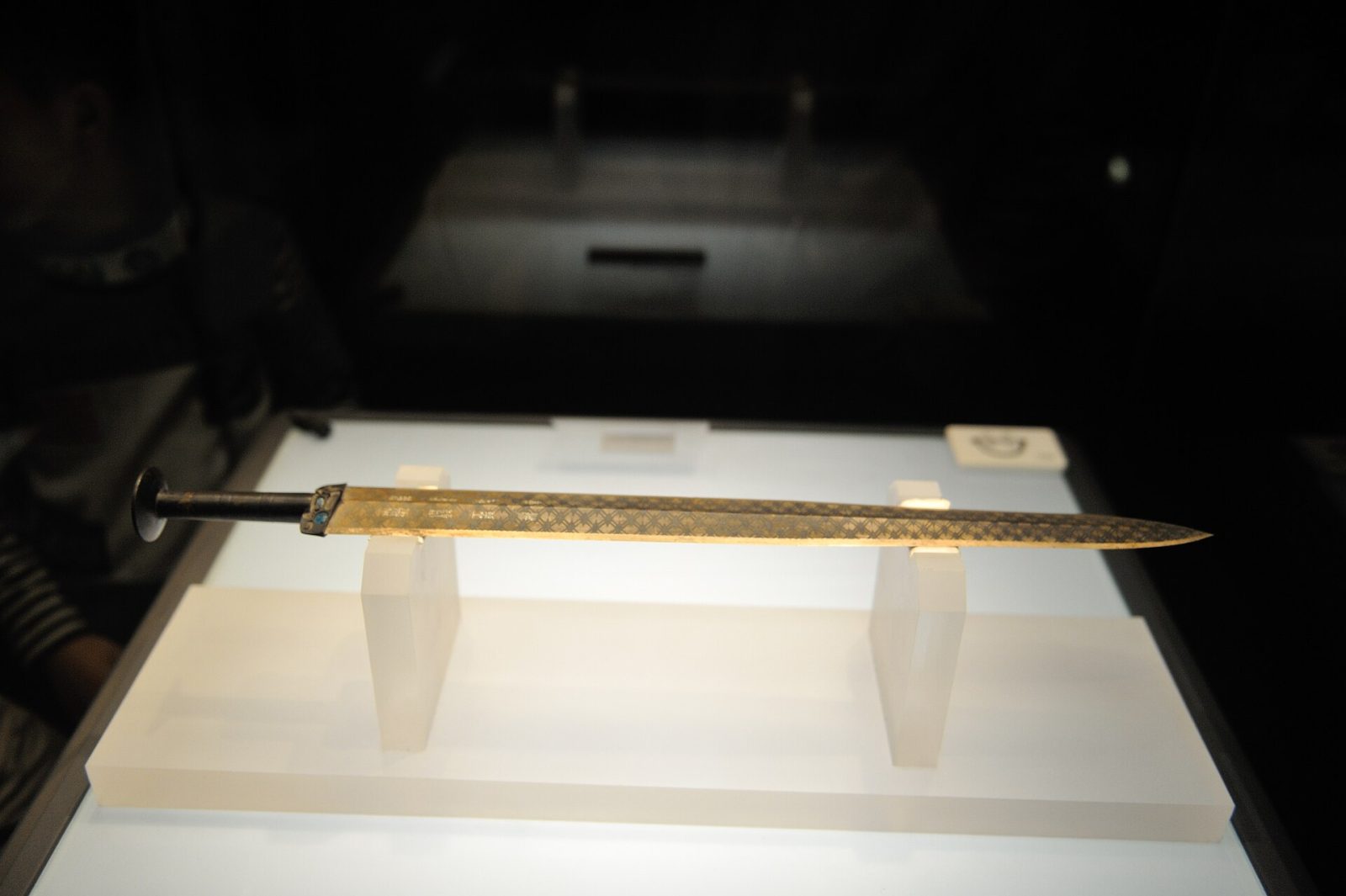
In December 1965 archaeologists excavating ancient tombs in Hubei, China, ahead of a canal scheme drew a bronze sword from its scabbard and found it bright and sharp. Its inscription names Goujian, a king of Yue who reigned from 496 to 465 BC.
Between October 1965 and January 1966, archaeologists from Hubei province, in central China, excavated more than fifty tombs at Wangshan, near Jiangling, ahead of a canal for a new reservoir. The area had been the heartland of the ancient state of Chu. In December 1965, in Tomb No. 1, the archaeologist Chen Zhenyu cleared the coffin and found a sword in a lacquered wooden scabbard that fitted it almost airtight. When he drew it out, the blade was bright and its edge still sharp.
The sword is bronze, about 56 centimetres long. The blade is covered in a black diamond-shaped pattern, the guard is inlaid with blue glass on one side and turquoise on the other, and the pommel is decorated with eleven fine concentric rings. Analysis has shown the blade to be bronze with a high proportion of tin, which made it hard, with sulphur in the patterned surface. Near the hilt is an inscription of eight characters in an elaborate bird script. Scholars read it as King Jiuqian of Yue made this sword for his own use, and identified Jiuqian as Goujian, king of Yue from 496 to 465 BC.
Goujian is one of the most famous kings in Chinese history. Defeated and humiliated by the neighbouring state of Wu, he is said to have slept on brushwood and tasted bitter gall every day to keep his anger alive, until he destroyed Wu in 473 BC. How his sword came to be buried in a later tomb of the Chu state is unknown; it may have been a gift, a dowry or a war trophy.
Claims that the sword has never rusted, or that it sliced through twenty sheets of paper, should be treated with caution; it is very well preserved, not untouched by time. In 1994, at the end of an exhibition in Singapore, it was knocked as it was taken from its case and suffered a small crack, and it has not left China since. It is the star of the Hubei Provincial Museum in Wuhan.
Written for Global Finds from the Hubei Provincial Museum, the National Office for Philosophy and Social Sciences (2016) and China News Service (2026). Photo: the Sword of Goujian in the Hubei Provincial Museum, Siyuwj, Wikimedia Commons, CC BY-SA 4.0.
Approximate location30.41, 112.19View on map
Source: Hubei Provincial Museum