The Lochar Moss Collar: a beaded torc taken apart and packed in a bowl, found by peat-cutters near Dumfries
Famous find Made in the 1st or 2nd century AD See it on the timeline →
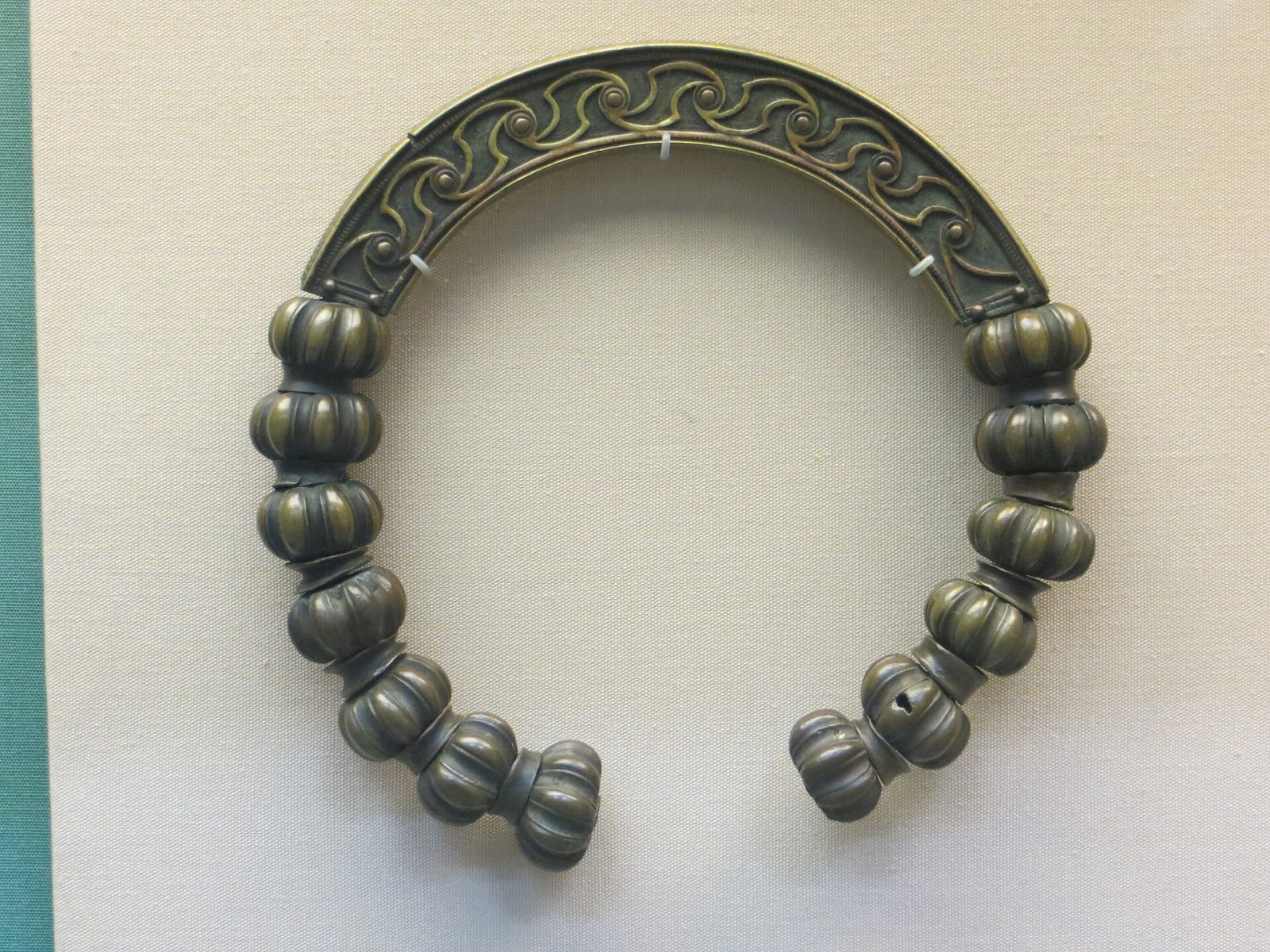
In the 1840s peat-cutters on Lochar Moss, near Dumfries in south-west Scotland, dug up a small bronze bowl. Packed inside it, dismantled, was a beaded collar made in the 1st or 2nd century AD, when Roman armies were pushing into Scotland.
Some time in the 1840s, peat-cutters working on Lochar Moss, a great raised bog stretching from Dumfries towards the Solway Firth in south-west Scotland, dug up a small bronze bowl. Packed inside it, taken apart, was a collar. The finder's name was not recorded, but the discovery was published by Daniel Wilson in 1851 and by Albert Way in 1852, and in 1853 a local collector, Thomas Gray, gave the collar and the bowl to the British Museum.
The collar is about 16 centimetres across and was made in two parts. The front is a crescent-shaped plate engraved with flowing scrolls in the La Tène style of Celtic art. The back is a string of hollow beads shaped like melons, alternating with smaller spacer beads. Thirteen beads survive and one is missing. The metal has been described as brass, an alloy of copper and zinc that reached Britain with the Romans.
Beaded torcs like this are a north British type, made in the 1st and 2nd centuries AD, when Roman armies were pushing into what is now Scotland. They combine the old art of the Iron Age with new Roman materials. The way the collar was dismantled and packed into the bowl, which may itself have been buried in a bag, suggests that it was placed in the bog deliberately, perhaps as an offering, a practice known across Iron Age Britain. A bog is not a place where things are easily retrieved, and whoever left it there probably never meant to.
The collar and the bowl are in the British Museum in London, where the collar has been on display.
Written for Global Finds from the British Museum, World History Encyclopedia, the Society of Antiquaries of London, Amgueddfa Cymru – Museum Wales and Treasure Trove Scotland. Photo: the Lochar Moss collar in the British Museum, Jononmac46, Wikimedia Commons, CC BY-SA 3.0.
Approximate location55.03, -3.52View on map
Source: World History Encyclopedia