The Beta Samati Ring: a bull-carved ring from a lost Aksumite town and one of Africa's oldest churches
Famous find Late Aksumite, about AD 540 to 645 (tentative) See it on the timeline →
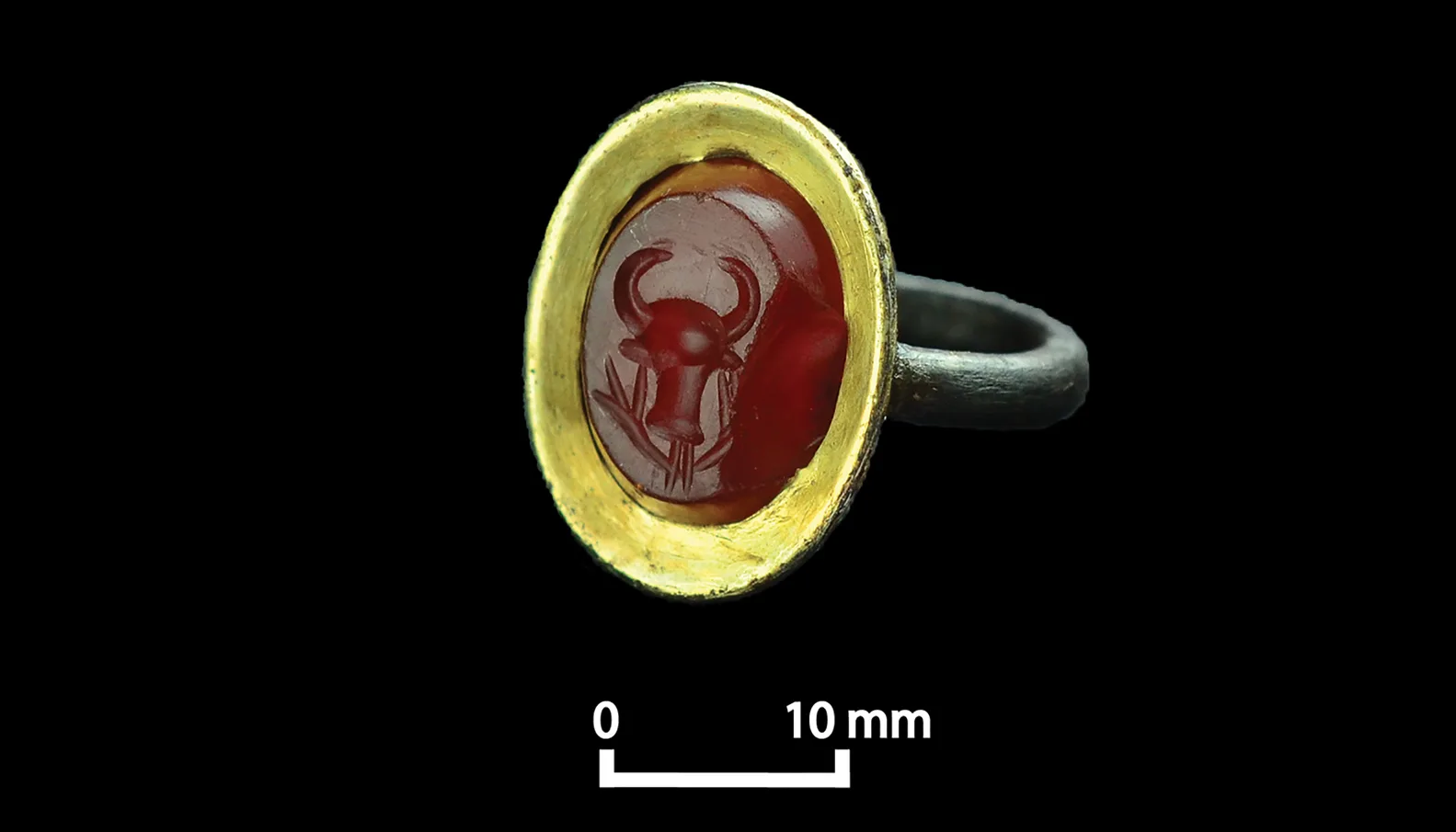
Excavating a hill in northern Ethiopia that local villagers pointed out to them, archaeologists found a lost town of the kingdom of Aksum, a 4th-century church, and buried beneath its floor, a ring set with a carnelian carved with a bull's head.
In 2009, archaeologists of the Southern Red Sea Archaeological Histories project, led by Michael Harrower of Johns Hopkins University, were surveying the Tigray region of northern Ethiopia when people from the village of Edaga Rabu showed them a large hill. Its local name, Beta Samati, means house of audience. Excavations between 2011 and 2016, carried out with Ethiopia's heritage authority, revealed that the hill was a lost town, occupied for about 1,400 years, from around 750 BC to the 7th century AD, through the rise and fall of the kingdom of Aksum.
Among its buildings was a basilica, a church built to the Roman plan, dating from the 4th century AD, the century in which Aksum's kings adopted Christianity. It may be one of the earliest churches in sub-Saharan Africa. Hidden 9 centimetres below its stone-paved floor, in a gap beside one of the walls, the team found a ring.
It is made of copper alloy, with a band of electrum, a natural alloy of gold and silver, and a bezel covered in gold foil. Set into it is a carnelian, a red stone, engraved with a bull's head above a vine or wreath. The ring looks Roman in the way it is made, but its imagery is not typical of Roman work, and where it was made is still unresolved. The bull was a powerful symbol in the old religion of the region, so a pagan emblem lay beneath a Christian church. The ring is thought to date from the late Aksumite period, perhaps the 6th or 7th century AD.
Other finds from Beta Samati show the town's place in a wide trading world: coins of the Aksumite kings from the pre-Christian Ezana to the later Armah, a stone pendant with a cross and the Ge'ez word for venerable, and pieces of wine jars from Aqaba on the Red Sea. The discoveries were published in the journal Antiquity in December 2019.
Written for Global Finds from M. J. Harrower and others in Antiquity (2019), Archaeology magazine (2019) and Live Science (2019). Photo: the Beta Samati ring, Ioana A. Dumitru, from the Antiquity article, Wikimedia Commons, CC BY 4.0.
Approximate location14.34, 39.04View on map