The Terracotta Army: farmers digging a well found China's first emperor's buried army, and its bronze weapons
Famous find Made about 246 to 210 BC (Qin dynasty) · Found in 1974 See it on the timeline →
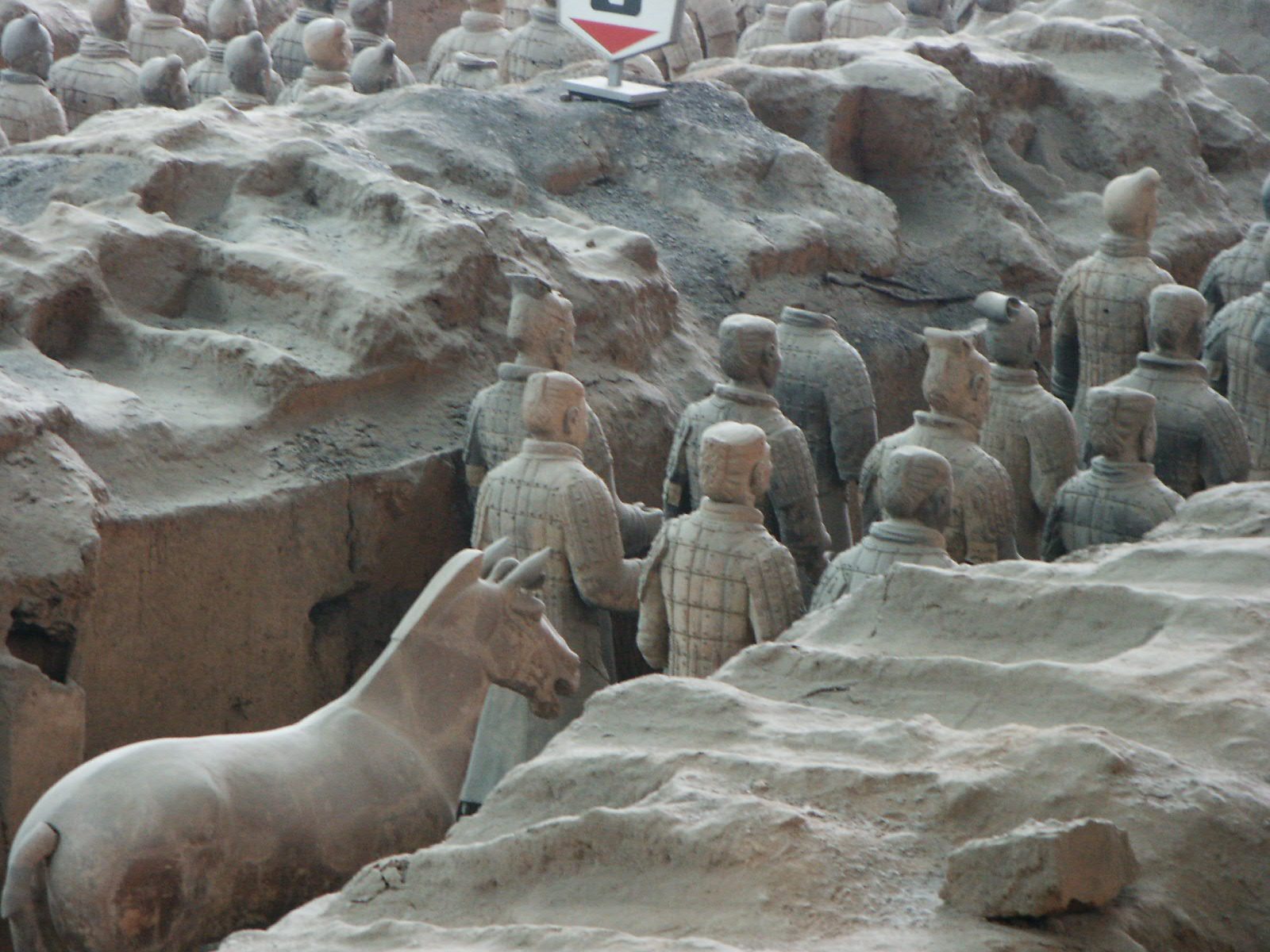
In March 1974 farmers digging a well during a drought near Xi'an in China brought up pieces of a clay figure and a bronze arrowhead. They had found the buried army of Qin Shi Huang, China's first emperor: thousands of life-size soldiers, with real bronze weapons still sharp.
In March 1974, during a drought, a group of farmers from a village near Lintong, east of Xi'an in Shaanxi province, China, were digging a well. Among them was Yang Zhifa. Several metres down they brought up fragments of a clay figure and a bronze arrowhead. Villagers had turned up broken pottery in the fields for generations, but this time the archaeologist Zhao Kangmin recognised the pieces as belonging to the Qin dynasty and began to put the first warriors back together.
The well had broken into a pit of the mausoleum of Qin Shi Huang, the king who unified China in 221 BC and made himself its first emperor. Work on his tomb began when he came to the throne in 246 BC and continued until his death in 210 BC. About a mile from his burial mound, three great pits held an army in clay: life-size soldiers, archers, officers, horses and chariots, each figure individually modelled. More than 2,000 have been excavated so far, and several thousand more are thought to remain buried. Pit 1 alone covers more than 14,000 square metres.
For a metal-detecting site, the army's weapons are just as remarkable. The soldiers carried real bronze weapons. The partial excavation of Pit 1 has produced spears, lances and swords, more than 260 crossbow triggers, and around 40,000 bronze arrowheads, usually in bundles of a hundred, a quiver each. The wooden shafts have rotted, but many blades are still bright and sharp. For decades it was claimed that the Qin had invented a chromium coating to stop rust. In 2019 a study showed that the chromium came from the lacquer on nearby wooden fittings, and that the weapons survived so well because of the fine, mildly alkaline soil and the composition of the bronze.
A museum was built over Pit 1 and opened in 1979, and the site became a UNESCO World Heritage Site in 1987. Excavation continues: in 2025 archaeologists found two chariots buried without their wheels in Pit 2. The pits are open to visitors at the Emperor Qinshihuang's Mausoleum Site Museum.
Written for Global Finds from M. Martinón-Torres and others in Scientific Reports (2019), NPR (2018), the Shaanxi Provincial Government (2023 and 2026) and Swissinfo (2013). Photo: warriors in Pit 1 of the Terracotta Army, Gary Todd, Wikimedia Commons, CC0.
Approximate location34.39, 109.27View on map
Source: Scientific Reports (Martinón-Torres and others, 2019)