The Tomb of the Marquis of Haihun: a deposed Han emperor's gold and ten tonnes of coins, saved from tomb robbers
Famous find Buried in 59 BC · Found in 2011 See it on the timeline →
In 2011 villagers near Nanchang in China reported that robbers had tunnelled into an ancient tomb. It belonged to Liu He, emperor for just 27 days in 74 BC, and held 478 gold objects, over ten tonnes of bronze coins and a lost version of the Analects of Confucius.
In March 2011, villagers near Guanxi, in Xinjian district on the outskirts of Nanchang in Jiangxi province, south-east China, reported that robbers had dug a shaft into an ancient tomb on Mount Guodun. The shaft had reached the main chamber, and the tomb was said to have been one step from being emptied. The Jiangxi Provincial Institute of Cultural Relics and Archaeology began a rescue excavation that year, and the work went on until 2016.
The tomb belonged to Liu He, who was placed on the throne of the Han empire in 74 BC and deposed after just 27 days. He was later made Marquis of Haihun and died in 59 BC. On 17 January 2016, a day after the inner coffin was opened, a white jade seal reading "Liu He" was found at the waist of the skeleton, confirming his identity.
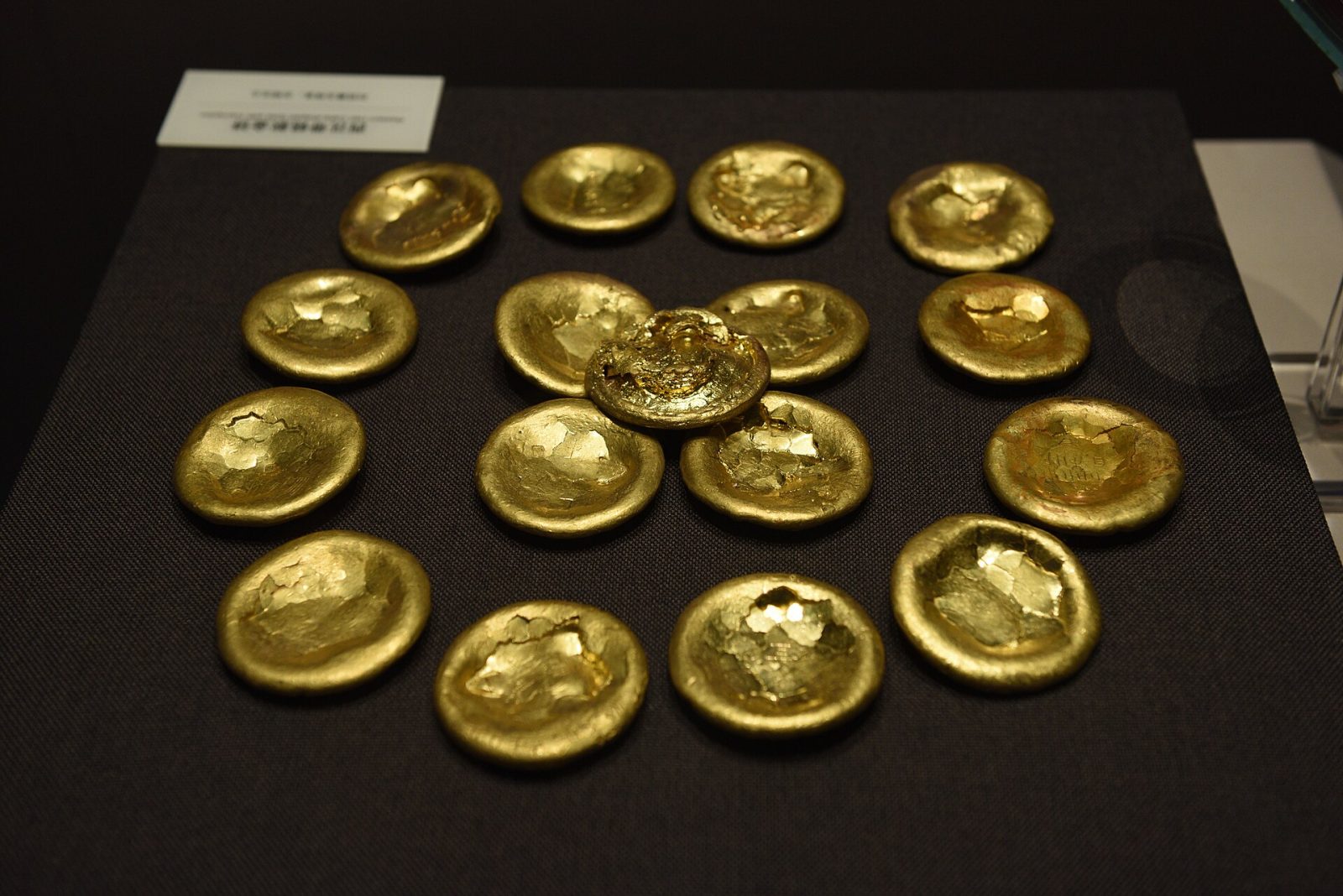
The tomb held more than 10,000 objects. There were 478 gold objects weighing about 115 kilograms: 285 round gold cakes of about 250 grams each, 48 ingots shaped like horses' hooves, 25 shaped like the toes of a mythical beast, and 20 gold plates. Four of the cakes carry ink inscriptions recording tribute gold from "your subject He, Marquis of Haihun" in the year 63 BC, owed to the emperor for offerings at the imperial temple. There were more than ten tonnes of bronze coins, usually counted at about two million, still strung in units of a thousand. More than 5,000 inscribed bamboo slips include a version of the Analects of Confucius lost for some 1,800 years, and a lacquered bronze mirror screen, damaged near the robbers' shaft, carries the earliest known portrait of Confucius. A pit beside the tomb held five real chariots and twenty horses.
All the finds belong to the state. Several hundred were shown at the Capital Museum in Beijing in 2016, and a museum at the site, the Nanchang Han Dynasty Haihun Marquis State Archaeological Site Museum, opened in September 2020 with more than 1,200 objects on display.
Written for Global Finds from People's Daily (2020), The Beijing News via China News Service (2016), The World of Chinese (2020) and China Daily (2025). Photo: gold cakes from the tomb of the Marquis of Haihun at the Jiangxi Provincial Museum, Siyuwj, Wikimedia Commons, CC BY-SA 4.0.
Approximate location29.03, 115.94View on map
Source: People's Daily