The Eagle Crown of Aluchaideng: steppe gold turned up by farmers in Inner Mongolia, part of it taken home
Famous find Made in the Warring States period, 5th to 3rd century BC · Found in 1972 See it on the timeline →
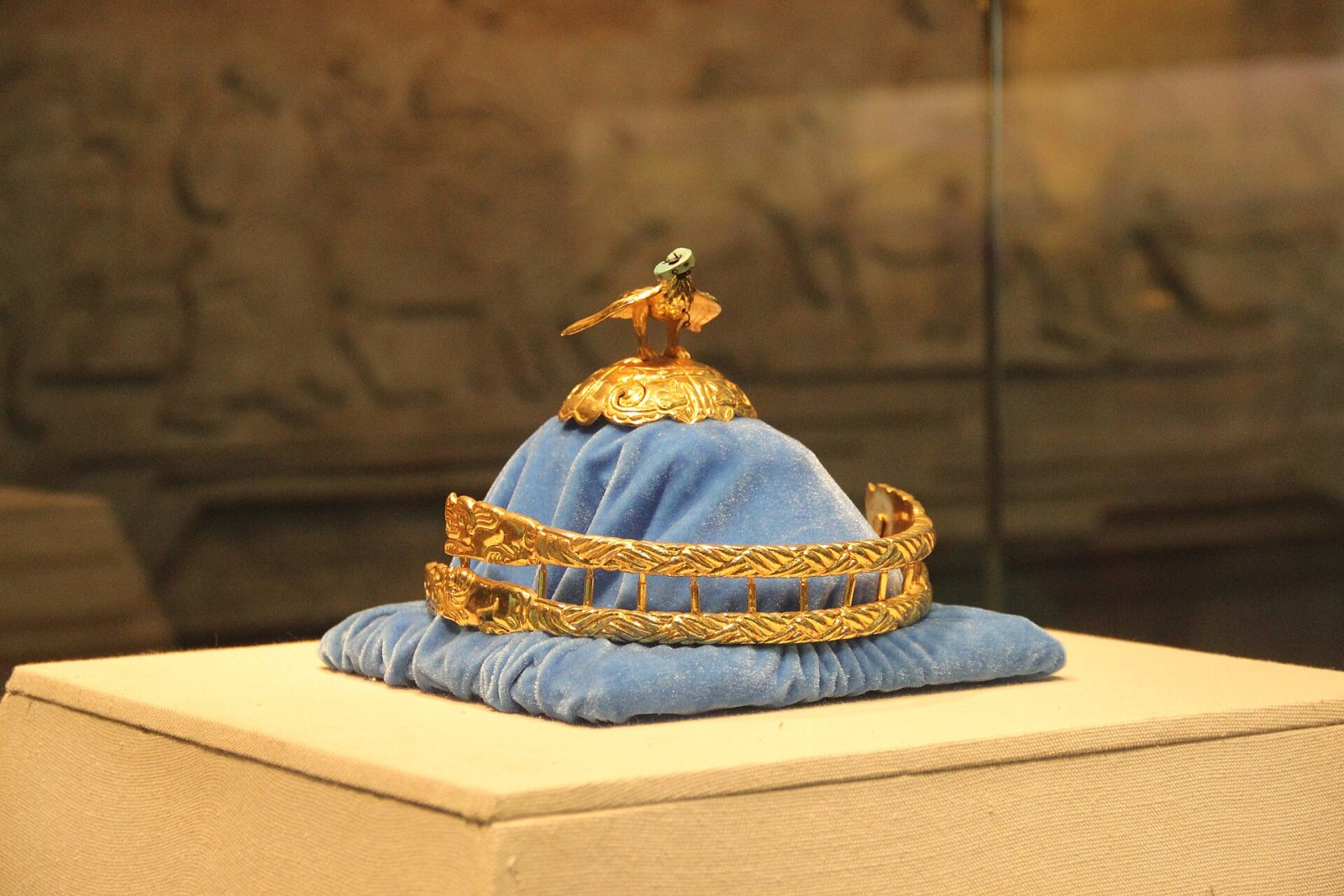
In the winter of 1972 farmers working land at Aluchaideng in Inner Mongolia, China, turned up gold. Some pieces went home with them and had to be recovered. Among more than 200 objects was a gold crown topped by an eagle with a turquoise head, weighing almost 1.4 kilograms.
In the winter of 1972, farmers working the land at Aluchaideng, in Hangjin Banner in the Ordos region of Inner Mongolia, in northern China, turned up gold and silver objects. Before the authorities arrived, some of the pieces had been taken home, and they had to be tracked down and recovered. The finders have not been named. In 1973 archaeologists surveyed and excavated the spot and found two tombs, and with the recovered objects the find came to 218 gold and 5 silver pieces.
The most famous is a gold crown in two parts, weighing about 1,394 grams in all. The crest is a thick gold hemisphere, about 7.3 centimetres high, embossed with four wolves attacking four horned sheep. Standing on top of it is a gold eagle with outspread wings, its head and neck made from two pieces of turquoise, so that the whole crest shows a chain of predators and prey, with the eagle at the top. Below it, a band of three rope-patterned gold strips went around the head. At the ends, which sat by the ears, are a crouching tiger, a horned sheep and a horse in relief.
The crown dates from the Warring States period of Chinese history, between about 475 and 221 BC. It is usually described as the crown of a Xiongnu ruler, the nomadic people of the northern steppes who later threatened the Chinese empire and against whom much of the Great Wall was built, and the Inner Mongolia Museum calls it the crown of a chanyu, the supreme Xiongnu ruler. Exactly which steppe people made it is debated, and the label is a convention. Chinese press reports describe it as the only crown of its kind found by archaeologists.
The crown is one of the treasures of the Inner Mongolia Museum in Hohhot, which opened a new building in June 2025, and it has been lent to other museums in China for exhibitions.
Written for Global Finds from Xinhua (2018), The Paper (2018) and China Daily. Photo: the Aluchaideng gold crown in the Inner Mongolia Museum, Hohhot, Gary Todd, Wikimedia Commons, CC0.
Source: China Daily