The Oxborough Dirk: a giant Bronze Age blade found when a man tripped over it in a wood
Famous find About 1450 to 1300 BC · Found in 1988 See it on the timeline →
In 1988 a man walking in woodland at Oxborough in Norfolk tripped over a piece of metal sticking out of the ground. It was the end of a bronze dirk 71 centimetres long, standing upright where it had been placed some 3,400 years earlier.
In 1988, a man walking in My Lord's Wood, near the village of Oxborough in the Breckland of Norfolk, caught his foot on something hard sticking out of the ground. It was the end of a bronze blade. When it was dug out, it turned out to be standing upright, point down, in the peaty soil, exactly as someone had set it there in the Bronze Age.
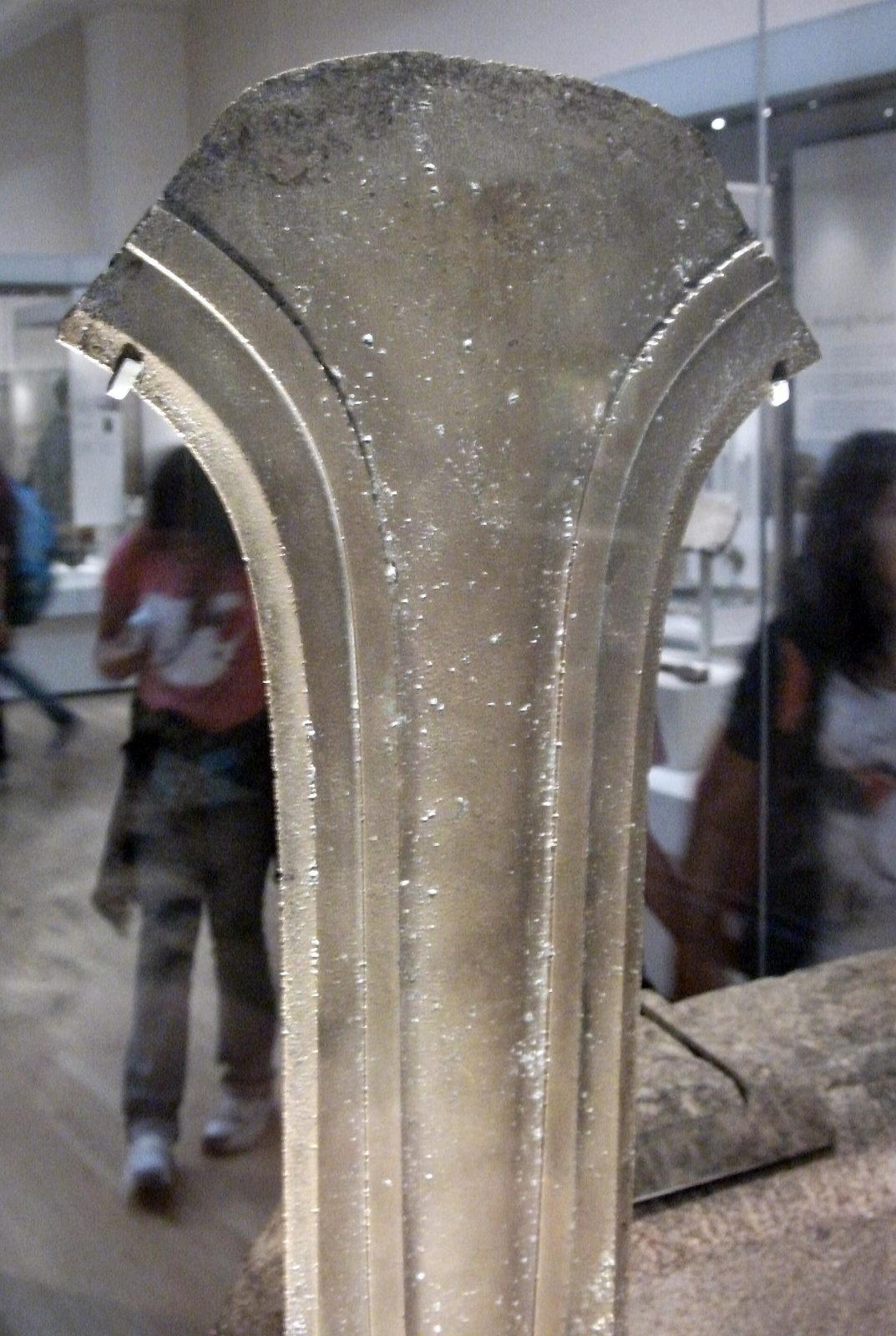
The Oxborough Dirk is 70.9 centimetres long and weighs about 2.4 kilograms. It has a long blade and a broad, flaring butt decorated with grooves. It looks like a weapon, but it could never have been used as one. Its edges were never sharpened, and the butt has no rivet holes to fix a handle. It is also far too large and heavy to wield. Instead, it seems to have been made as a ceremonial or prestige object, perhaps as an offering, a weapon in form only.
It belongs to a very rare group. Only six giant dirks of this kind are known, called the Plougrescant-Ommerschans type after two of the find places: two from England, at Oxborough and Rudham in Norfolk, two from France and two from the Netherlands. They are so alike in their shape, decoration, metal and size that they may all have been made in the same workshop, and then carried hundreds of kilometres apart. The Oxborough Dirk dates from the Middle Bronze Age, around 1450 to 1300 BC.
The finder's exact spot was recorded only roughly, and when archaeologists visited in 1990 they could not find it again. The dirk was shown at Norwich Castle Museum and then at the British Museum, which acquired it in 1994 to 1995 for about £52,000, with the help of Art Fund. It is displayed at the British Museum in London.
Written for Global Finds from the Norfolk Historic Environment Record, Art Fund, the National Heritage Memorial Fund (2014) and D. Amkreutz and D. Fontijn's Larger than Life (2024). Photo: the decorated butt of the Oxborough Dirk in the British Museum, Johnbod, Wikimedia Commons, CC BY-SA 3.0.
Approximate location52.58, 0.56View on map