The Helmet of Meskalamdug: a gold wig-helmet from the Royal Cemetery of Ur, saved from the 2003 war
Famous find About 2600 to 2450 BC · Found in 1927 See it on the timeline →
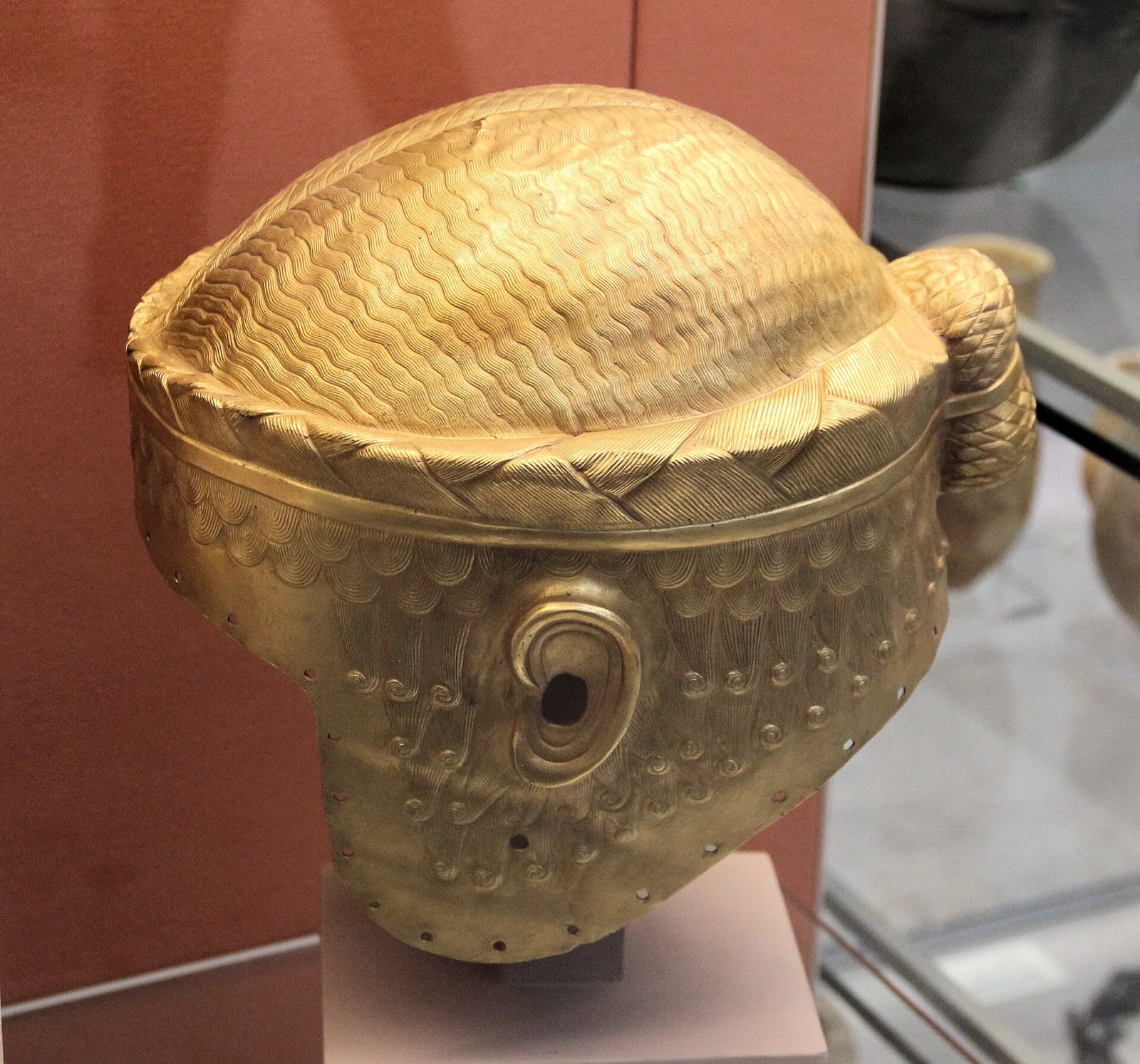
In 1927 Leonard Woolley, excavating the Royal Cemetery at Ur in southern Iraq, found a helmet beaten from a single sheet of gold in the shape of a man's hair. Around 4,500 years old, it survived the looting of 2003 hidden in a flooded bank vault.
In the late 1920s, the British archaeologist Leonard Woolley was excavating the ancient city of Ur, in the south of what is now Iraq, for the British Museum and the University of Pennsylvania Museum. His team uncovered a great cemetery of the early Sumerian city, with hundreds of graves, a handful of them extraordinarily rich. Late in 1927, in a grave numbered PG 755, they found a man buried with gold and silver vessels, weapons, and a helmet of solid gold.
The helmet was hammered from a single sheet of gold, about 18 carat, into the shape of a man's head of hair. Waved locks, a headband, a bun at the back and the ears are all worked in relief, the strands of hair chased one by one. The ears are pierced, so the wearer could hear, and holes around the rim held laces for a quilted cloth lining. Woolley called it a peruke in solid gold, life size. It is about 23 centimetres high.
The helmet itself carries no inscription, but a gold lamp and gold bowls near the head were inscribed with a name: Meskalamdug. Scholars still debate whether he was a king of Ur or a prince of the same name. The grave dates from about 2600 to 2450 BC, and the helmet is one of the masterpieces of Sumerian goldwork.
The original went to the Iraq Museum in Baghdad, and electrotype copies were made for the British Museum and the Penn Museum. When war came in 2003 and the Iraq Museum was looted, the helmet was not there: it had been moved, with other gold from Ur, to the vaults of the Central Bank of Iraq. In June 2003 a team led by the investigator Matthew Bogdanos found the treasure safe, in a flooded basement of the bank.
The original helmet belongs to the Iraq Museum in Baghdad, which reopened to the public in 2022. A copy is displayed at the British Museum in London.
Written for Global Finds from the Penn Museum, L. Woolley in the Museum Journal (1928), National Geographic and Al Jazeera (2003). Photo: the British Museum's electrotype copy of the helmet of Meskalamdug (a replica; the original is in the Iraq Museum), Gary Todd, Wikimedia Commons, CC0.
Approximate location30.96, 46.11View on map
Source: Penn Museum