The Clonmacnoise Crozier: an abbot's staff decorated with Viking silver snakes, whose finding was never written down
Famous find Made in the late 11th century See it on the timeline →
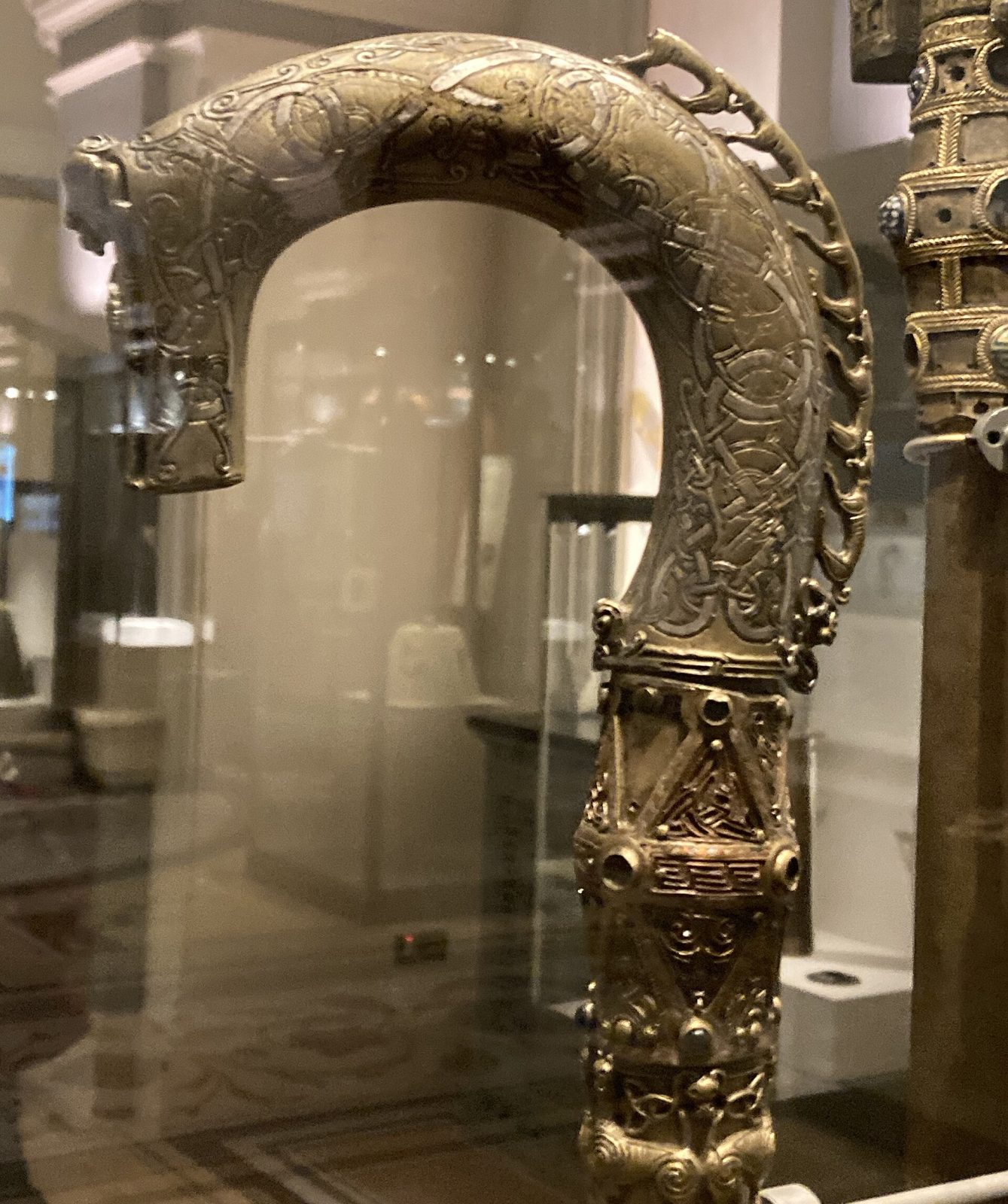
The Clonmacnoise Crozier is one of Ireland's finest medieval objects, a bishop's or abbot's staff of bronze and silver made in the late 11th century. Nobody recorded who found it, where or when; by 1821 it was said to have been dug up at Clonmacnoise some thirty years before.
The Clonmacnoise Crozier is an early medieval Irish crozier, the staff carried by a bishop or abbot. It is about a metre long, a wooden core sheathed in tubes of copper alloy, with three barrel-shaped knops; it was probably once some 20 centimetres longer, with a fourth. The crook is its glory. Each side carries four or five silver snake-like animals outlined in black niello, looped through one another in figures of eight, in the Ringerike style of Viking art, and along its crest runs an openwork row of dog-like beasts biting each other, about half of them now lost. In the 14th or 15th century a new drop-plate was fitted, with an enamelled grotesque head and a cleric spearing a dragon.
How it came out of the ground is a mystery. No finder, date or findspot was ever recorded. The antiquarian George Petrie, writing in 1821, said it had been found about thirty years earlier, around 1790, in Temple Ciarán, the tiny church at Clonmacnoise believed to be the shrine of the monastery's founder, together with a chalice and other treasures. The archaeologist Griffin Murray, re-examining the evidence in 2021, concluded that there is no real basis for the Temple Ciarán story, and that the crozier's link with Clonmacnoise, the great monastery on the Shannon in County Offaly, rests on its style and workmanship rather than on any record of where it was found.
It was made in the late 11th century, perhaps for Abbot Tigernach Ua Bráein, who died in 1088, though whether in a workshop at Clonmacnoise or in Viking Dublin, where near-identical snake patterns were found on trial pieces excavated at High Street, is still debated. Murray suggests it may once have been snapped and shortened to hide it from raiders.
By the 1830s it belonged to the Dublin collector Henry Charles Sirr. The Royal Irish Academy bought his collection in 1841, and it passed to the National Museum of Ireland in 1890, where it is displayed in the Treasury of the Archaeology museum in Kildare Street alongside the Lismore crozier.
Written for Global Finds from G. Murray in the Proceedings of the Royal Irish Academy (2021), F. O'Toole in The Irish Times (2011) and the National Museum of Ireland. Photo: the Clonmacnoise Crozier in the National Museum of Ireland, Ceoil, Wikimedia Commons, CC BY-SA 4.0.
Source: Proceedings of the Royal Irish Academy (G. Murray, 2021)