The Bredgar Hoard: Roman gold from the invasion of Britain, dug up building a bungalow called Treasure Trove
Famous find Coins 45 BC to AD 42; buried about AD 43 · Found in 1957 See it on the timeline →
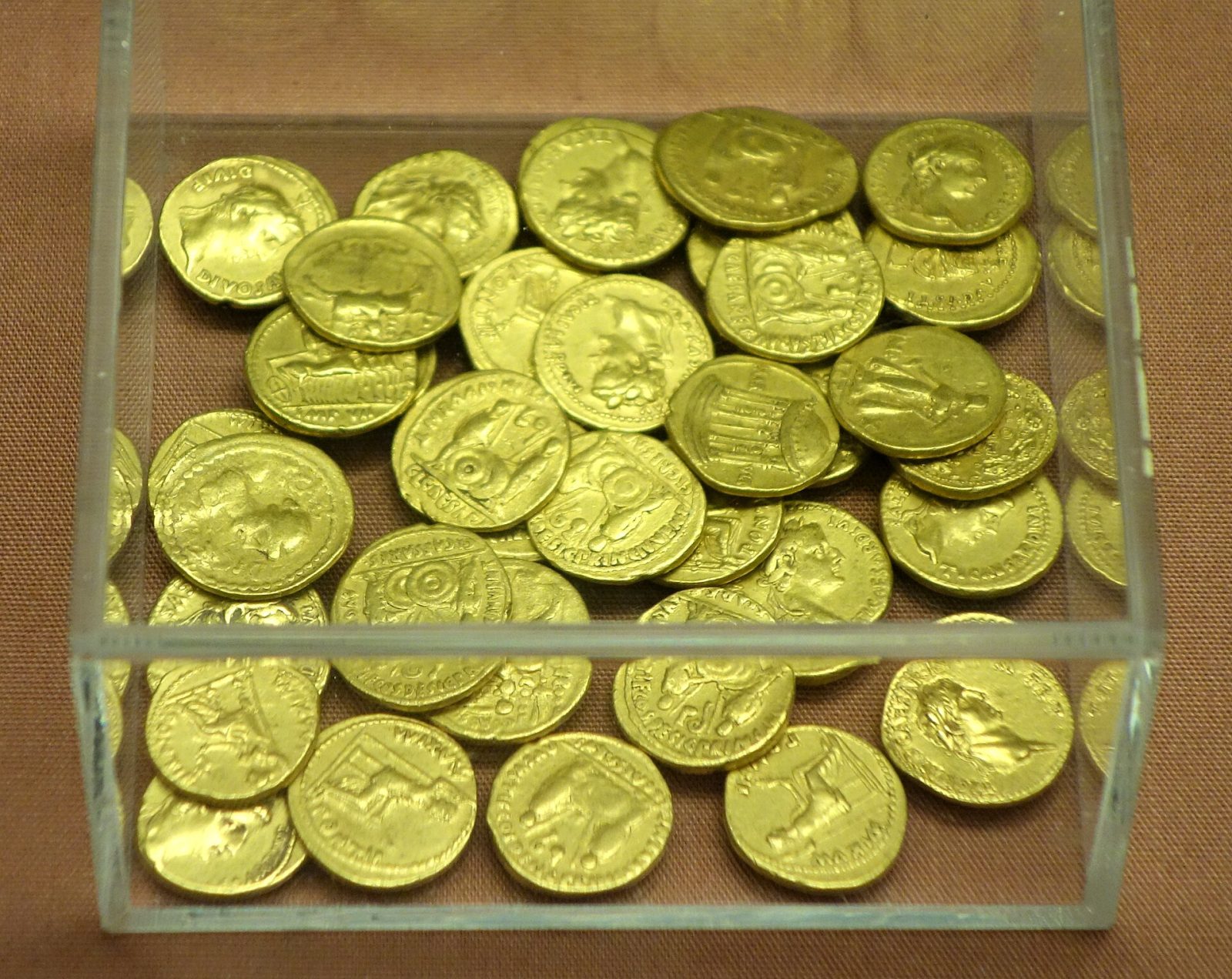
On 29 July 1957 Bryan Hollands, digging foundations for his bungalow at Bredgar in Kent, found 34 Roman gold coins. The latest, of the emperor Claudius, were almost unworn, and the hoard is thought to have been buried at the time of the Roman invasion of AD 43.
On 29 July 1957, Bryan Hollands was digging the foundations for his new bungalow in Gore Road, Bredgar, a village near Sittingbourne in north Kent, when he found a group of gold coins in the ground. The bungalow was named Treasure Trove.
There were 34 Roman gold coins, aurei. One had been struck for Julius Caesar in 45 BC; twelve were of the emperor Augustus and seventeen of Tiberius; one was struck in memory of Nero Drusus, the father of Claudius; and three were of Claudius himself, issued in AD 41 and 42. Between them they cover about ninety years of Roman history, and the latest coins were practically in mint condition, as if they had hardly been handled.
The date matters. In AD 43 the emperor Claudius sent an army to conquer Britain. It is usually thought to have landed in Kent and fought a great battle at a river crossing, generally identified as the Medway, a few miles from Bredgar. The coins were buried soon after that date, and when they were published in 1958 they were described as the earliest purely Roman coin hoard found in Britain. The popular theory is that a Roman officer buried his savings before the battle of the Medway and never came back for them. It is an attractive story, but it cannot be proved; a possible Roman camp nearby was investigated in 1996 without result.
The hoard was declared treasure trove and acquired by the British Museum, where it is on display. Maidstone Museum, closer to where it was found, has a set of replicas on long-term loan from the British Museum.
Written for Global Finds from the Kent Historic Environment Record, Archaeologia Cantiana (1958 and 2006) and the British Museum. Photo: the Bredgar Hoard in the British Museum, Daderot, Wikimedia Commons, CC0.
Approximate location51.31, 0.69View on map
Source: Kent Historic Environment Record