The Visby Armour: mass graves from a medieval battle, where the dead were buried still wearing their armour
Famous find Battle fought on 27 July 1361 · Found in 1905 See it on the timeline →
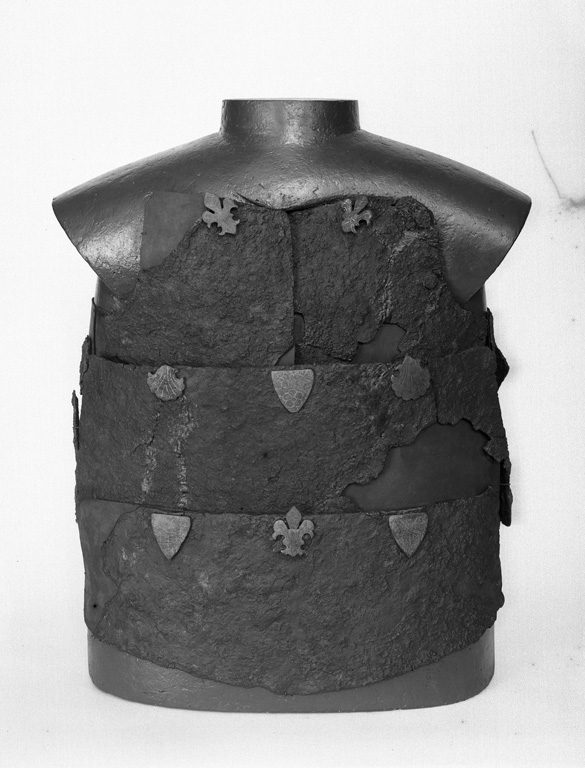
In 1361 a Danish army slaughtered about 1,800 Gotlanders outside the walls of Visby, and many were buried still in their armour. Excavated from 1905, the mass graves at Korsbetningen gave up some two dozen coats of plates and nearly 200 mail hoods, a unique record of medieval armour.
In July 1361 King Valdemar IV of Denmark landed on Gotland, the Swedish island in the Baltic, and defeated an army of Gotland peasants first at Mästerby and then outside the walls of Visby. The final battle took place on 27 July 1361, according to the inscription on a memorial cross that still stands at the site. About 1,800 Gotlanders were killed, and Visby surrendered two days later. The dead were buried in mass graves at Korsbetningen, just outside the town's east wall, and many went into the ground still wearing their armour, probably because the summer heat made stripping the bodies impractical.
In 1905 Dr Oscar Wennersten and the builder Nils Pettersson opened the first grave, which held between 250 and 300 skeletons; the German emperor Wilhelm II visited the dig. A second grave, begun in 1912, was completed by the archaeologist Bengt Thordeman around 1929 and 1930 and held 798 people, and a third, dug by a Swedish and Danish team in 1928, held 119. In all, the remains of 1,185 people were recovered, and a fourth grave was largely left undisturbed.
The armour is unique. There are some two dozen coats of plates, made of iron plates riveted inside a fabric or leather covering, nearly 200 mail hoods, shoulder pieces and at least one gauntlet, as well as a rare lamellar armour of a type that originated in Asia. Thordeman's study of 1939 and 1940 is still a key work on medieval armour. Many of the dead were young, elderly or disabled, a reminder that this was a local levy fighting for its homes rather than an army of professional soldiers.
The armour is displayed at the Swedish History Museum in Stockholm in its exhibition Medieval Massacre, and the Gotland Museum's Fornsalen in Visby, which holds the skeletons, tells the story of the battle.
Written for Global Finds from the Swedish History Museum (Historiska museet), the Gotland Museum, Uppsala University (2025) and B. Thordeman, Armour from the Battle of Wisby 1361 (1939). Photo: a coat of plates from mass grave 2 at Korsbetningen, photographed in 1936, Swedish National Heritage Board, Wikimedia Commons, public domain.
Approximate location57.63, 18.30View on map