The Kyrenia Ship: an ancient Greek trader found by a sponge diver, and dated by its almonds
Famous find Sank about 286 to 272 BC · Found in 1965 See it on the timeline →
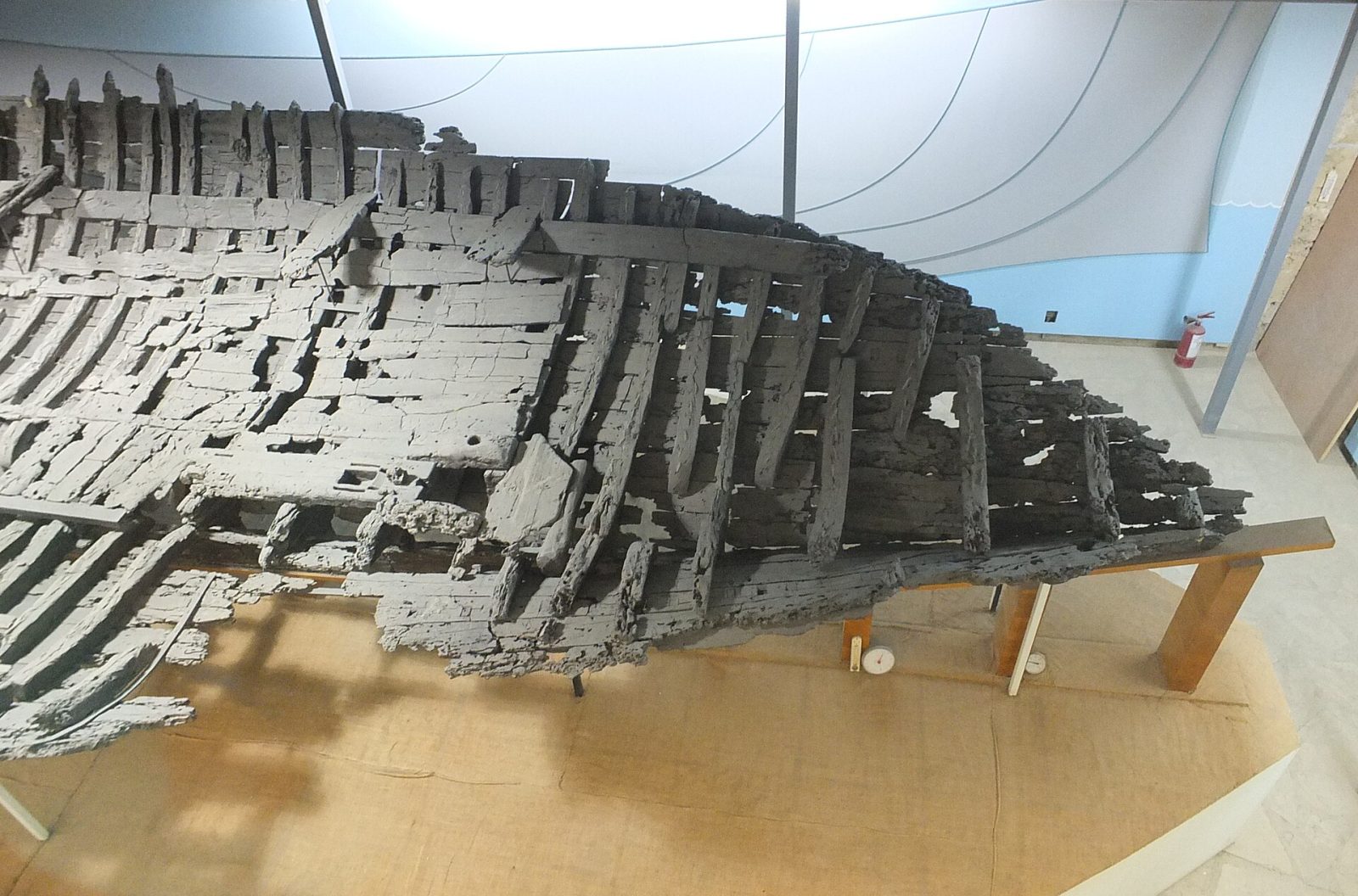
In November 1965 a sponge diver off Kyrenia in northern Cyprus spotted a mound of ancient jars on the seabed. It was a small Greek merchant ship, sunk around 2,300 years ago with its cargo of wine jars, millstones and thousands of almonds, and its hull is preserved.
In November 1965, Andreas Cariolou, a diver and town councillor in Kyrenia on the north coast of Cyprus, was diving for sponges about a mile from the harbour when he saw a mound of ancient pottery jars on the seabed, some 30 metres down. He then lost the spot, and it took him a great many dives to find it again. In 1967 he showed it to the American archaeologists Michael and Susan Katzev.
Between 1967 and 1969 Michael Katzev, of the University of Pennsylvania Museum, led an international team that excavated the wreck, making thousands of dives. Under the jars lay the remains of a small merchant ship, about 14 metres long, built of pine in the ancient Greek way, with the planks of the hull joined edge to edge before the frames were added. Its hull had been sheathed in lead fixed with copper tacks, and it had been repaired several times: the ship was already decades old when it sank. The team took the surviving hull apart piece by piece underwater, raised it, and conserved it.
The cargo was that of a small coasting trader. There were about 400 amphorae, most of them from Rhodes, more than two dozen stone millstones stacked as ballast, and more than 9,000 almonds, still in their shells. The crew's cups, plates and bowls suggest there were about four of them. There were no skeletons and no personal treasures, so the crew probably escaped when the ship went down.
For years the wreck was dated to about 295 BC from its coins and pottery. In 2024 a new study used radiocarbon dating on the almonds, a single season's harvest, and on carefully cleaned samples of the wood, and concluded that the ship sank between about 296 and 271 BC, most probably between 286 and 272 BC.
Kyrenia, Girne in Turkish, lies in the north of the island, under Turkish Cypriot administration since 1974. The reassembled hull has been displayed since the early 1970s in the Shipwreck Museum inside Kyrenia Castle, where a joint project of both communities improved the gallery in 2019. Full-size sailing replicas of the ship, the Kyrenia II and the Kyrenia Liberty, have been built and sailed.
Written for Global Finds from Cornell University (2024), S. Manning and others in PLOS ONE (2024), the Institute of Nautical Archaeology, M. Katzev in Expedition (1970) and UNFICYP. Photo: the hull of the Kyrenia ship in the Shipwreck Museum, Kyrenia Castle, Ad Meskens, Wikimedia Commons, CC BY-SA 4.0.
Approximate location35.35, 33.34View on map
Source: Cornell University