The Volubilis Bronzes: a Roman king and Caesar's great enemy, dug up together in Morocco in 1944
Famous find About 25 BC to the 1st century AD · Found in 1944 See it on the timeline →
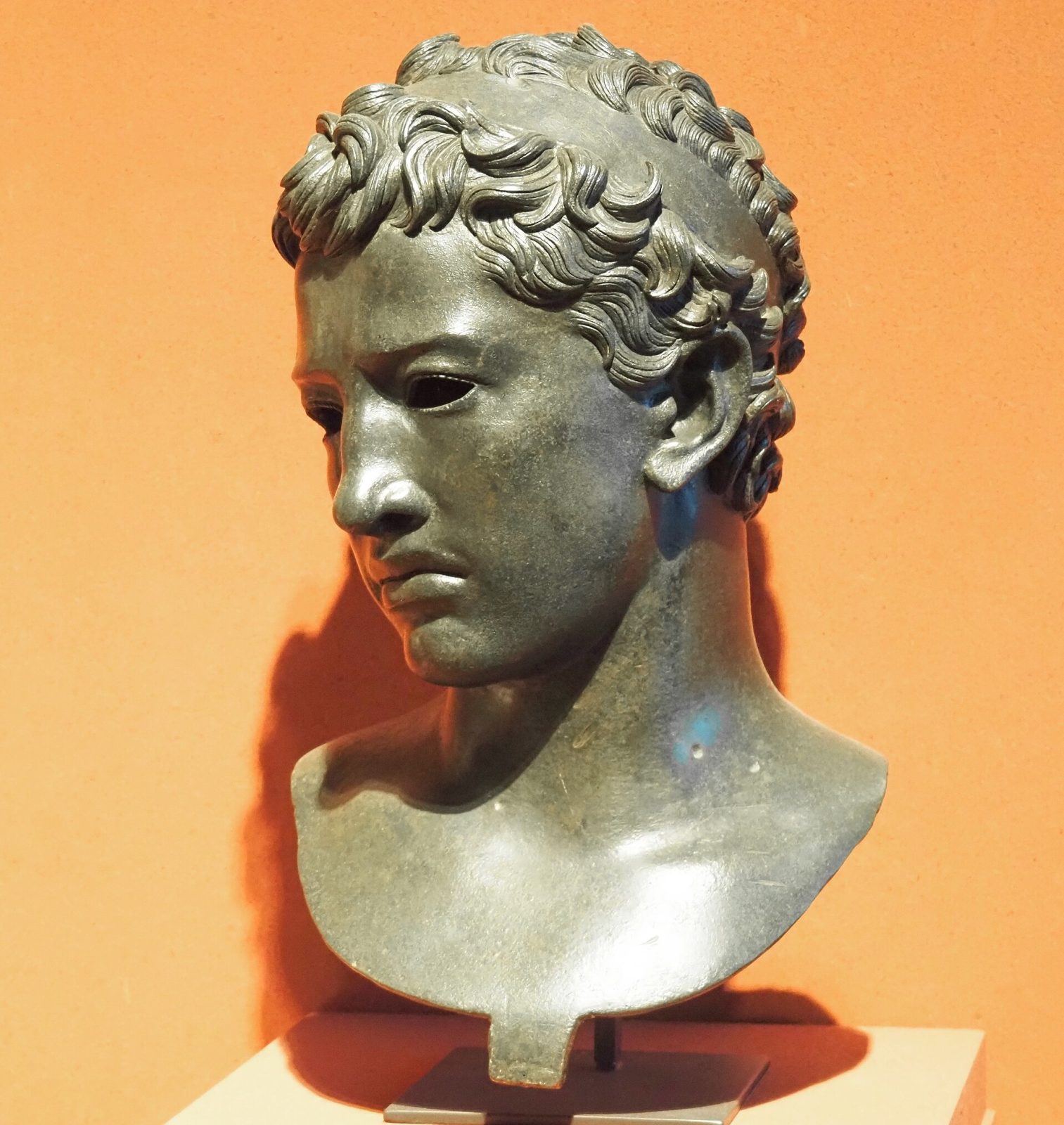
In the winter of 1943 to 1944 excavations at the Roman city of Volubilis in Morocco uncovered two superb bronze busts: one of the statesman Cato, his name inlaid on his chest, and one usually identified as King Juba II of Mauretania. They may once have stood side by side.
Volubilis, on a fertile plain near Meknes in northern Morocco, was one of the great cities of Roman North Africa, an important town of the kingdom of Mauretania and later of a Roman province. Excavations began there in the 1880s and continued under French archaeologists through the first half of the 20th century. In the winter of 1943 to 1944, Raymond Thouvenot, Morocco's inspector of antiquities, was excavating the north-east quarter of the city, where its richest families lived, when the site gave up two outstanding Roman bronzes.
The first was a bust of Cato the Younger, the stern Roman statesman who opposed Julius Caesar and took his own life at Utica, in what is now Tunisia, in 46 BC rather than surrender. It was found in a large house now called the House of Venus, after one of its mosaics, in a room floored with a mosaic of Hylas and the nymphs. It had stood on a brick pillar against the wall, slipped off it, and been held almost upright by the fallen rubble, the top of its head only a few centimetres below the modern ground. It is just under life size, 49 centimetres high, and the name CATO is engraved on its chest.
The second, found on 8 February 1944, lay half a metre down beside the doorway of the back room of a shop across the street. It shows a young man with short curly hair and a royal headband, his head turned and tilted. It is usually identified as Juba II, the scholar-king who ruled Mauretania under the emperor Augustus and married Cleopatra Selene, the daughter of Cleopatra and Mark Antony. Some scholars have suggested other rulers, including Hiero II of Syracuse and Hannibal. In the room next to Cato's stands a matching empty pillar, and Thouvenot believed the two busts had once been displayed as a pair. The Juba bust is dated to about 25 BC and the Cato to the 1st century AD.
Both busts belong to the Museum of History and Civilisations in Rabat, formerly the Rabat Archaeological Museum, and have been lent to exhibitions in Marseille, Moscow and Madrid.
Written for Global Finds from R. Thouvenot in Monuments Piot (1949) and the Comptes rendus de l'Académie des Inscriptions (1944 to 1945), C. Picard (1946) and the MuCEM, Marseille. Photo: the bronze bust usually identified as Juba II, shown at the National Archaeological Museum, Madrid, in 2022, Laci3, Wikimedia Commons, CC0.
Approximate location34.07, -5.55View on map