Arzhan-2: an untouched Scythian royal tomb in Siberia, with 5,700 gold objects
Famous find Late 7th century BC · Found in 2001 See it on the timeline →
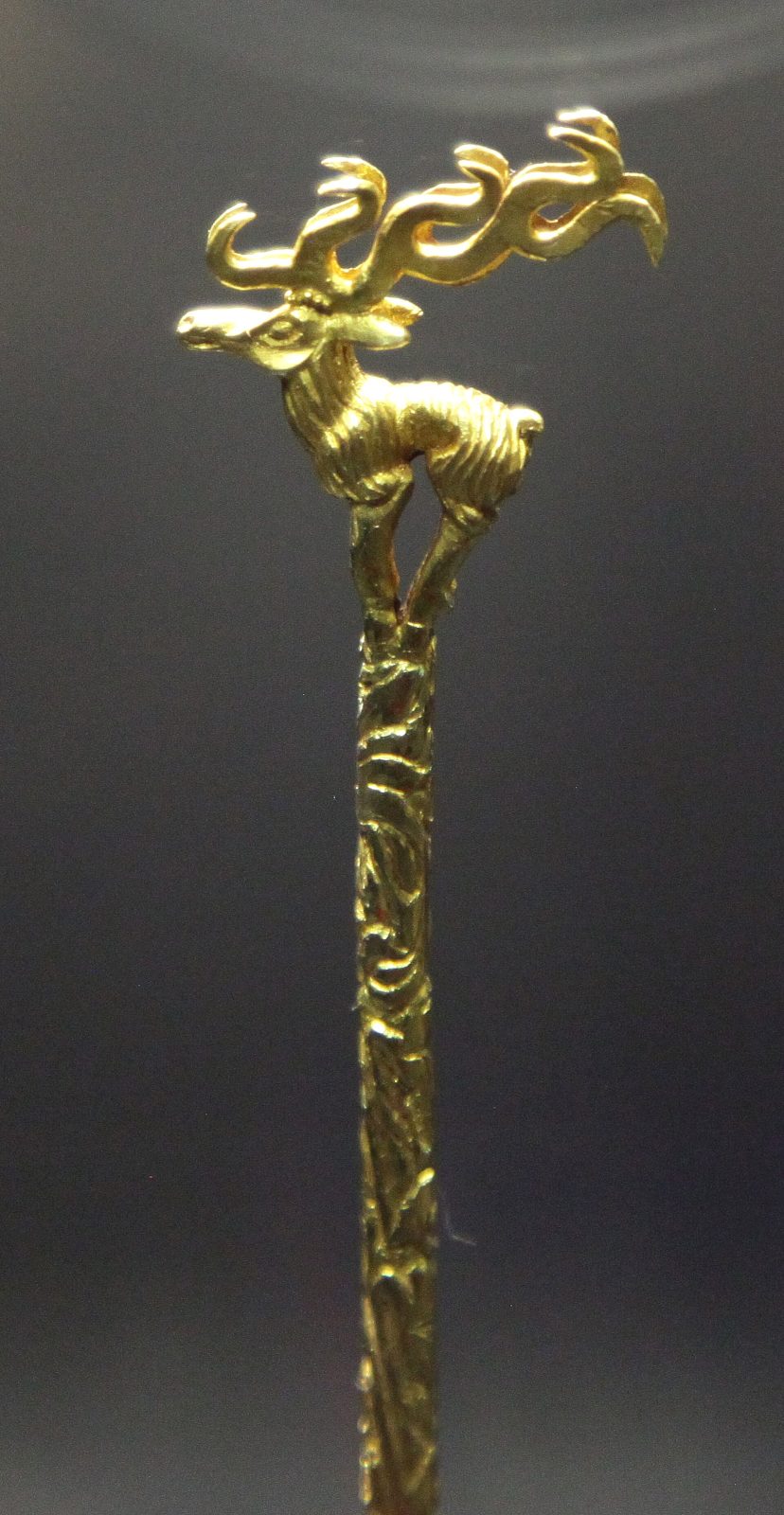
In 2001 Russian and German archaeologists excavating a burial mound in Tuva, southern Siberia, found a royal grave the looters had missed because it lay off-centre. A king and queen lay in it with about 5,700 gold objects, including capes sewn with thousands of tiny gold panthers.
In the Uyuk valley of Tuva, a republic of southern Siberia near the border with Mongolia, lies a group of great burial mounds known as the Valley of the Kings. From about 1998, a Russian and German expedition led by Konstantin Chugunov of the State Hermitage Museum and Hermann Parzinger and Anatoli Nagler of the German Archaeological Institute excavated one of them, Arzhan-2. Like almost every royal mound on the steppe, it had been dug into by looters long ago. But the looters had searched the centre. In 2001 the archaeologists found a burial pit, Grave 5, off to one side, untouched.
At the bottom of the pit, more than four metres deep, was a chamber of larch logs containing a man and a woman, buried in the second half of the 7th century BC. Grave 5 held about 9,300 objects, around 5,700 of them gold, weighing in all some 20 kilograms. The man wore a massive gold torc and a cape sewn with about 2,500 tiny cast gold panthers. At his belt was an iron dagger inlaid with gold, and beside him lay a gold-covered quiver, arrows, a bow and a battle axe. His trousers were sewn with gold beads. The woman wore a cape with matching panthers of pressed gold sheet, and had her own gold-hilted dagger, a gold comb and a ladle. Among the treasures is a gold pin topped by a standing stag with long, stylised antlers. Elsewhere in the mound were further graves, with attendants and horses.
The burial is one of the earliest and richest of the Scythian world, the horse-riding peoples who ruled the steppes from Siberia to the Black Sea. Study of the man's skeleton also revealed the oldest known case of prostate cancer that had spread through the body.
The finds were restored at the Hermitage in St Petersburg and shown in Russia and Germany. Since 2008 most of them have been displayed in the Golden Hall of the Aldan-Maadyr National Museum of Tuva in Kyzyl, the capital of Tuva, with some pieces held by the Hermitage.
Written for Global Finds from K. Chugunov in Current World Archaeology (2019), the National Museum of the Republic of Tuva (Z. Anayban, 2010) and New Research of Tuva (2021). Photo: the gold stag pin from Arzhan-2 in the National Museum of Tuva, Kyzyl, Zamunu45, Wikimedia Commons, CC BY-SA 4.0.
Approximate location52.08, 93.66View on map