The Ngoc Lu Drum: a 2,000-year-old bronze drum dug from a riverbank by Vietnamese dyke builders
Famous find About 500 BC to AD 1, Dong Son culture · Found in 1893 See it on the timeline →
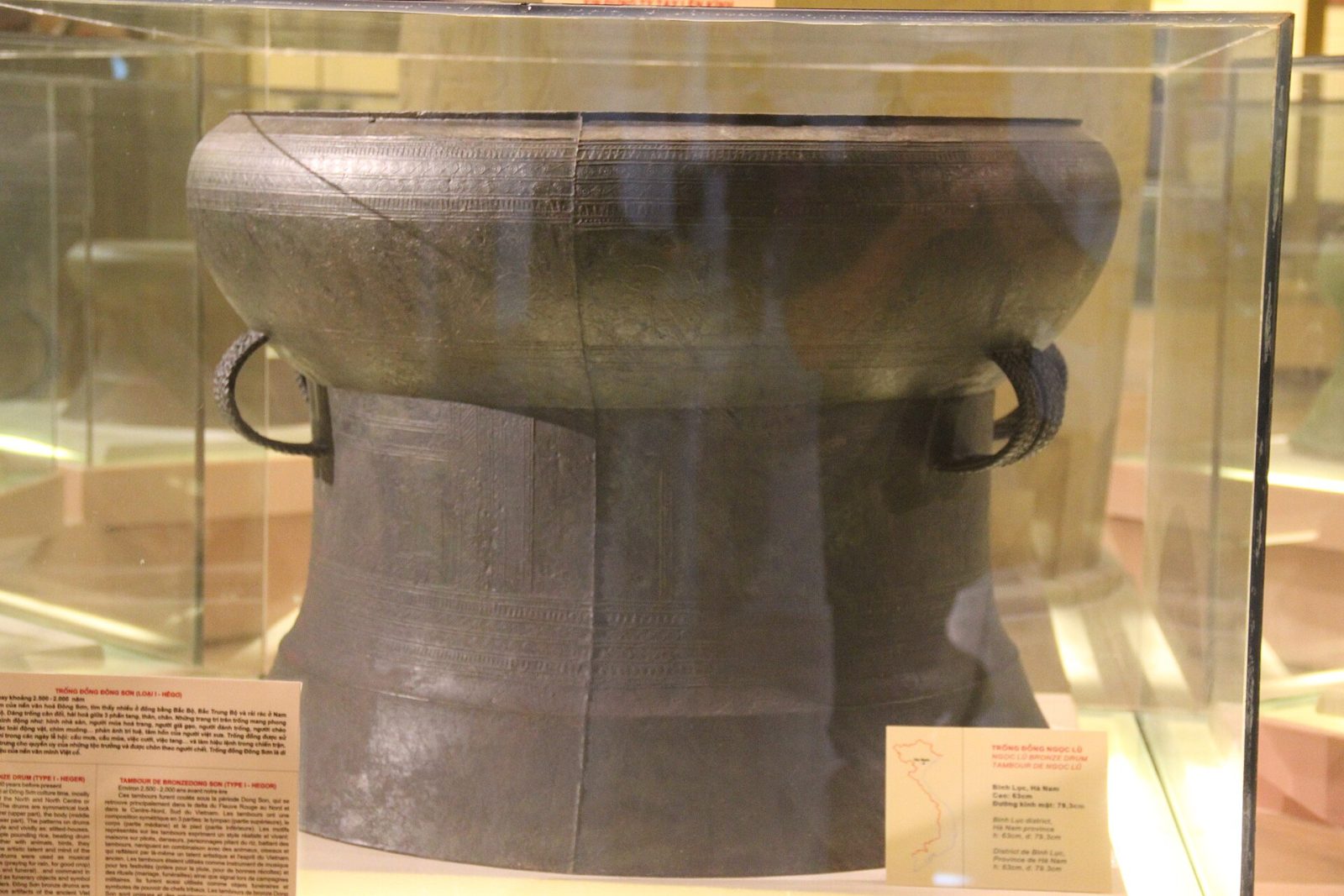
In 1893 villagers building a dyke beside the Red River in northern Vietnam dug up a great bronze drum. Decorated with dancers, houses on stilts, birds and war-boats, the Ngoc Lu drum is the finest of the Dong Son culture and a National Treasure of Vietnam.
In 1893, villagers building a river dyke at Nhu Trac, in what was then Ha Nam province in northern Vietnam, dug up a large bronze drum from the sandy ground. They gave it to the communal house of the nearby village of Ngoc Lu, where it was kept and used in village rituals for about ten years. In 1903 it was acquired by the French research institute in Hanoi, the École française d'Extrême-Orient, for its museum, which is now the National Museum of Vietnamese History.
The drum is 63 centimetres high, with a striking face, or tympanum, 79.3 centimetres across. It was cast in one piece and decorated all over. At the centre of the tympanum is a 14-pointed star, surrounded by 16 bands of patterns and scenes. People wearing feathered headdresses dance and play music; others pound rice; there are houses raised on stilts, deer, and 36 birds, half of them flying. Around the body of the drum, six long boats carry feathered warriors.
It is the finest of the bronze drums made by the Dong Son culture, the Bronze and Iron Age people of the Red River valley, named after the village where their remains were first studied. The Ngoc Lu drum dates from about 2,500 to 2,000 years ago. Its scenes are among the most detailed pictures we have of life in ancient South-East Asia, and drums of this kind were traded and treasured far beyond Vietnam.
In 2012 the Ngoc Lu drum was named one of the first National Treasures of Vietnam. It is on display at the National Museum of Vietnamese History in Hanoi.
Written for Global Finds from the National Museum of Vietnamese History and Dai Bieu Nhan Dan (2026). Photo: the Ngoc Lu bronze drum in the National Museum of Vietnamese History, Hanoi, Gary Todd, Wikimedia Commons, CC0.
Approximate location20.57, 106.05View on map