The Matara Lamp: a bronze hound catching an ibex, found in a rock cavity in Eritrea
Famous find Usually dated to the 1st century BC See it on the timeline →
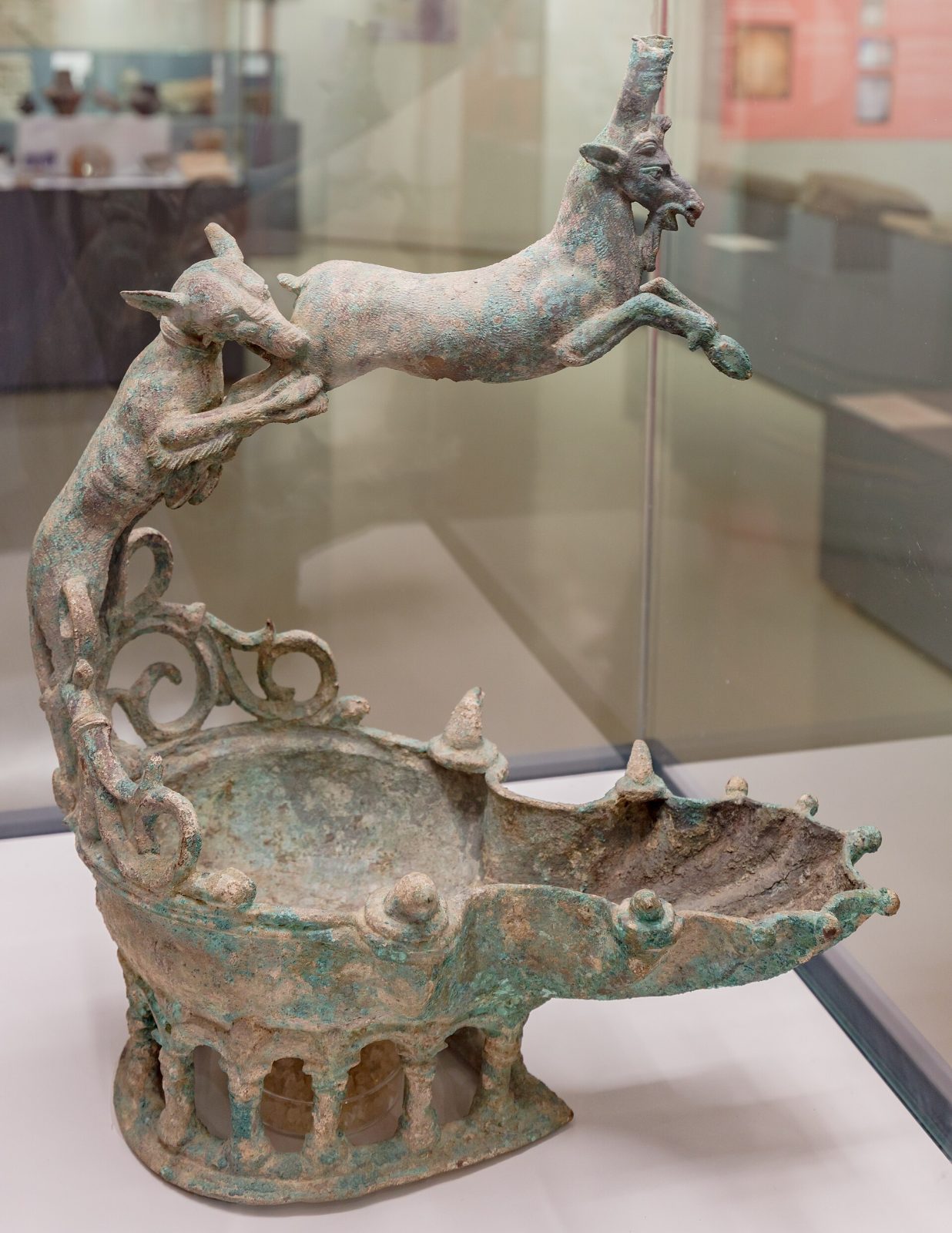
During excavations at the ancient town of Matara in Eritrea, which began in 1959, the French archaeologist Francis Anfray found a bronze oil lamp lying in a rock cavity. On top, a collared hunting dog sinks its teeth into a leaping ibex, a masterpiece of the 1st century BC.
Matara, near Senafe in southern Eritrea, was a town on the high plateau between the Red Sea and the interior, an important centre before and during the kingdom of Aksum. In 1959 the French archaeologist Francis Anfray began excavating it for the Ethiopian Institute of Archaeology, at a time when Eritrea was part of Ethiopia, and worked there in a series of campaigns until 1970.
One of his most remarkable finds was a bronze oil lamp, lying on its side 1.8 metres down in a cavity in the rock beneath one of the buildings. It is 41 centimetres high. The bowl, which held the oil and the wick, is shaped like a shell and edged with little flames, and it rests on a base formed of thirteen stylised palm trees. On top, a hunting dog with a collar round its neck leaps on an ibex and sinks its jaws into the animal's hindquarters. The ibex's horns were broken off and lost in antiquity. On the back of the bowl is a tiny ox skull in relief. The lamp was probably made in South Arabia, across the Red Sea, under the influence of Greek art, and is usually dated to the 1st century BC. Only a few lamps of this type are known, all from South Arabia.
Matara produced other treasures. In one building Anfray found a bronze vase holding fourteen Roman gold coins of the 2nd century AD, emperors of the Antonine dynasty among them, which had been fitted with loops and worn as pendants, together with gold crosses and chains. They show how far Roman gold travelled along the Red Sea trade routes.
The Matara finds were taken to Addis Ababa, and the lamp is displayed in the National Museum of Ethiopia. Since Eritrea's independence in 1993, Eritrea has asked for the return of artefacts excavated on its territory.
Written for Global Finds from F. Anfray in P@lethnology (2012), the Mail and Guardian (2005) and the National Museum of Ethiopia. Photo: the Matara bronze lamp in the National Museum of Ethiopia, Addis Ababa, Diego Delso, Wikimedia Commons, CC BY-SA 4.0.
Approximate location14.67, 39.42View on map
Source: P@lethnology (F. Anfray, 2012)