The Vani Gold: a Colchian noble's golden headdress from the land of the Golden Fleece
Famous find Late 4th century BC · Found in 2004 See it on the timeline →
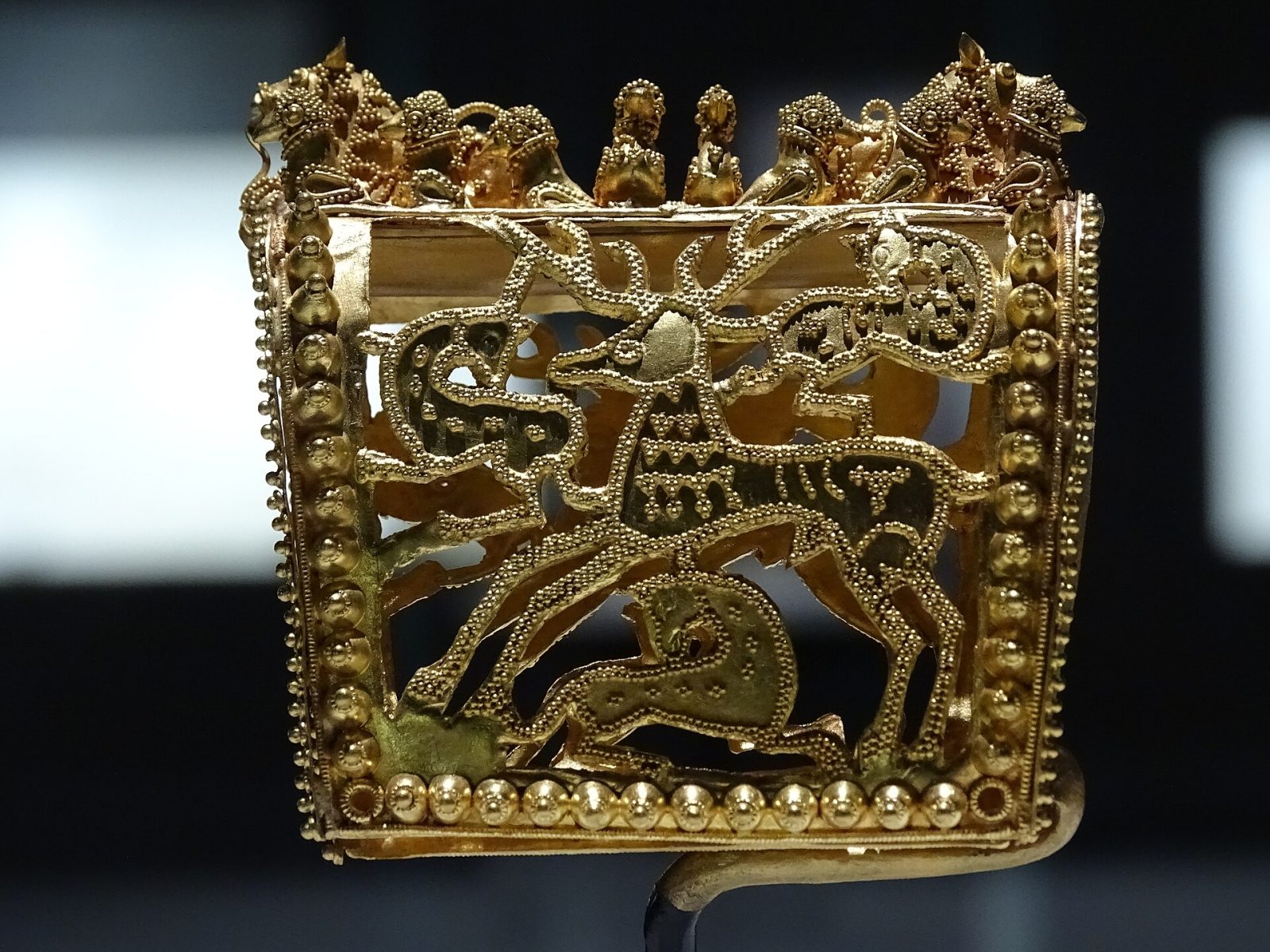
In 2004 archaeologists at Vani in western Georgia, ancient Colchis, opened a grave where a noble lay with four companions and a horse, wearing a gold headdress with griffins, a stag and deer. Vani's gold made it famous as the land of the Golden Fleece.
Vani, in western Georgia, was a city of ancient Colchis, the land that Greek legend made the home of the Golden Fleece, sought by Jason and the Argonauts. The legend may have a basis in fact: gold was panned from Colchis's rivers. Excavations at Vani began in earnest in 1947 under Nino Khoshtaria, continued from 1966 under Otar Lordkipanidze, and since 2002 have been led by Darejan Kacharava of the Georgian National Museum. The town's hilltop graves have produced some of the richest gold of the ancient world.
In 2004 the team excavated Grave 24, a pit cut into the rock beneath a mound of pebbles, near a sanctuary on the upper terrace of the town. In it lay a person of high rank with four companions, who wore humbler jewellery, and a horse. The main burial wore a headdress decorated with gold: eight griffins, a forehead band and an openwork gold ornament. There were gold eagles and ducks sewn onto the robe, a large gold brooch, a silver coin beside the head and more than 15,000 beads.
The openwork ornament is only 6.6 by 6.5 centimetres. Cut out of a sheet of gold, it shows a stylised stag and three smaller deer, with lions along the top edge and birds between them. The museum describes it as one of the earliest examples of this cut-out technique in goldwork. Its art draws on steppe (Scythian) and Near Eastern traditions, a sign of Colchis's place between the Greek world, the Persian empire and the peoples of the north. The grave dates from the late 4th century BC.
The Vani gold has been shown in major exhibitions, including at New York University's Institute for the Study of the Ancient World and the Getty in the United States. It is kept in the Archaeological Treasury of the Georgian National Museum in Tbilisi.
Written for Global Finds from the Institute for the Study of the Ancient World, New York University (2008), the Fitzwilliam Museum, Cambridge, and the J. Paul Getty Museum. Photo: the gold headdress ornament from Vani Grave 24 in the Georgian National Museum, Tbilisi, Adam Jones, Wikimedia Commons, CC BY-SA 2.0.
Approximate location42.08, 42.52View on map