The Shigir Idol: a 12,000-year-old wooden figure dug up by gold miners in a Urals peat bog
Famous find Carved about 12,000 years ago · Found in 1890 See it on the timeline →
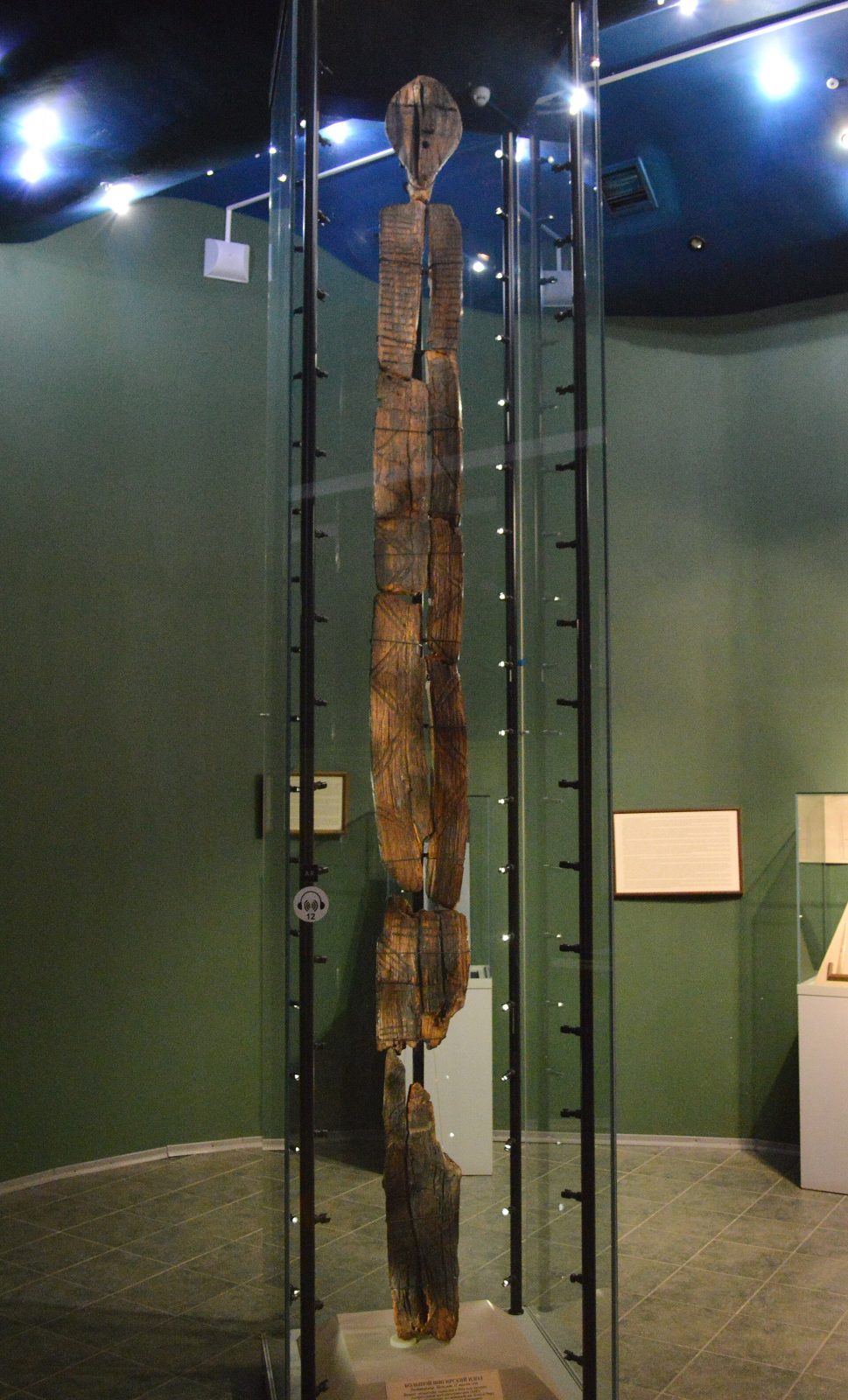
In 1890 gold miners digging in the Shigir peat bog in Russia's Ural Mountains found fragments of a huge carved wooden figure. Recent radiocarbon dating shows it was carved about 12,000 years ago, making it the oldest known monumental wooden sculpture in the world.
On 24 January 1890, by the Russian calendar of the time, gold miners working the Second Kurya mine in the Shigir peat bog, near the village of Kalata, now Kirovgrad, in the Middle Urals, dug up pieces of carved wood about four metres down. The land belonged to Count Aleksei Stenbock-Fermor, who had the find handed to the museum of the Ural Society of Natural Science Lovers in Yekaterinburg.
The ten large fragments came from a single split trunk of Siberian larch, carved while the wood was fresh with polished stone tools. First assembled, they stood 2.8 metres tall. In 1914 the archaeologist Tolmachev reconstructed the idol at 5.3 metres, with a carved head, a plank-like body and a pointed base. Part of the lower section was later lost and survives only in his drawing, and the idol on show today stands 3.4 metres tall. Its body is covered with zigzag patterns and faces. Researchers found a new face in 2003, using a knot in the wood as its nose, and another in 2014.
Radiocarbon dates in 1997 suggested the idol was about 9,500 years old. In 2014 a German and Russian team took new samples, and studies published in 2018 and 2021 pushed the date back to about 10,000 BC, roughly 12,000 years ago, at the end of the last Ice Age. That makes it about twice as old as Stonehenge or the Egyptian pyramids, and the oldest known monumental wooden sculpture in the world, carved by hunter-gatherers. The researchers think it stood upright, fixed to something rather than dug into the ground. The sampling itself led to a police investigation into damage to a heritage object, closed in 2016 after experts found no harm.
The idol stands in a room of its own at the Museum of History and Archaeology of the Urals, part of the Sverdlovsk Regional Museum of Local Lore in Yekaterinburg. The bog has since been flooded, and the spot where it was found can no longer be reached.
Written for Global Finds from M. Zhilin, T. Terberger and colleagues in Antiquity (2018) and Quaternary International (2021), ScienceAlert (2021) and Rossiyskaya Gazeta (2016). Photo: the Big Shigir Idol in the Museum of History and Archaeology of the Urals, Лапоть, Wikimedia Commons, CC0.
Approximate location57.38, 60.14View on map
Source: Antiquity (Zhilin et al., 2018)