The Copper Scroll: an ancient treasure map engraved in copper, found in a cave near the Dead Sea
Famous find 1st century AD · Found in 1952 See it on the timeline →
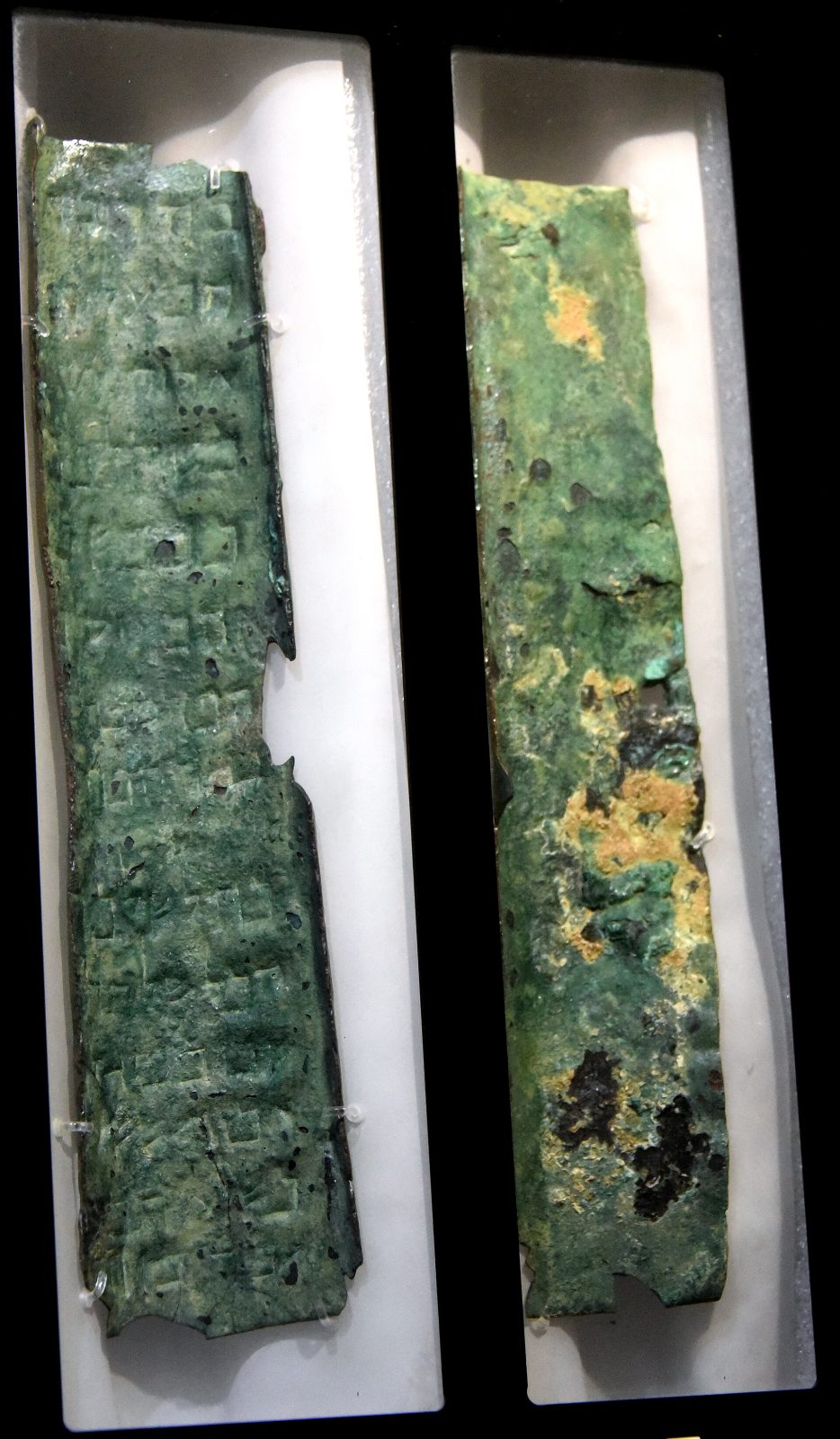
In March 1952 archaeologists searching the caves near Qumran, by the Dead Sea, found two rolls of corroded copper. When they were finally cut open, the text proved to be a list of 64 hiding places for gold, silver and sacred objects. None of the treasure has ever been found.
In March 1952, archaeologists of the École Biblique in Jerusalem and the American Schools of Oriental Research, led by Roland de Vaux, were searching the caves in the cliffs near Qumran, by the north-west shore of the Dead Sea, in the West Bank, then under Jordanian rule. Bedouin had already found the first Dead Sea Scrolls nearby. In a cave now known as Cave 3, the team found something no one had seen before: two rolls of oxidised copper, too brittle to unroll.
The rolls were three sheets of almost pure copper, originally riveted together into a strip about 2.4 metres long and 30 centimetres high. It took until 1955 and 1956 to find a way to read them. At the Manchester College of Science and Technology in England, Professor H. Wright Baker sawed the rolls into 23 strips. The text, engraved letter by letter into the metal in an early form of Hebrew, turned out to be an inventory of treasure: a list of 64 places where gold, silver, sacred vessels and scrolls had been hidden, with a total running to thousands of talents. One entry reads, in translation, in the salt pit under the steps, 41 talents of silver. The last says a more detailed copy was hidden elsewhere.
The scroll is usually dated to the 1st century AD. Whether the treasure was real, perhaps the riches of the Temple in Jerusalem hidden before its destruction by the Romans in AD 70, or legend, is still debated. The scholar John Allegro, who published the text in 1960 ahead of the official edition, led expeditions to search for it. Neither he nor anyone since has found a single item on the list.
In the 1990s the scroll was conserved by the French electricity company EDF, which also made replicas. The original is displayed in the Jordan Museum in Amman, where it is one of the centrepieces of the collection.
Written for Global Finds from the École Biblique et Archéologique Française, the Anchor Bible Dictionary (B. Pixner), the University of Southern California's West Semitic Research Project and History Hit (2026). Photo: strips 1 and 2 of the Copper Scroll in the Jordan Museum, Amman, Osama Shukir Muhammed Amin, Wikimedia Commons, CC BY-SA 4.0.
Approximate location31.76, 35.46View on map